
 Those that grow in the wild or on their own, without cultivation are called wildflowers. Wildflowers indigenous to the continent are called "natives". Others, which may be quite common, but not indigenous, have been introduced from some other part of the world and are referred to as "naturalized." Both types share one common distinction: They are equipped to grow on their own in nature. Any flowering plant growing without deliberate human aid. Today`s wildflower seed mixtures and the fascination with wildflower gardening is directly descended from early English gardening innovators who recognized the flowers of the wild as perhaps the most wonderful and beautiful flowers of them all. Wild flowers are the source of all cultivated garden varieties of flowers. Although most wild flowers are native to the region in which they occur, some are the descendants of flowering plants introduced from other lands.
Types of Wild flowers
Annual Wildflowers: These are the species that grow and bloom quickly from seed, and this group includes some of the most popular wildflowers with gardeners. Annuals have long blooming seasons, usually about two months. First frost cuts down the annuals, ending their one-season life cycle. If they "come back" the following year, it is due to seeds produced from fading flowers and dropped during the season before. Some gardeners replant the wild annuals in their meadows each year to refresh full bloom.
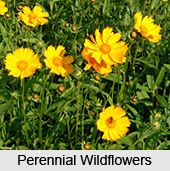 Perennial Wildflowers: These are the highly valued species that return each year from expanding clumps, and contribute to building a permanent wildflower garden or meadow. From seed, most perennials do not bloom until they have lived through at least one growing season and a winter. During their first year, they make small top growth while developing deep root systems. This allows the plant to survive its first winter, and then develop into a full size blooming plant in its second season. Most perennials bloom for approximately two weeks each year. If they are winter lasting in their growing region, most are quite permanent, and can live and expand for decades. A few are "short-lived" in some areas, and may return only 3 to 5 years.
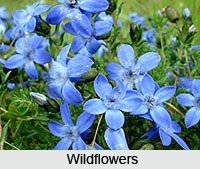 Biennial Wildflowers: These wildflowers live out two-year life cycles from seed, blooming only during their second season. They also reseed heavily, and are usually quite permanent in meadows. Most meadow wildflowers require full sun. After all, most wildflower displays are seen in nature in wide-open places. However, there are exceptions, even, some which demand shade. Most wildflowers on this list absolutely require full sun. A few of these enjoy some shade, but will tolerate full sun.
These Wildflowers were on our land before any human settlement, in other words these Wild plants were put in place by nature, not by humans. One of the strangest and most interesting wildflowers of the southwest mountains is called "ground cone". The casual observer seldom sees the plant, perhaps because it usually pushes out of the soil near or under the branches of shrubs. The aboveground flower stalk is strikingly similar to a small pinecone, and with age looks even more like an old, weather-beaten cone. But you can be sure it is not a pinecone when you see small purplish flowers between the numerous overlapping scales. The fleshy flower stalk arises deep in the ground from a tuberous mass attached to the root of a nearby host shrub.
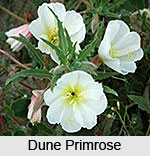
One of the loveliest wildflowers of sandy soils and sand dunes is "dune primrose". It has very flashy, large white flowers that turn pinkish with age. It often grows in abundance with beautiful pinkish-purple "sand verbena", producing a magnificent wildflower display. Cactus is the famous example of Wildflower. Desert and mountain wildflowers are named after just about every possible thing, including brushes, houses, musical instruments, jewelry and the anatomy of animals.
Wildflowers
They grow wild, since they are not intentionally seeded or planted and are equipped to grow on their own in nature.