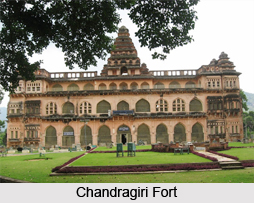
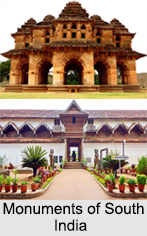
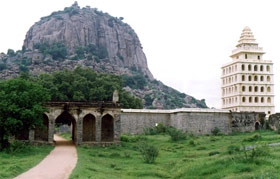
Gingee Fort lies in the Villupuram region in Chennai and covers three fortified hills-Krishnagiri, Chandragiri and Rajagiri. In fact all the three hills together constitute a fort complex, yet each hill contains a separate and self contained fort. It was originally constructed as a small fort in the ninth century by the Chola Dynasty and later modified by the Vijayanagara Kings. They reconstructed and strengthened it in 1442. It was raised to the status of an impenetrable citadel to protect the small town of Gingee, a strategic place for driving away invading armies. The fort was so unassailable that it was given the name of `Troy of the East` by the British.
 Before the Gingee Fort was established there was a forest in that area. A sage named Tatikkara Virappan was living in that area worshipping the Seven Virgins. All seven had appeared to the sage in a single form, urging him to do a one-hundred-and-eight-day puja at the Chettikulam. Their wrath aroused, the goddesses determined not to let him finish his lengthy puja, and disappeared to the eight directions. They then appeared in the dream of a shepherd (Konar), who had access, to a special tree called the "every day sprouting tree". When one cut its leaves or branches, they replaced themselves over night. Moreover, it was a property of the tree`s leaves, branches, and stems that if anything alive were thrown with them into fire, it would become gold. The goddesses instructed the shepherd to put some of the leaves into the sage`s fire, and to kill him by pushing him into it. The shepherd did as told, and the sage became solid gold. With the gold from the sage`s body and from other creatures transformed into gold by the same method, the shepherd built the Gingee Fort.
 Legends of Gingee Fort
As a group, the seven goddesses are still said to guard the fort, and each of the seven has a temple within the area. But three of the seven stand for the rest as the immediate recipients of the actual sacrifice: two of them, Kamalakkanniyamman and Kaliyamman (Kali), whose temples are within the fort, and one, Mariyamman, who represents the town. Accordingly, one male buffalo (erumaik kata) is sacrificed beside an old and withered kattuvakai tree at a point near the fort granary and main gate at the base of the Anandagiri (or Rajagiri). This point is said to mark the fort`s border (ellai). A second buffalo is then offered within minutes at a crossroads on the way to the Mariyamman temple. Moreover, once the two buffaloes are sacrificed, the icons (actually karakams) of Kamalakkanniyamman (who is the main goddess of the fort) and Mariyamman are brought together in a scene of great festivity so that the two "sisters" can meet, "kiss," and romp about together, and in effect ritually affirm an underlying identity that is repeatedly stressed by informants: that all seven virgins, sisters, and goddesses are one and the same.
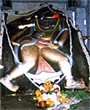 There are important reasons as to why each of these three goddesses is evoked differentially: Mariyamman in connection with the town, Kaliyamman in connection with scenes of possession and blood-drinking, and Kamalakkanniyamman in connection with the fort. But insofar as it is essentially a buffalo sacrifice associated with the royal fort, it is centred primarily on Kamalakkanniyamman. It is her weapon: a silver culam, or trident that is brought down from her temple and made symbolically present for the actual sacrifices. In all this, it is clear that Kamalakkanni is linked primarily with Goddess Durga. The buffalo sacrifices transpose into ritual Durga`s feat of killing the Buffalo Demon. In fact Kamalakkanniyamman is a form of Durga as goddess of forts. And the festival, as a spring Navaratra, is itself ultimately a festival of Durga. It is thus Kamalakkanniyamman as Durga who allows us to define the unity of the seven goddesses.
 It can be no accident that in the myth of the origins of the Gingee Fort, the first sacrifice that takes place, the one which makes the construction of the fort possible, is one that provides the required human model. It is the same goddess or goddesses now receiving the offerings of buffaloes, who originally instituted her own royal cult by the exemplary sacrifice of the sage Tatikkara Virappan.
History of Gingee Fort
The fort was also used by the Gingee Nayaks when they ruled the place. In 1638 it was lost to Bijapur and in 1677 it fell to Shivaji. Thirteen years later Imperial troops were despatched from Delhi against Shivaji`s son Raja Ram, who was concentrating his forces at Gingee. The French under de Bussy and d`Auteuil succeeded in a night attack and held the rock fortress for eleven years, until it surrendered to the British in 1762. Gingee fort was declared a National Monument in the year 1921 and is presently under the control of the Archaeological Department.
The Bijapur Nawabs who held the fort from about 1660-77 AD called it Badshabad, while the Marathas who succeeded them called it Chandry or Chindy. The Mughals, on their capture of the fort in 1698 A.D. named it Nasrat Gaddah in honour of Nawab Zulfiquar Khan Nasrat Jang, the commander-in-chief of the besieging army. Later, the English and the French called it Gingee or Jinji. The early Madras records of the English give the spelling Chingee or Chengey.
 Architecture of Gingee Fort
The fort consists of three hills which are connected by walls enclosing a total area of 7 square kilometres. On the summit of the central peak, Rajagiri, stands a citadel which is over 152 m (500 ft) high. It has three defensive lines, all with powerful gateways, and two with triple arches. The route to the citadel is defended by seven gateways; three of the gates in the second and fourth walls have large courtyards between them. The first gate has a barbican and moat crossed by a drawbridge, but the courtyard walls are destroyed. Over the lintel of the second gate is a small circular carving of Kirtimukha- `Mouth of Glory`-with a demonic head. The gateways in the curtain walls are staggered in the classic mediaeval pattern to enable the defence to delay an enemy advance.
Inside the fort, the most notable buildings are the Kalyana Mahal, two temples and various granaries and storehouses. It had an eight-storied Kalyana Mahal (marriage hall), granaries, prison cells, a military gymnasium and a temple dedicated to its presiding Hindu Goddess called Chenjiamman. The fortifications contain a sacred pond known as Aanaikulam. The walls of the fort are a mixture of the natural hilly terrain comprising the Krishnagiri, Chakkilidrug and Rajagiri hills, while the gaps were sealed with the main wall that measures 20 metres (66 ft) in thickness.
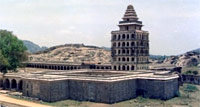
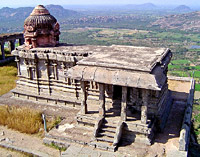
The Kalyana Mahal is built in the Indo-Islamic style and is one of the most attractive ruins in the fort. It is a square courtyard surrounded by chambers with a large central tower of eight storeys resembling a beehive. In the middle of the court is 27 metre high square tower with a pyramidal roof. Each storey, except the highest two, comprises a small room surrounded by an arcaded veranda. These rooms were used by the ladies of the Governor`s household.
It can be said about the Gingee Fort that most of the buildings and structures in the fort complex were raised by the successive rulers of Gingee belonging to the Vijayanagara, Nayaka, Maratha, Mughal, Carnatic Nawab, the French and British families during the period from 1383 to 1780 AD.
There is a sophisticated system of water supply via earthenware pipes connected to large reservoirs. Other features of interest include the Raja`s Bathing Stone, a large granite block near where the palace once stood, and a huge gun crowning Rajagiri.