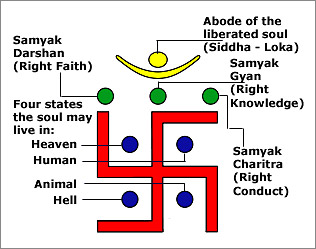
 Using of symbols is well spread among the Jains. They use several holy symbols which are held with much reverence by the Jains. Swastika is the holiest and the most important Jain symbol. It is an equilateral cross with its arms bent at right angles, in either left-facing or right-facing forms. The term is derived from Sanskrit `swasti`, meaning well being. It is a widely used sacred symbol in Dharmic religions (Hinduism, Buddhism and Jainism). The cross of the Swastik resembles four stage of existence in which a soul can be born, the existence as god (above) and as a being from the hell (below), as animal (heraldic left) and as man (right). The three points over Swastik are the three jewels: right knowledge, right faith and right conduct of life. A crescent moon with a point found over this Jain symbol signifies salvation. The sign is extensively used in the cult because every worshipper, who enters a temple, arranges the rice he offers to the idol in the form of such Swastika. Nandyavarta is a sign which is related to Swastika. Srivatsa is really a cowlick which the Tirthankaras carry on their breast.
Jains carry a symbol of their sects on the forehead. Jains put the symbol in the centre between the two eyebrows in the form of a heart, and they use a paste of sandal for it; this shows that the person believes in the "religious of the heart".
Objects used in prayer have also a symbolic significance. The holy thread (Yajnopavita, Janeo), the three strands of which are supposed to symbolize the three constituents of prime matter, Sattva, Rajas and Tamas, among Brahmanas, reminds one of the three precious stones (knowledge, faith, conduct of life) or three successions of the Tirthankaras in the past, present and the future world-periods, among Jainas.
Swastika, Nandyavarta and Srivatsa are counted with eight "Mangalas" or signs of luck which are extremely popular in the iconography of Jains."
The other 5 Mangalas are:
1. Vardhamana, a powder box
2. Bhadrasana, a throne
3. Kalasa, a water jug
4. Darpana, a mirror
5. Matsya-yugma, two fish
The 8 Mangalas are often illustrated in the temples and also shown on the banners of the processions.
The wheel of the saints (Siddha-chakra) is a symbol which should not be missing in any of the Jaina temples. It has the shape of a lotus having eight leaves. The centre and the eight leaves are supposed to symbolize 5 Paramesthis and 4 virtues, and the centre signifies (1) Arhat, the uppermost leaf, (2) Siddha, the middle right, (3) Acharya, the lowermost, (4) Upadhyaya, the middle on the left, (5) Sadhu. The other leaves symbolize: (6) knowledge, (7) belief, (8) way of life, (9) asceticism.
Even the holy sounds are symbolically illustrated in the temples. The syllable "Om" consists of a thick line of black stone which is bent and runs pointedly upwards and downwards with two lines running heraldically to the left from this and lying horizontally over one another. Of these, the upper one which intersects the black line is red and has a form of a rectangle, whereas the lower one has yellow colour. It joins the black line on one side and it is rounded off on the other. There is a yellow half moon over this sign with a black circular point over it. A sitting saint is depicted respectively on the point, the half moon and the three lines.
The sound "Hrim" is illustrated by a conventional symbol which consists of several multi-coloured horizontal and vertical lines which are arranged in a definite form. There is a white half moon and a black circle over the figure. The images of the Jain Tirthankaras are fitted in the individual parts of the figure, viz., both the black Jinas Munisuvrata and Aristanemi in the black circle, the two white saints Chandraprabha and Puspadanta in the while moon, the two red Tirthankaras Padmaprabha and Vasupujya on the upper, red, horizontal line and the two blue prophets Malli and Parshvanatha on the blue vertical lines; the remaining 16 Tirthankaras who are said to have the golden (yellow) body colour are illustrated on the other part of the figure which is of yellow (golden) colour. Footprints of the Tirthankaras or other holy persons serve as their symbols.
Jain Symbols
Jain Symbols occupy an important position in Jain Philosophy. They are highly revered by the Jains in their day to day life. The most important symbol of the Jains is a Swastik.