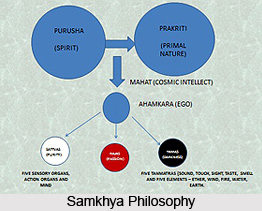
Prakṛti refers to matter or nature. It is active yet
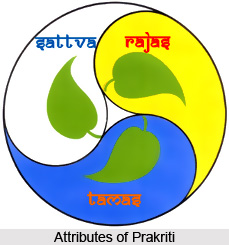
unconscious, composed of a dynamic balance of the three guṇas—sattva,
rajas, and tamas. When Prakṛti comes into contact with Puruṣha, this
equilibrium is disrupted, setting the process of manifestation into motion and
giving rise to twenty-three tattvas. These include:
·
Intellect (buddhi or mahat)
·
Five gross elements (Mahabhutas)
- earth, water, fire, air, and space, which arise from the subtle elements
·
Five subtle elements (tanmatras) – sound, touch,
seeing / form, taste, smell
·
The sense of individuality (ahaṃkara)
·
Mind (manas)
·
Five sensory capacities (Jnanendriyas) -
hearing, touch, sight, taste, and smell
·
Five action capacities (Karmendriyas) - hands
(hasta), feet (pada), speech (vak), anus (guda), and genitals (upastha)
Together, these tattvas form the basis for all sensory
experience, perception, and cognition.
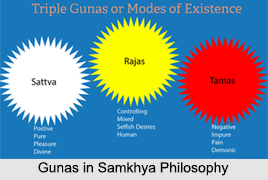
Three Gunas in Prakriti
In Samkhya philosophy, guṇa refers to one of three inherent
qualities or tendencies - sattva, rajas, and tamas. These guṇas form a
foundational framework that many schools of Hinduism use to
classify human behavior as well as natural phenomena. The three gunas of
Prakriti are:
Sattva: Sattva
represents the guṇa of balance, harmony, goodness, purity, universality,
holism, creativity, positivity, peace, and virtue. It naturally gravitates
toward dharma and jnana (knowledge). A person or action aligned with this
quality is described as sattvik.
Rajas: Rajas is the guṇa associated with passion,
activity, movement, and dynamism. It is neither inherently good nor bad, but
can manifest as self-centeredness, ego, and strong individual drive. Rajas
embodies the innate force behind motion, energy, and action, and is often translated
as “passion” in the sense of active engagement. It plays a crucial role in
actualizing and energizing the other two guṇas.
Tamas: Tamas is the guṇa associated with inaction and
ignorance. It is opposite of sattva and rajas. It manifests through dullness,
inactivity, apathy, lethargy, and sometimes through violence. Among the three
guṇas, it is generally regarded as the lowest or most limiting quality.
In prakriti, these gunas are exactly at 1/3 rd level. There
is perfect balance or equilibrium of three guna in prakriti as a whole.