Indianetzone: Largest Free Encyclopedia of India with thousand of articles Indian Weddings

Art & Culture | Entertainment | Health | Reference | Sports | Society | Travel
Free E-magazine
Indian Weddings : Indian Wedding l History of Indian Wedding l Classification of Marriages in India l Types of Marriage l Indian Hindu Wedding Rituals l Maharashtrian Wedding l
Home > Society > Indian Weddings > Manipuri Wedding, Indian Wedding
Forum on
Indian Weddings
Discuss about the Indian culture, custom, mores, ethnicity and tradition.

 
Free E-magazine
Subscribe to Free E-Magazine
on Indian Weddings

 
Manipuri Wedding, Indian Wedding

The Manipuri marriages are inevitably as colorful as the other traditions of the land. The Manipuries prefer marriages in their own community but are open to inter-caste marriages outside Manipuri community too.

Matchmaking
Among the Magh, young men and women get an opportunity to know each other closely at the New Year eve at the grand festival. This is the apt time when they choose their partners, and then ask for the approval of their parents.

Girls of the Garo, Tippra, Khasia and Magh tribes go to the market to purchase and sell goods. This again provides an opportunity for boys and girls to know each other more closely, select partners, and then marry with the consent of their parents. Young men and women among the Santal, Garo and Manipuri tribes work together in the fields and thus get an opportunity to select their life partners while in work. Manipuris do not marry within their own clans.

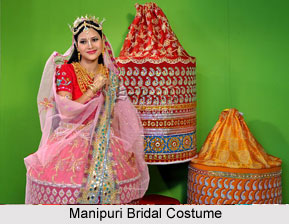
Costumes in Manipuri Wedding, Indian WeddingCostumes - The bridal dress is unique. It is essential for the bride to wear the Raslila skirt. The bridegroom`s dress is white dhoti, kurta and turban. Kirtans and Shahnai music are played when the bride and the bridegroom have completed their seven rounds. The bride follows the steps in rhythmic styles with the music.
The Garos used to wear barks of trees, which had been pounded and softened to resemble thin cloth. Lower-class Garos still wear a tiny piece of cloth, which simply cover the genitals. Some tribes living in the deep forests of the Chittagong Hill Tracts still wear tree leaves as their only wedding dress. Santal dresses are called panchi, panchatat and matha. The main dress of the Chakmas is the lungi that is worn with a shirt. Their women wear a pindhan or the red and black sarong, and plus a blouse called silum. Magh women cover their body from chest to knees with a thami or sarong over a full-sleeved blouse.

Ornaments and cosmetics- Among the Manipuris, there is very limited variety in the ornaments that tribal women wear. In north Bengal they wear almost similar ornaments. Santal and Oraon women wear ornaments in their hands, feet, nose, ears and neck. Oraon women tie their hair in a peak style and wear a tikli on the forehead. Chakma women wear bangles and anklets, as well as coin earrings and necklaces. Garo women do up their hair in bun style, which they then adorn with flowers. Magh women use a kind of herbal powder or wood paste to lighten their faces.

Marriage customs in Manipuri wedding
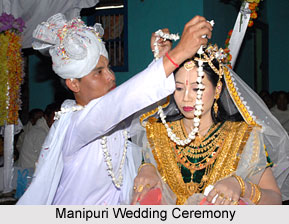
Manipuri Wedding, Indian WeddingManipuris erect colorful wedding pandals, and the bride and groom move round the pandal to be greeted with paddy and durva grass. A Manipuri bride comes to visit her parents for the first time after five days of her marriage thus providing an occasion for a sumptuous feast. According to tribal custom, all members of the clan are invited to this ceremony and they come with presents of rice, meat, fowls, pigs, money and alcohol.

Marriages are performed in accordance with the customs. Before the marriage parents of the boy go to meet parents of the girl. This starting approach is termed `Hinaba`. The horoscopes are matched and if both the parents agree then the next date for the meeting is fixed. On the next meeting, called Yathang Thanaga, the consent is given by the girl`s parents. The next stage is `Waroipot puba`, the groom`s family members bring food, and the contract is finally sealed. Finally the engagement is declared amongst the friends and relatives, this is called `Heijapot`. Friends and relatives from the boy`s side then go to the girl`s parents with fruits, food and presents.

The girl`s parents invite their friends and relatives. The Brahmin decides the marriage date and rituals. A Manipuri marriage party is of a great show but little is wasted for giving meals. Not less than thirty cars will attend a marriage in a Meitei house in Imphal. A marriage attended by a convoy of cars is considered as a status symbol. The men dress in dhoti and kurta with a shawl wrapped around and women in pink `fanek` and white chader.

The reception ceremony is very formal. At the entrance of the gate a Meitei woman offers a Thali containing a banana leaf in which the betel nut, pan and tamul is arranged. The arrangement for sitting is made around the Tulsi platform. In each Meitei house the Tulsi plant is grown over a raised platform. All the auspicious ceremonies are conducted around this plant.

The Manipuri groom is welcomed by lighting a pradip and a young boy washes his feet. At this time kirtan is sung and tradition music is played. Two women from both sides release a pair of taki fish symbolizing the groom and the bride into water. It is an auspicious omen if the pair of fish moves side by side in the water. In a similar ceremony among the Garos, a cock and hen with throats slit are thrown to the ground. It is a good omen if, while they are in their death throes, the two come together to die. Otherwise, it is an ill omen and must be remedied through prayer and spell by a khamal who is the mendicant.

The gods and other deities are offered exceptional food on the occasion so that they may bless the couple in abundance. A Manipuri bride comes and visits her parents for the first time on the fifth day after marriage, providing an occasion for a prolific feast. According to tribal custom, all members of the clan are invited to this ceremony and they come with presents of rice, meat, fowls, pigs, money or alcohol. chakmas cannot marry during the dark of the moon, full moon, or eclipse. Oraons, Santals, Khasias, Garos and Manipuris cannot marry within their own clans. Manipuris are mot allowed to marry close relations. Members of the same Garo clan look upon each other as brothers and sisters, and so cannot marry within the clan. However, Maghs marry within their clan as they discourage inter-clan marriages. Marriage between cousins is, however, forbidden, as is marriage between a man and his father`s sister or mother`s sister.

A Santal wife becomes part of her husband`s clan. Magh men cannot marry again unless the wife is barren or mentally ill. Divorced and widowed women are permitted to remarry among both Maghs and Oraons. Divorce is allowed on the grounds of incompatibility, impotence or the wife`s disloyalty. However, though divorce is allowed among the Oraons, Khasias, Chakmas and Maghs, it is very rare in Manipur. The party responsible for the divorce has to pay compensation to the other party. At times a young Garo woman chooses a Garo boy, marries him and keeps him at her parents` home. Such marriages are rare these days. However, some tribes, such as the Oraon, allow their boys and girls to elope and marry, with consequent parental consent. Oraon and Santal wives apply vermilion on their forehead or in the parting of their hair. However, the Maghs do not within the clan, if they do, it is considered as disgraceful and the guilty and then they are expelled from the village.

Not to marry is considered to be a sin for the Khasias. Khasia women can have more than one husband at a time on the basis of the first husband`s impotence or dishonesty, desire to have more children or strong sexuality but this hardly happens. A Khasia woman cannot marry someone from any other tribe. A Khasia girl may invite home a chosen boy from an approved clan, live together for a few days and, if she finds him acceptable, may marry him with the supported of both families. In Khasia weddings, women cannot go along with the groom`s party to the bride`s house.

Among the Oraons, however, women can go along with the groom`s party. After being blessed by his mother and elders, the Khasia groom leaves his mother`s house wearing dhuti and turban and escorting the bridal party. Khasia wedding feasts are elaborate and comprises of rice and dry fish, followed by alcohol. Three pieces of dry fish are offered to the gods, seeking their divine blessings for a new couple. Between the matriarchal Khasia and Garo tribes, the groom becomes a ghar jamai in the part of his in-laws` house. Chakma weddings take place at the bride`s house after the ritual of exchanging alcoholic drinks on the either sides. A Manipuri groom adorns himself with a dhuti and turban and the bride wears the traditional gathered skirt, blouse, and peaked head dress.

Among the Chakmas and Maghs, the cost of safeguarding of minor children has to be borne by the husband. Among the Khasias, either the couple or someone else has to notify the clan chief about the divorce. The chief asks the couple to think and gives time for reconciliation. If this does not work, an announcement is made of the breakup of the marriage. The person responsible for divorce has to pay the other party some compensation. Among the Khasias it is usually the wife who is held liable for divorce. If the husband is responsible, he is taken into arrest or given a beating with shoes; his face is tarnished with lime and black paint and his head is shaved. A pregnant woman cannot be divorced, however, a widow may marry after a year of her husband`s death.

Food and drinks during the Manipuri weddings - The tribals eat everything except their totems. The Garos do not eat cats, because cat is their totem. Maghs, Chakmas and Khasias are prohibited from eating beef, and Garos do not drink milk. Magh and Chakma men and women are very much fond of smoking. Their favorite dishes are those that are sour and are made of rotten prawns. Oraons cook rats, eels, potatoes and khesari pulse. Alcohol made of rotten rice is every tribe`s favorite drink.

More on Marriage System in Indian States
Oriya wedding Rajput wedding Gujarati Wedding Telugu Wedding
Tamil Wedding Malayalee wedding Bengalee wedding Maithil Brahmin wedding
Punjabi Wedding Maharashtrian Wedding Assamese wedding Manipuri Wedding
Marwari Wedding Kashmiri Wedding Kannada Wedding


More on Indian Wedding Accessories
Wedding Music Wedding Songs Traditional Indian Wedding Dresses
Bridal Jewelry Bridal Make Up


More on Indian Religious Weddings
Sikh Wedding Buddhist Wedding Christian Wedding Rituals
Sindhi Wedding Jain Wedding Hindu Wedding Rituals
Parsi Wedding Jewish Wedding Muslim Wedding Rituals


More on Types of Marriages
Prajapatya Marriage Gandharva Marriage Asura Marriage
Rakshacha Marriage Paishacha Marriage Arsha Marriage
Daiva Marriage Brahma Marriage


See also
Indian Wedding Traditional Games in Indian Wedding Kinds of Indian Wedding
History of Indian Wedding Marriage system in Indian States Indian Marriage Acts
Types of Marriages Indian Religious Wedding Marriages in Indian Villages
Classification of Marriages Steps in Indian Marriage Ceremony Indian Wedding Feasts
Indian Marriage Customs Wedding Decorations Indian Wedding Accessories


Recently Updated Articles in Indian Weddings
E-mail this Article | Post a Comment
Manipuri Wedding, Indian Wedding Sitemap