About Indian Bronze Sculptures
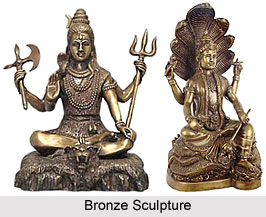 Sculpture of Bronzes immensely radiates a sense of immortality and powerfully reflects the fascination and mystery about the ancient cultures of Buddhism, Jainism and Hinduism. The art of making Bronze sculptures began in the Indus Valley Civilization (2400-B.C.), where the Indus Bronze statuette of a slender-limbed "dancing girl" was found in Mohenjodaro. The stone sculptures and their inner sanctum images in the temple remained on a fixed place, until the 10th century, where the newly emerged religious concepts demanded that the deities should appear in a variety of public roles. As a consequence, large bronze images were created as these images could be carried outside the temple places. Then from the 9th to the 13th centuries in the Chola period, the art activities were carried out in enormous quantity, where new temples to show the architectural skills were built and old ones renovated with additional beauty and grand festivals were organized.
These art works are a visual interpretations of celestial beings, illustrate about the human condition of transcendence through which he led to spiritual enlightenment. Some of the features of the Bronze sculpture are closely linked with the regional basis. Some of the characteristics of Bronzes sculptures that are found commonly can be marked on the basis of geographical division:
Western Indian Bronze: The metal sculpture flourished in this region of Gujarat and Rajasthan from the 6th-12th century. Most of the Bronze sculptures from this side are associated with Jainism, including the savior figures of Mahavira and many ritual objects such as incense burners and lamp bearers. Made with using lost-wax casting method, the eyes and ornaments of the statue were frequently inlaid with silver and gold metal, to add look in it.
Eastern Indian Bronze: The metal sculpture flourished in the states of modern Bihar and West Bengal from the 9th century. Most of these metal sculptures were made from alloys of the eight metals; the bronze sculptures were produced by lost-wax casting only. These mainly represent various divinities like Shiva, Vishnu.
South Indian Bronze: The metal sculpture flourished in the districts of Thanjavur and Tiruchchirappalli in Tamil Nadu from the 8th-16th century. These artworks in Bronze were ranging from small household images to almost life-size sculptures intended to be carried in temple. These included the figures of Hindu divinities, especially in the various iconographic forms of the god Shiva and Lord Vishnu.
 Bronze is of exceptional historical interest and still used widely for various applications. It was prepared before 3000 BC, for making statues, coins and other decorative articles. Later, the bronze sculpture continued through the 10th and 11th centuries in many countries including India.
The Chola-period bronzes have their figures depicting sensuous and detailed clothing and jewelry. The art works of this period are famous for their subtle modeling and clear outline marked on the form, as well as for maintaining an ideal balance of graceful realism and heroic classicism. During Chola-period, Bronze images were made using the lost wax technique.
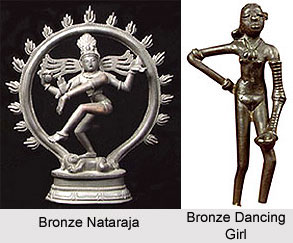
From this period only, many fine figures made from Bronze, an alloy of copper are famous - it contains Shiva in various forms, such as Vishnu and his consort Lakshmi, and the Shiva saints. The sculptors in the 11th and the 12th centuries worked in real sense to achieve classic quality. The best example of this is the form of Nataraja; the Lord of the dance is a creation of this period.
Even the Indus valley sculptures gain significant attention when aesthetic values are concerned. From many sculptures that are discovered from this place, the most remarkable is the statue of the dancing girl in Bronze, since it illustrates the details that were achieved through it, when considered as a whole. She is shown as nude with erect posture placing her right hand on her hip and both her legs are bent at the knee point as if she is dancing. A trefoil necklace and the bangles worn in her left arm are carved beautifully. Available to us from centuries, the Bronze temple images seem to have been cast specially for eternity.
Chola Bronze Sculptures
The Chola bronze sculptures are renowned for their form and contents. While discussing about bronze sculptures it is necessary to figure out that South India has always been of immense significance as far as bronze sculptures are concerned. But it was under the patronisation of the Cholas in 900 AD that this form of art attained maximum glory. However, even today the tradition of making bronze sculptures has been kept alive in South India. Even the `Dhyana Slokas` mentions the Chola bronze sculptures. One of the earliest examples of this kind of sculpture was found in Tamil Nadu. It was an antique bronze sculpture of a mother-Goddess from Adhichchanallur. The mind-blowing sculptures in the Chola period were crafted with the method of bronze-casting.
The Chola bronze sculptures are quite simple to look at. The intricate details generally found on sculptures are missing. Inspite of being devoid of ornamentation the Chola bronze sculptures are elegant, expressive and exquisitely beautiful. These sculptures are renowned for being graceful and it seems that the artists have rendered to the lifeless metal. The poses and the expressions on the faces of the figures are so explicit that the absent surrounding of the figurine is easily discernible. Apart from the mudras or the poses the artisans have taken special care of the other details. For instance, if an artisan is making a statue of a god or goddess then the weapons and the `vahana` are also taken into account.
One of the mudras in which the Hindu deities are often found in the Chola bronze sculpture is the Rishabaandhika pose. Lord Shiva is seen in this pose where he stands with one leg crossed across the other leg to the other side. One of his arms is bent and he is leaning on something. The way in which his figure has been carved it is apparent that he is leaning something. Here Lord Shiva is actually leaning on his `vahana` Nandi.
Another figure of Ardha Nareeswara is also considered a remarkable piece of Chola bronze sculpture. This metal statue is of Lord Shiva. The uniqueness of the figurine is that the right half of the sculpture is that of male and the right half has the figure of Goddess Parvati. The male and the female figures have been blended so intricately that it is impossible to figure out the demarcation line between the two figures. This particular figure has been carved in accordance to the Shilpa Shastras. The mudras, proportions, ornaments and expressions have been carefully etched on the stone. The Chola bronze sculptures were made with lot of care. One of the reasons for this was that the Shilpa Shastras propounded that creating an image at one time with full attention was equivalent of performing real yoga.
Apart from these there are other sculptures that have been excavated in different parts of South India. One such place is the Tanjore district. Here bronze sculptures of Vrshabhavahana and his consort were discovered these sculptures belong to the reign of Rajaraja I.
A number of dance poses were also popular in early Chola period that were widely used in sculpting. Anandatandava mode of dance has been popularly used on both stone and bronze. Alongwith this form the sculptor of Nataraja came into being. Even today the image of Nataraja remains an important piece of work for art lovers.
The later Chola bronze sculpture gradually lost the artistic wizardry and the sculptures look lifeless. They became more traditional and the rhythmic movements and vibrancy were no more. After the downfall of the Chola Empire stone was again evolved as the accepted material for sculptures.
Nayaka Bronze Sculptures
Nayaka Bronze sculptures are characterized by expressionless faces, rounded sagging abdomens. The Vijayanagar period also witnessed the strain on quantity rather than quality. The earliest and the best example of this style were represented by the Kannappa Nayanar in the Siva temple at Kalahasti in the Chittoor district. The Nayaka bronze sculpture were tall and slender build, the hair was dressed peculiarly. The Kannappa Nayanar from Tiruvelangadu is an example of this type of Bronzes. The facial feature of these structures was very sharp but the elbows were angular and stylisation is evident from the circular mark of the knee caps.
One more example of the early phase of Vijayanagar Nayaka period was the beautiful Yoga narasimhar, which is 16.5 feet in height. It had very less stylised locks and the posture was splendid. Vaishnavite bronzes especially of the Alvars belonging to the early Nayaka period can be found yet. Few of these bronzes of the Vijayanagar period include the Kaliya Krishna from Nilappadi, Natesa from Peraiyur, Chandikeswara from Dharmapuram and the famous Parvati from Jambavanodi.
One can see the famous Vijayanagar Bronze sculpture Natesa from Belur in Salem district having origin in 1510 A.D. This unique sculpture has many important details like the `prabha mandala` of oval shape has forty flames and each of which except for the topmost one show four tongues. These are formed in the clear fan-wise arrangement of the feathers on the crown and the anklets on both ankles.
But since the beginning of the 16th century the art had begun to decline in Vijayanagar. It is evident from the treatment of the faces of the Bronze sculptures and the modelling of the legs, the contraction at the knee-joint, the stretching out of the leg, etc. After 1600 AD, the conventionalised emblems became more popular and the dress and the ornaments were also worn conventionally in these bronze sculptures of Vijayanagar.
Another bronze of the Nayaka period of Vijayanagar is the Pradoshamurthi (Siva) from Tiruvaduthurai. This was adorned with necklaces of wire, stylised headgear and the origin of the bronze sculptures can be traced from the garments worn by them. Even though these bronzes were conventionally fashioned, the stylistic arch of the prabha with prominent head decoration at its ends add charisma to it
One more example of the Vijayanagar Nayaka period is the group of bronzes representing Lord Vishnu as Vaikutanatha with Sridevi and Bhudevi. In this structure all the deities were shown sitting on a coiled serpent. Vishnu is seated with his right leg placed on his left lap, lower arm hanging down and resting on the right knee while the corresponding left arm is kept on the seat as if in support of the body leaning backwards. This unique posture makes the figure look majestic. The bronzes of the goddess are similar to each other. The modelling of these bronze sculptures was heavy but smooth. A little imperfection can be noticed only in the arms of Vishnu. The ornaments worn by these bronze structures of Vijayanagar Nayaka period were uniformly stiff and heavy. The clothes looked apparently stiff. However the faces were full of splendour and the expression suggests divine composure.