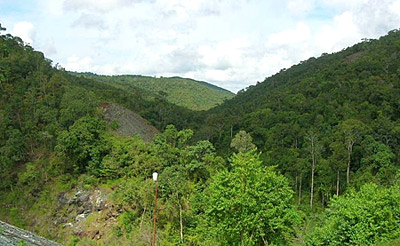
Bamboos or tree grasses comprise a diverse group of plants in the grass family. These giant grasses are separated from the other grasses by certain `bambu-soid` characters which are considered primitive. Bamboo is believed to have originated in Asia. The tree grows in wild- all around most parts of India, particularly in the hilly woods of western and southern India, but is cultivated only in the lower Himalayas and in the valleys of the River Ganga and Indus. While 150 species are found in the Indian subcontinent, India alone accounts for more than 100. They have a wide range of distribution and are found in all parts of the country except in Kashmir valley.
The structural foundation of the plant is the underground, segmented and condensed rhizome which goes on propagating vegetatively. The aerial part (stem) is called the culm and several culms arising out of the ramifications of the rhizome are collectively called the clump. When they occur in dense impenetrable thickets they are called `congested clumps`, which is the general feature of most bamboos. However, there are others that have spreading rhizomes; here the culms arise singly at intervals and form `open clumps`.
Bamboo-culms are branched at the nodes. The branches are sometimes spiny as in the case of Spiny bamboo. Depending on the species they may be mere shrubs with culms no thicker than a pencil as most hill bamboos are, or they may become giants reaching a height of 37 m and a diameter of more than 0-25 m as in the case of the Giant bamboo of Burma which is cultivated at Dehradun in India and some other places. Whereas most of the bamboos are erect, quite a few are scramblers and even climbers stretching over the crowns of tall forest trees. Nearly all species are green when fresh but some like the pan tropical Tiger bamboo are of a beautiful golden colour with green stripes or otherwise variegated. An occasional species has a near black colour. Most species have hollow culms but some like strictus or the Male bamboo have solid culms.
 The growth of a bamboo plant is remarkable. During the monsoons new shoots emerge from the underground rhizome in the form of cone-like buds which again are characteristic for each species and are used as a tool in their field-identification. These are wrapped over by strong, sharp-pointed sheaths covered with minute irritant hair. The tender shoot inside is very delicate and luscious, but at the same time is poisonous as it contains hydrocyanic acid. Perhaps this is how nature protects them from the ravages of grazing cattle or wild animals. Those shoots are a great delicacy and serve as supplementary food. The poisonous effect is destroyed after boiling. Bamboo shoot is then cooked or made into pickles.
The popular belief is that new shoots sprout only when there are thunder and lightning. Besides the fact that during the monsoon lightning is common there is a scientific basis too. Elongation of shoots takes place gradually in the initial stage and then they become so active as to grow in leaps. In some of the tall species like D. giganteus they may grow up to about one meter in a day. The bamboo shoot grows to its full length in three months` time and by then the rains also come to an end. Bamboo clumps go on adding shoots and become impenetrable thickets. Within 3 to 5 years the culm matures and turns brownish.
Bamboos usually reproduce from root-like rhizomes that give rise to new long-lived culms. They generally flower only after many years, at fixed intervals, and not just every year, at which time they produce seeds and then die. In many bamboos flowering occurs after 20 or 60 years; in several others it may not occur until 120 years after the last flowering. In some species, however, the interval may be shorter, 3 years or so; a few may flower even annually. As a matter of fact flowering in bamboos is erratic and varies between the physiological extremes of constant flowering and constant sterility. The majority of bamboos falls between these two extremes and represent flowering cycles of several to many years.
Cultivation of bamboos is done by seed or offsets, in some cases by cuttings or layers. If the seed is good, which is seldom the case, it germinates easily and the seedlings are reared and transplanted in the field; but as general seeding years are scarce, it is necessary to wait for seed and, therefore, propagation by vegetative methods is quicker.
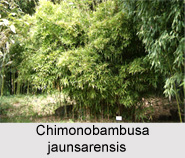
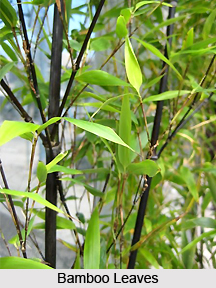
The stem of the tree is round, even and hollow. Its nodes are inflamed. The tree has no branches but, the lower segments, i.e., three-fourths of the trees have more spines between each node. It has plain, glittery, skinny, rigid, polished and dark green leaves. Flowers grow in bunch and the seeds bear a resemblance to the corn of wheat in shape.
An examination of illustrates that it 88.8% contains moisture, 3.9% protein, 0.5% fat, 1.1% minerals and 5.7% carbohydrates per 100 grams of its eatable portion. Its vitamin and mineral content comprises calcium, phosphorus, iron, thiamine, riboflavin, niacine and vitamin C. Its vital energy value is 43.
Bamboo leaves are a rich source of hydrocyanic and benzoic acids. Unripe bamboo shoots contain numerous enzymes such as nuclease, deamidase, proteolytic enzyme, amylase, amigdalin splitting and silicon splitting enzymes. Further more, the juice of the pressed bamboo shoots has protease activity, which helps in digesting proteins.
The number of ways bamboos enter into the diverse phases of human life is too well known. . Bamboo is a material that is sufficiently cheap and plentiful to meet the vast needs of the human population-from the child`s cradle to the dead man`s bier. In the humid tropics whole houses are built entirely of bamboo. In fact there is no limit to the varieties of articles that can be made out of this natural plant resource. Among the more sophisticated uses are the manufacture of a large variety of writing papers, charcoal for electric batteries, liquid diesel fuel obtained by distillation and enzymes.
Besides all uses bamboo has important medicinal properties. For instance bamboo is used to treat stomach disorders, respiratory disorders and menstrual disorders. It is also used to cure intestinal worms, wounds and ulcers. Even during pregnancy nripe bamboo shoots, mingled with palm jaggery is given once or twice a day for a week to induce abortion during the first month. Similar preparation can be used in the last month of pregnancy to cause labour.
Bamboo shoots are also used as edibles in numerous processes. They are used in preparation such as bamboo candy, bamboo chutney and canning of bamboo in syrups.
Thus, it can be concluded saying that bamboo an important member of the grass family has ample uses to the society.