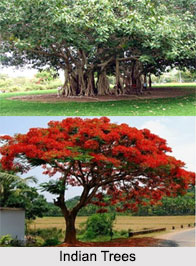
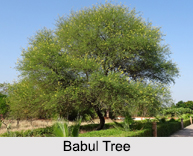
 Origin
The Hindus hold bael tree extremely sacred. The history of this tree has been traced back to the Vedic era (2000 B.C. - 800 B.C.). Reference of bael fruit has been made in Yajurveda. The bael tree has immense mythological consequence and generally thrives near temples. Leaves of the tree are traditionally used as holy offering to Lord Shiva, the God of health. Lord Shiva is thought to dwell beneath the bael tree. The bael tree is native to India and grows throughout the sub-continent, as well as most countries of South-east Asia.
Methods of usage
Bael fruit acts a marvellous laxative, washing off the stomach of impurities, together with stomach and organic troubles.
Healing Power and Medicinal Properties of bael fruit
The bael tree is one of the most utilitarian medicinal plants of India. Its medicative attributes have been detailed in the ancient medical exposition in Sanskrit, `Charaka Samhita`. Every part of this tree-stem, bark, root, leaves and fruit at all stages of maturity -have medicinal merits and have been used as remedy for a long time.
The fruit`s medicinal worth is extremely high when it just begins to mature. The fruit is fragrant, cooling and purgative. It holds back secretion or haemorrhage. The immature or half-ripe fruit is beneficial for digestion. It is useful in thwarting or curing scurvy. It also toughens the stomach and boosts its action.
Constipation cured by bael fruit
Ripe bael fruit is regarded the best of all purgatives. It cleanses and strengthens the intestines. Its everyday usage for 2 or 3 months disposes even the old hoarded faecal matter. For better results, it should be taken in the form of sherbet, prepared from the flesh of the ripe fruit. The seeds are removed after breaking the shell, with the contents scooped out and sifted. Milk and sugar are added to make it more appetising. The flesh of the ripe fruit can also be consumed without the addition of milk or sugar. Approximately 70 grams of the fruit will do for an adult.
Diarrhoea and Dysentery cured by bael fruit
The immature or half-ripe fruit is possibly the most effective remedy for continual diarrhoea and dysentery, where there is absence of fever. Best results are received by the use of dried bael or its powdered form. The bael fruit when is still green, is shredded and dried in the sun. The dried bael slicings are powdered and stored in air-tight bottles. The unripe bael can also be baked and consumed together with jaggery or brown sugar.
 Peptic Ulcer cured by bael fruit
A concoction of bael leaves is considered an effective solution for peptic ulcer. The leaves are doused overnight in water. This water is sieved and taken in the morning. The soreness and uneasiness are relieved when this treatment is sustained for a few weeks. Bael leaves are rich in tannin, which alleviates swelling and helps in the mending of ulcers. Bael fruit taken in the form of a beverage also possesses incredible healing properties due to its mucilage content. This forms a coating on the stomach, mucosa and thus helps heal ulcers.
Ear Problems healed by bael fruit
The root of this tree is used as a home antidote for curing ear troubles. A solid piece of the root is soused in neem oil and ignited. The oil that trickles from the burning end is an extremely effective medicine for ear troubles. The antiseptic attributes of neem mixed with the astringent extract of bael root, helps in healing infection, persistent swelling and bleeding.
Respiratory Disorders cured by bael fruit
Medicated oil prepared from bael leaves provides alleviation from persistent colds and respiratory infections. The juice distilled from bael leaves is mixed with equal quantity of gingelly or sesame oil and heated exhaustively. A few seeds of black pepper and half a teaspoon of black cummin are added to the heated oil. It is then removed from fire and preserved for further use when essential. A teaspoon of this oil should be massaged onto the scalp before a head bath. Its everyday use builds up immunity against cold and cough.
Precautions - The ripe bael fruit should not be taken everyday for an extensive period of time. When used without a break, it results in atony of the intestines or lack of normal elasticity and subsequent gas formation in the abdomen. Bael fruit should also not be taken in excess at once- too much intake may produce a feeling of weightiness in the stomach.
The sherbet made of bael should never be very dilute. It should be gelatinous, so that it can be exhaustively chewed. It may produce weightiness in the stomach, if taken in haste.
Composition
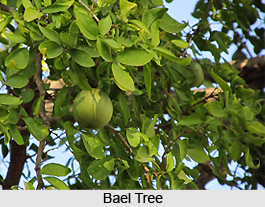
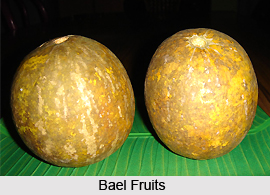
Bael is a big tree, reaching a height of 8 to 10 metres. It has a huge, solid trunk, extraordinary branches with long, straight offshoot, fragrant leaves, sweet-scented and greenish-white flowers. The fruit is woody and polished, 5 to 15 cm in diameter. It has abundant seeds that are thickly covered with fibrous hair and are implanted in a fat perfumed pulp. The flesh is eaten both fresh and dried.
An examination of the bael fruit demonstrates that it comprises 61.5% moisture, 1.8% protein, 0% fat, 1.7% minerals, 2.9% fibre and 31.8% carbohydrates, per 100 grams of eatable portion. Its mineral and vitamin contents consist of calcium, phosphorus, iron, carotene, thiamin, riboflavin, niacin and vitamin C. Its vital energy value is 137.
Various chemical elements have been sequestered and distinguished from various parts of the bael tree. These comprise alkaloids, coumarins and steroids. The leaves contain skimianinc, sterol and aegelin. The active ingredient of the fruit marmorosin is identical to imperatorin. Other coumarins contained in the fruits are altoimperatorin and B sitosterol. Roots of the tree have been discovered to contain psoralin, xanthotoxin, scopoletin and tembamide.