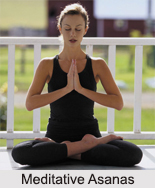
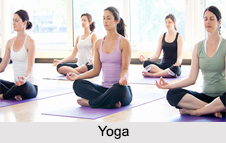
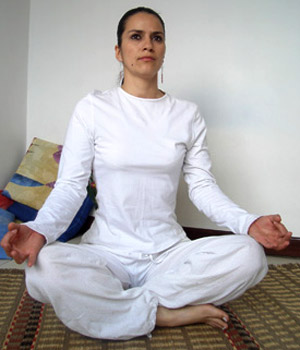
 Sukhasana is a Yoga Asana considered highly comfortable and well-suited for meditation. It was first mentioned in the Darsanopanishad, one of the twenty Yoga Upanishads. Sukhasana is a relaxed posture suited for those who are just beginning yoga practice, and is highly suited for associated Mudra practice.
Meaning of Sukhasana
`Sukha` means joy or relish in Sanskrit. Consequently, Sukhasana merely means a joyous posture, or a stance that gives joy or ease to the body.
Yoga Texts and Sukhasana
Sukhasana is one of the few meditative asanas that cannot be said to have a long history, at least when compared to other poses like the Padmasana and the Siddhasana. It was first mentioned in the Darshanopanishad and the Trisikhibramanopanishad, two of the twenty Yoga Upanishads (1400 AD). However, neither describes a specific posture as the Sukhasana. Instead, the text merely states that any posture comfortable to a practitioner is a Sukhasana, or a relaxed, easy posture. Both specify also that those who are weak must practice the Sukhasana. Nevertheless both group the Sukhasana with other highly regarded postures, and the Darsanopanisad promises that `those who master the asanas conquer the worlds.`
A later text, the Sri Tattva Nidhi, composed in Mysore at around the 19th century, does describe the Sukhasana in the same way as it is performed nowadays. The Sri Tattva Nidhi is a treatise on traditional poetry, exercise, sports, music and others, deriving much of its material on yoga asanas from the Vyayama Dipika, an older text devoted to exercise.
Practice of Sukhasana
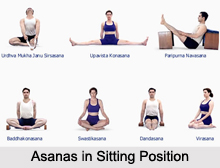
Sukhasana basically consists of sitting in the standard cross-legged position while opening the hips and lengthening the spine, its relative ease on the knees makes this posture preferable for following exercises like Siddhasana and Padmasana for many people with physical difficulties.
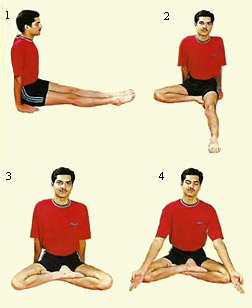
A sequential process for the performance of Sukhasana follows.
* One should sit of the floor and stretch out the legs
* The person then has to bend on the alternate leg and being the preferred leg and place the heel under the opposite thigh
* The individual has to sit in cross-legged fashion and keep the ankles crossed.
* The body should be kept straight, spine erect, abdomen well controlled and head perfectly poised.
* Finally, the person should place the hands on the knees with the palms facing downwards.
* The person should completely relax the body tension and should close the eyes and stay composed.
* The person should mentally observe the breath going in and out for one full minute and only after he/she is fully self-possessed then one can start with other exercises.
Effects of Sukhasana
Sukhasana is very simple to perform and its value lies in establishing inner harmony with oneself. It provides the most favourable condition for more complicated exercises. Sukhasana can be done in any time of the day. Sukhasana is recommended to the beginners, to the ones who cannot approach the diamond position (Vajrasana) for long durations or the ones who cannot execute the lotus position (Padmasana) yet.
It is suggested for the breathing control exercises (Pranayama) or for meditation (Dhyana). Sukhasana can be instrumental in leading to perfection a lot easier than any other asana. In the Yogi tradition it is said that Sukhasana is perfectly executed when the practitioner can maintain it continuously, for three hours and forty eight minutes, in an adequate inner focusing. If Sukhasana is brought to this kind of perfection, it offers a triple spring of benefits: physical, mental and spiritual.
In addition to this Sukhasana provides harmonious, controlled stimulation of the erotic processes and creative imagination. This yoga asana stabilises the body. The execution of Jnana Mudra calms down the mind. Orienting the palm face up in Sukhasana has got a considerable sedative effect. Orienting the biceps forward loosens up the shoulders and the superior part of the belly. Thus position makes it easy for the individual to breathe. Due to the correct position of the pelvis the backbone acquires an ideal position through Sukhasana. Moreover, this position increases the state of serenity, tranquility, eliminates the anxiety and gives the person complete peace of mind. Sukhasana eliminates exhaustion and tiredness after a physically exhausting activity or after a repetitive mental activity. Practiced together with Vajrasana and Shavasana, it is one of the best yoga asanas that can help the individuals to relax the muscles. Sukhasana also acts even upon the colon muscles.