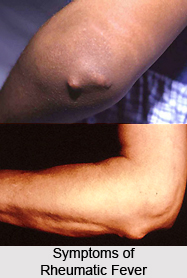
 Rheumatic fever or Aamavata Jwara is a general disorder accompanied by pain in the joints. Feverishness and copious perspiration are some other symptoms. The disease is one to which children and adolescents are more prone. It is generally not evident among people over thirty years of age. If the disease attacks an individual up to the age of eighteen, proper care and medication can control the disease. The disease has a tendency to spread in an erratic manner, and involves the smooth membranes of the body. Particularly the heart is involved in greater way.
Causes and Symptoms of Rheumatic Fever
An attack of rheumatic fever generally begins with a chill, followed by fever. It is accompanied by a feeling of stiffness or pain in one or more joints, usually of the knees, ankles, wrists, or shoulders. With the passage of time, the pain becomes really severe. The patient"s face becomes flushed and his whole body is bathed in perspiration. The temperature is usually 39.4 degree C. The pulse becomes rapid but strong and the tongue becomes coated. The patient also suffers from excessive thirst, loss of appetite, and constipation. The attack lasts for a few days if there is no relapse. If the disease is not controlled, certain complications may develop. Inflammation of the outer membrane, the inner membrane, and the muscle of the heart may also develop. The risk of cardiac complications is greater among patients of tender age since their joints are small and their swelling may sometimes be overlooked. Another serious complication, which is noticed in some cases, is hyperpyrexia or high fever. Fever usually ranges from 41.1 degree C to 42.2 degree C.
Medicines and Prescriptions for Rheumatic Fever
Hinguleshwar, Aamavatari Rasa, Saubhagya Vati: 120 mg of Hinguleshwar; with 240 mg each of Aamavatari Rasa and Saubhagya Vati to be administered thrice daily with warm water.
Vishveshwara Rasa, Shringa Bhasma, Yavakshara, Hritpatri (digitalis): 120 mg each of Vishveshwara Rasa and Shringa Bhasma; 240 mg each of Yavakshara and each of Yavakshara and Hritpatri. All these four medicines are to be given twice daily with honey.
Home Remedies: A hot compress of sand or salt put in a bag and heated over a hot plate, should be applied to the swollen joints. Leaves of amarbel or dhatura heated over a hot plate may be applied to the affected joints as a poultice.
Diet and Other Regimen
As a dietary supplement, Panchkol-shruta milk may be given thrice daily in quantities of up to 180 ml. Soft and warm foods, and substances such as bitter gourd which contain acrid components, are recommended.
Complete rest is advised for patients of rheumatic fever, and diuretics should be administered in appropriate cases. Constipation should be treated with laxatives.