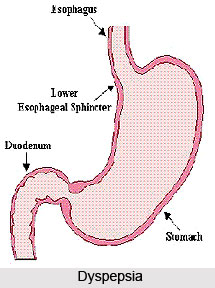
 Dyspepsia or indigestion is the term applied to difficulty in digesting food. The thing can be described as hard or difficult, and also chronic or recurrent pain and discomfort centered in the upper abdomen. Discomfort includes mild pain, upper abdominal fullness and feeling full earlier than expected with eating. It can be accompanied by bloating, belching, nausea or heartburn. Heartburn is excluded from the definition of dyspepsia as it usually has a different cause and management pathway.
Many people get dyspepsia. It is often caused by lifestyle factors, such as smoking and diet, but there are some serious causes also such as cancer of the stomach, peptic ulcer disease and some medications. When people have dyspepsia but no risk factors for any of the serious causes, it can be labeled undifferentiated dyspepsia and treated without further investigations.
Causes and Symptoms: Dyspepsia may be associated with pain in the region of the stomach, flatulence, eructations, a foul taste in the mouth, heartburn, and a general feeling of discomfort. There is also loss of appetite in some cases of dyspepsia. Irregular food habits in the form of overeating or eating at the wrong time, or the wrong type of food leads to indigestion. All of these are very common reasons to start the disease.
The general term applied to the symptoms associated with dyspepsia in Ayurveda is Agnimandya. This is a decreased digesting capacity of agnis, particularly, jatharagni, which aids digestion. The aggravation of the doshas i.e. vata, pitta, and kapha always lead to this disease. Excess of vata leads to pain in the stomach, pitta causes a burning sensation and if kapha is vitiated, there is nausea and also vomiting.
Home Remedies: As in constipation, it is easier to prevent dyspepsia than to cure it, if one follows the simple rules enunciated by Ayurveda. Fresh and hot food should be taken in pleasant surroundings. It should be taken only when the previous meal has been properly digested. Foods, which do not agree with each other, should be avoided. One should never eat in a hurry or when worried or angry. Emotions like anger and worry, and tensions of modern life, will inevitably lead to dyspepsia. One should avoid eating if heaviness is present. The quantity of food taken should be enough to assuage one`s hunger without producing a sense of fullness.
 The quantity of food to be ingested varies from individual to individual. A cardinal rule to follow in the matter of food is to avoid excess. Some people turn into gluttons, whereas others, though their number is limited, subsist on very little food. Sleep and food are really matters of habit. They can be increased or decreased within certain limits without impairing one`s health. The human body is a wonderful machine. It adjusts itself to circumstances very quickly, much more quickly than the human mind does. Excess food not only puts too much of load on the digestive system, it is also thrown out of the body in an undigested or incompletely digested form. The quantity of food needed to nourish the body also varies according to the seasons. In summer you need more intakes of liquids than of solid foods, whereas in winter it is the reverse. In winter unctuous, sour and saline foods, flesh of birds and aquatic animals, wines and strong alcoholic beverages may be taken without any harm; but in summer, cooling drinks, milk, rice, and flesh of animals dwelling in forests are the proper foods. Wines should be avoided in summer, except when they are diluted with water.
For chronic indigestion, chew about 1 gm of ginger with powder of rock salt before meals.
Medicines & Prescriptions: An Ayurvedic preparation marketed for dyspepsia is Hingvashtaka Churna, the major ingredients of which are hing or asafoetida, shunthi or Zingiber officinale, pippali or Piper longum, maricha or Piper nigrum, ajamoda or Carum roxburghianum, jiraka or Cuminum cyminum, and black cumin seed. The remedy acts best when taken with buttermilk after food. Or it may be taken with the first morsel of food. One teaspoon of the preparation may also be mixed with an equal quantity of ghee and taken twice daily. In cases of pain accompanying dyspepsia, another medicine is Mahashanka Vati, two tablets of which should be taken thrice daily with warm water.
Other prescriptions that are to be used in many cases can be mentioned as:
Ajirnadi Rasa, Shatapatriyadi Churna: 3/4 gm of Ajirnadi Rasa and 2 gm of Shatapatriyadi Churna have to be taken in the morning and evening with warm water.
Draksharishta: 20 ml to be taken with water twice daily, after meals.
Haritaki Churna, Raisins, Sugar: 3 gms each of Haritaki Churna and raisins and 6 gm of sugar to be taken at night with water.
Agnimukha Lavana, Narayan Churna: 1 gm each of Agnimukha Lavana and Narayan Churna to be taken thrice daily with warm water.
Lashunadi Vati, Samudradi Churna, Sarjikasatva: 1 gm each of Lashunadi Vati, Samudradi Churna, and Sarjikasatva to be taken twice daily with warm water after meals.
Diet and Other Regimen: Easily-digestible food with very little or no spices should be taken. Fried foods should be avoided.
Light exercise, preferably, morning walks are recommended in every case.