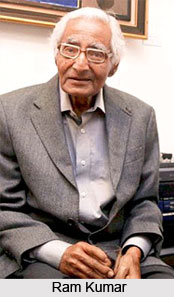
Ganesh Pyne was born in Kolkata in the year 1937. After school he joined the Government College of Art and Craft in Kolkata. He received his diploma in drawing and painting in 1959. Initially Pyne was greatly influenced by the brothers Abanindranath Tagore and Gaganendranath Tagore. He did water colour painting. In the early `60s, he spent some part of the day sketching for animated films made at Mandar Mullick`s studio. He became a member of the newly-formed Society of Contemporary Artists in 1963. In the initial stage of his paintings, blue and black were the two colours frequently used by him. He used to draw paintings that were rich in imagery and symbolism.
From water colour, Pyne gradually turned to gouache and then tempera since the mid-60s. During this time his figuration and palette changed. The figures were introduced with a skeletal aspect while animals showed their fangs and claws. His subjects were either hunters or prey. Dark shadows dominated his canvases. Certain motifs like boats, bits of bone, wood and other debris, dark doors and windows, birdman, Chaitanya(the leader of the Bhakti Movement), animals, daggers surfaced repeatedly in his works . Most of his artistic contents reflected the opposing pulls of death and life eternal. His varied treatments of the eyes are noteworthy.
 He claimed that his exposure to Walt Disney`s cartoons and his own experience as a young animator in Calcutta finally gave him the creative liberty. This left an indelible mark on his later work, where the grasshopper, the tiny bird, the lion and the monkey kept reappearing. After his marriage to Meera, Pyne moved from north to south to a flat adjacent to Vivekananda Park. Here his style changed significantly. He favoured lighter shades, but painting was still his raison d`etre. The walls of his studio became his canvas and are alive with his fascinating scribbles and doodles; quite as fascinating as his notebooks that crawl with sketches and commentaries.
The yellow pages of his fascinating childhood bear the testimony to the crafted realities on canvas as childhood experiences and stories were stored with amiable dexterity, Pyne created visual narratives of monkeys as princes, talking grasshoppers, and boy magicians. The monkey named Bir Bahadur, which means `master of all things` in Bengali, shown in courtier`s robes but loosely harnessed by a rope, began life as Akbar`s pet monkey. His wide grin and eager eyes suggests his bondage is due to mischievous behaviour. It is only through the result of Pyne`s technique of building up paint in washes, glazing them so that each successive layer allows the one beneath to breathe through it, that one can imagine such a world. His art knew no escapism or annihilation of the present to explore the smoky alleys of the unattainable or the unexplored. He created myth existing within the present itself. Time had been his sickle and consciousness his boards clip.
 Ganesh Pyne as an artist has experimented with various media. Ganesh Pyne draws inspiration from Bengal`s rich storehouse of legends. His paintings seemed to be an imaginative depiction of the stories every Grandma tells her grandchildren in sultry summer afternoons. He blends the romanticism and fantasy of these folklores to create a world of `poetic surrealism`.
His style has been shaped by his own cognitive content of topographic point, alienation, anguish, horror and moods of affection and placidity, surfacing in each of his works. Images derived from those experiences act as the offshoots of an idea that may have flitted through his mind. The lines are daring, exact, restricted and the drawings that materialise, are effective both in structure and substance. Removed from colour, they communicate an architectonic eminence in coordinating the pictures.
Some exhibitions of Ganesh Pyne are-- in 2005 Retrospective by Galerie 88, Mumbai; in 2000 Exhibition of drawings on Mahabharata 1967 to 1987 at The national Gallery of Modern Art, Mumbai; 1998 Retrospective by CIMA, Kolkata; in 1994 `Sketches`, The Village Gallery, New Delhi; in 1992 `Jottings`, The Gallery, Kochi; in 1991 `Jottings`, The Village Gallery, New Delhi; in 1990 Exhibition of Illustrations for book on Wajid Ali Shah, Galerie 88, Kolkata; in 1997 `Image-Beyond Image`, Contemporary Indian Painting from the collection of the Glenbarra Art Museum, Japan, exhibited at the National Gallery of Modern Art (NGMA), New Delhi ; Birla Academy of Art and Culture, Kolkata; Karnataka Chitrakala Parishad, Bangalore; National Gallery of Modern Art, Mumbai; in 1997 `Colour of Independence`, organised by Centre for International Modern Art (CIMA)
 As acknowledgement to this talent he has been conferred accolades like-- Abanindra Puraskar, Government of West Bengal in 2004; D. Lit (Honoris Causa), University of Kalyani 2003; Gagan Abani Puraskar, Visva Bharati in 1997; Shiromani Puraskar, Asian Paints, Kolkata in 1985; Artist of the Year, Sangeet Shyamala, Kolkata in 1978; Birla Academy of Art and Culture, Kolkata in 1973; Academy of Fine Arts, Kolkata in 1957; Calcutta Art Society, Kolkata in 1956; Government College of Arts and Craft, Kolkata in 1955. Some books have also been written on him, such as-- Thirst of a Minstrel: The Life and Times of Ganesh Pyne by Shiladitya Sarkar, Publisher: Rupa & Co. (published in November 2004); Enchanted Space: The Private World of Ganesh Pyne by Sovon Som. Publisher: CIMA (2006); Ganesh Pyne, his life and times by Ella Datta. Publisher: Centre for International Modern Art (1998).
His self-portraits afforded a rare glimpse into what he called his "ambivalent" existence. The front of respectability checked wild emotions within. These lawless urges, which we try to bury in our unconscious, are released in the twilit world of Pyne`s paintings.
Pyne was known for his insight, his penetrating vision, the rich hues that glimmered through the penumbra that pervaded his paintings, and his lapidary style. Art has lost its artistic definition with the death of Pyne on 12 March 2013.