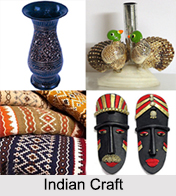
Kutch has been an ideal shopping destination for textiles with hand block printing. In this technique, fabric is decorated by printing designs on it. Hand block printing in India was the chief occupation of the chippas - a community of printers. They use metal or wooden blocks to print designs on the fabrics by hand.
Ajrakh prints
Ajrakh printing is one of the popular traditional crafts of Kutch. The wold "AJRAKH" means "keep it to day" and probably served as means of publicity. It also means beautifying and in Arabia, Ajrakh denotes the blue colour which is an essential of the craft. The Khatri community has been engaged in this craft for many centuries and the technnique is handed down from father to son. Recently Harijan artisans trained under Khatri crafts people are also pur suing this craft. Dhamanka and Khavda are the two most important centres.
Batik Prints
Batik is one of the most attractive and important crafts of Kutch. In this printing paraffin-wax is used as the resist material. In the 18th and 19th century, the East India Company used to export Batik. Nowadays the craft depends more on local demand than on the export market.
Tie and Dye
Tie and dye, popularly known as Bandhani, is a famous traditional handiwork of the Kutch district, gandhanis are very closely associated with deep rooted social customs. It is treated as a symbol of married life. It is a must in the marriages of Hindus and Muslims. Discovery of dyed cotton fabric dating back to the Indus valley civiliation shows that the art of dyeing using mordant was well known to the dyers, 5000 years ago. Tie-dye still continues to have an important position in Gujarat. Bandhani designs are carefully built up in a number of colors, starting with the lightest and working through to the darkest. Designs are usually lightly printed with block made up of small dots.
 The crafts man or woman will then tie tiny knots where the dots are shown. The parts of the design to be in the lightest colour will remain knotted throughout the process, but as each new color is applied, some of the knots will be strategically untied allowing the color to penetrate.
Printing with Vegetable dyes Printing with dyes of Vegetable Origin is a traditional art of the district. Introduction of synthetic dyes have almost entirely replaced the indigenous dyes. However a handful of craftsmen still follow the laborious process of preparation of natural mellow dyes and print colours such as indigo (Indigofers Tinctoria) katho (Acaciacarecha) lakas (Red, wood Adenantherapavonia) haldar (Curelums Louga) harda (Terminalia nebula) majitha (Rubia carditolia) padvas (Termarics Indian) and which used a kaiya type of clay. Lac (a type of resin) is used in the preparation of colors for printing and dying.
The crafts man or woman will then tie tiny knots where the dots are shown. The parts of the design to be in the lightest colour will remain knotted throughout the process, but as each new color is applied, some of the knots will be strategically untied allowing the color to penetrate.
Printing with Vegetable dyes Printing with dyes of Vegetable Origin is a traditional art of the district. Introduction of synthetic dyes have almost entirely replaced the indigenous dyes. However a handful of craftsmen still follow the laborious process of preparation of natural mellow dyes and print colours such as indigo (Indigofers Tinctoria) katho (Acaciacarecha) lakas (Red, wood Adenantherapavonia) haldar (Curelums Louga) harda (Terminalia nebula) majitha (Rubia carditolia) padvas (Termarics Indian) and which used a kaiya type of clay. Lac (a type of resin) is used in the preparation of colors for printing and dying.
Rogan painting
The rogan painting craft is more than 100 years old. Hand-pounded castor oil is turned into a paste by boiling. Later, coloured powder diluted in water is mixed with the castor oil. The pastes of yellow, red, blue, green, black and orange are kept in earthen pots with water to stop the paste drying. An iron rod, flat at both ends, is used to paint half of the design with the support of left hand fingers, from the bottom of the cloth then its impression is transferred on to the other half portion of the cloth.
Cushion covers, bed spreads, petticoats, kurtas, curtains, table cloth, wall hangings are painted with this technique. Generally geometrical motifts are preferred. Sometimes floral motifs are also adopted. Only 3 craftsmen of Nirona village use this technique.