Jain Philosophy means a follower of Jina, which is applied to those persons who have conquered the lower nature, passion, hatred, etc.
Concept of Jain Philosophy
Jain Philosophy is a dharmic religion and philosophy that originated in ancient India. The word `Jain` comes from the word `Jina` which means a conqueror. `Jina` comes from the root `Ji`-`to conquer`. It means conquering the passions like lust, anger, pride and greed are considered as the major passions, which are considered the enemy of the souls. It does not mean conquering nations.
Jain Philosophy and Buddhism
The Jina or the `conquering saint`, who has conquered all worldly desires, is with Jains what Gautama Buddha or the perfectly enlightened saint is with Buddhists. He is also called Jineswara (chief of the Jinas), Arhat, "the venerable", Tirthankara or the saint who has made the passage of the world. The Jains follow the teachings of Tirthankaras. `Tirtha` literally means a ford, a means of crossing over. It metaphorically denotes a spiritual guide or philosophy, which enables one to cross over the ocean of recurring births in this world. `Kara` means `one who makes`. The word Tirthankara means a `Jain Holy Teacher`. These teachers or Tirthankaras are not creators or rulers of the world. They are pure divine souls, who have attained perfection and can never again take human birth.
Foundation of Jainism in India
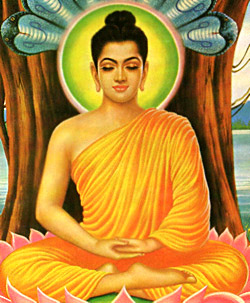
Mahavira, the 24th Tirthankara, is not the founder of Jainism, but the first active propagator who revived the Jain doctrines. `Maha` means `great` and `Vira` means `a hero`. Jainism is similar and has much in common to the Buddhistic ideas. The idols, which represent the Tirthankaras, are like that of Buddha in a meditative posture. Like those of the Buddha, Mahavira`s doctrines were formulated as a reaction to and rejection of the Brahmanism (religion based on the Hindu scriptures, the Vedas and Upanishads) then taking shape.

Theme of Jain Philosophy
Jain philosophy deals extensively with the problems of metaphysics, reality, cosmology, ontology, epistemology and divinity. Jainism is basically a transtheistic (referring to a system of thought or religious philosophy that transcends theism, and is thus neither theistic, nor atheistic) religion of ancient India. It is a continuance of the ancient Sramana tradition that co-existed with the Vedic tradition from primeval times. The discerning features of Jain philosophy are its belief on independent existence of soul and matter, denial of creative and omnipresent God, strength of karma, eternal and un-created universe, a strong emphasis on non-violence, stress on relativity and multiple facets of truth, and morality and ethics, based on liberation of soul. Jain philosophy endeavours to explain the principle of being and existence, the nature of the Universe and its constituents, the nature of bondage and the means to attain liberation. It has often been described as an ascetic movement for its strong emphasis on self-control, non-indulgences and renunciation. It has also been referred to as a model of philosophical liberalism for its assertion that truth is relative and multifaceted, and for its willingness to adapt all possible view-points of the rival philosophies. In this respect, it is also compared to Western concepts of subjectivism and moral relativism. Jainism strongly maintains the individualistic nature of soul and personal responsibility for one`s decisions; and that self-sufficiency and individual efforts alone are responsible for one`s liberation. In this light it is similar to individualism and objectivism.
Unified Thought of Jainism
Jain philosophy remained unified and undivided, though as a religion, Jainism was divided into various sects and traditions. The contribution of Jain philosophy in developing Indian philosophy has been substantial. Jain philosophical concepts like Ahimsa, Karma, Moksa, Samsara and like have been absorbed into the philosophies of other Indian religions like Hinduism and Buddhism in diverse forms. While Jainism traces its philosophy from teachings of Mahavira and other Tirthankaras, numerous Jain philosophers from Kundakunda and Umasvati in ancient times, to Yasovijaya in recent times, have contributed extraordinarily in developing and refining the Jain and Indian philosophical concepts. Jain cosmology denies the existence of a supreme being responsible for creation and operation of universe.

Major Jain Symbols
Jainism has stated some very important symbols that are advised to be followed by the Jains, believed to be extremely holy. Some of them are also common to Buddhism and Hinduism, and are also found to be in extensive usage today. Some of them are - 24 Lanchhanas for the Tirthankaras, the Ashthamangals, the Triratna and Shrivasta, Siddha-chakra. However, the most significant and holiest among them is the Swastika, resembling an oblong cross, with curved hands.
Jaina Concept of the Universe
Jains uphold a restricted line in the concept of the universe. According to them, the world goes narrowed down at the top, broad at the middle and again turns broad at the bottom. The universe is changeless and eternal.
Constituents of reality in Jain Philosophy
The Jains believe in six essential substances as the intrinsic elements of the Universe.They divide in into Java, Ajava, Dharma-tattva, Adharma-tattva, ka and Kala classifications. Each carries a different connotation, with respect to living being, non-living being, the principles of motion and rest, space and time. According to the Jains, the universe gains surplus dynamism through these qualities.
Metaphysics in Jain Philosophy
The metaphysical principle in Jainism is solely pivoted around the soul and its characteristics, its properties, its way of action, and the final path to salvation. Firstly, the limitless soul is divided into the categories of liberated and non-liberated. A soul can only achieve the status of liberation, when it has becomes successful to break free from the restraints of karma. The incarnated soul is thus found to reside in four respective territories. Secondly, metaphysics states that the soul can never be governed by outside agents, it is the master of its own entity. The final state, states about the nine measures through which a soul can achieve its liberated status and become free worldly karma.
Morality and Ethics in Jain philosophy
Morality and ethics amongst the Jainas is based on a common thought that a layman can accomplish, provided he follows in the stated path of fivefold vows. The five vows comprise - non-violence, non-possession, non-stealing, truth and celibacy. In order to differentiate between right and wrong or to have a good conduct, one need not have to fear the Almighty or the community. It is actually for one`s own well-being and triumph that austerity is necessary.

Karma: Law of Causation in Jain Philosophy
Standing at a major difference from the other thoughts of philosophy, karma in Jain philosophy fetches an entirely novel concept. Karma is not an overriding force that destroys every person, but a materialistic complex of fine matter that resides within the soul. A moral action is normal to carry its consequences, which implies that a consequence occurs when one commits an act of sacrilege. Due to the Jain disbelief in God, they are of the faith that such actions are brought about by an inner activity of karma in accordance with the soul. Due to dissatisfaction in a current life, the karmic desires are carried over to the next life.
Nature of Divinity and God in Jain Philosophy
Jains are famous for their studies and theories on the fact that there is nobody called the Supreme creator or God, who is responsible for all creation. According to them, a spiritual and devoted life can be led, following the "24 Jinas" and their way of life. Jains consider these scholarly men as the godlike beings.
Path to Moksha in Jain Philosophy
The Jains lay enormous stress on the liberation or freedom of the soul from every kind of karmic materialistic bondage, otherwise termed as moksha. In fact, this is the basis of Jain philosophy. Moksha is a blissful state, where the soul is known to finally gain the knowledge of the infinite. Although, this is not so easy as it is said. One needs to strive hard to achieve moksha, contrary to which one is termed a non-believer in the fundamental Jain path.