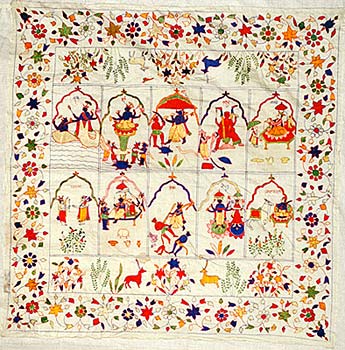
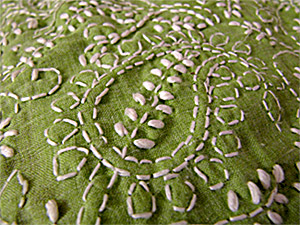
 An integral part of Indian culture, chikan kari, was strongly rekindled by Moghul patronization and attained perfection as the exquisite needlework and hand work underwent further honing and refinement.The name chikan has been derived from the Persian word Chakin or Chikeen meaning a kind of cloth wrought with needle work. Chikan is said to have originated as a court craft, during the reign of Mughal Emperor Jehangir, by his wife Noor Jahan.
Traditionally, the chikan embroidery was exclusive white items, decorations similar to the cotton, jamdani, and woven traditions. The Nawab Shujaudaula of Avadh was greatly attracted by this craft. It was his keen initiative and interest, which promoted this craft in present day Lucknow. Another record of the travelers of the sixteenth century describes that during the sixteenth century, white work from Bengal, was influenced by the Portuguese traders, the residents of the port Hugli, north of Calcutta of that time. The Bengali migrants who came from Dacca in eighteenth century to settle in Lucknow brought this art of surface ornamentation to Lucknow. Chikan work came into production by the nineteenth century. During this period similar work was also produced at Calcutta and Madras. It is reported that earlier brass, bone, copper or iron needles were used, now only steel needles are used.
Fine Art of Chikan Embroidery
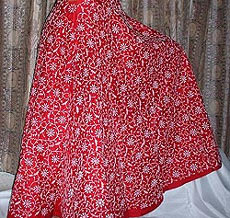 Originally embroidery was done on white tanjeb; the muslin from Dacca, using only white untwisted cotton or some times tussar silk for embroidery. A large number of men were practising this art of embroidery since nineteenth century. Trade is now predominantly practiced by woman in Lucknow and adjoining villages. Some of the popular motifs are: Kairi (mango motif, generally made using taipchi stitch ); dhaniya patti (corriander leaf); phanda is made and a straight stitch is done to make the base of the stem; dhum patti (leaf pattern made of cross-stitch); ghas patti (grass leaves V-shaped line of stitches worked in a graduated series); murri (grain motif - diagonal stitches are worked several times on a basic stitch to form a grain shape); kangan (bracelet-made by combination ofkeel, murri andjali stitch);joda murri (pair of grains);maharaki (close button hole is done around a hole, and finished with murri); sadi-maharaki (no hole is made, the part made in the centre is finishedwith tapichi and murri); daraz/katub (two fabrics are overlapped, stitched and extra fabric is cut, the cutting is called katub); pechani (taipchi stitch is covered by entwining the thread over it in a regular manner to provide the effect of a lever spring); tanjire (for lining the motif, looks like a chain); gitti (circle is formed with minute hole in centre); phanda (single chain is made, then on its top 3-4 similar chains); keel (first phanda is formed then the needle is inserted over and over the chain stitch to form a keel); kangira (seam allowance of fabric is folded such that triangles are formed on the wrong side of the fabric).
Procedure of making Chikan Embroidery
After cutting the fabric in required length, the designs are traced on the marked areas with blocks of a variety of shapes, sizes and forms. The block is dipped in neel (a chemical dye), which is mixed with glue and is soaked in cloth pads. The block is then printed on the desired area of the design. The embroiderer uses these printed outlines as a pattern and guide. These designs are embroidered by various stitches. The stitches used for chikankari are only that applied in regular embroidery. Tapichi (stem stitch ), bukhara (inverted stem stitch), are some of the popular stitches. Skill lies in rendering them in a specific way with the needles of the varying sizes. The stitches employed for this embroidery are pulled work, which create intricate patterns, locally known as jali work; the double back stitch; running and back stitch. No hooks or frames are used while embroidering. The left hand has to continually stretch the cloth gently weft ways and warp ways to avoid puckering. The jali work in particular is done with wide blunt needle. This needle makes the holes in the fabric with ease. Intricate floral designs are indigenously embroidered using white/coloured cotton thread, on sheer white or pastel coloured muslin, organza and these days some times silk. The ingenuity of chikan-kari, the art of surface ornamentation lies in deploying up to thirty-five stitches to embroider the floral, geometrical, animal patterns.