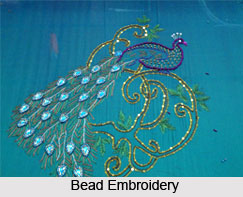
 Bead embroidery is a type of beadwork that uses a needle and thread to stitch beads to a surface of fabric, suede or leather. Bead embroidery is a very beautiful and unique form of embroidery which can add new life in ones embroidery designs patterns. One can use this technique to make handmade gifts, on clothes, bags, caps, cushion covers and other home décor stuffs. From ancient traditions to the modern culture, the style of beaded embroidery has evolved from simple designs to creatively sewn beaded embellishment techniques. The need to beautify both garments as well as household objects with precious, semi precious stones and glass beads has made this embroidery very popular. Bead embroidery is one of the most expressive, most satisfying methods of beadwork, which is like painting with beads; forms create themselves, patterns flow and the beads know where they want to be. The popularity of beading embroidery is also increasing in today"s world. It is not only used for clothes but for other accessories like purse, bag, gloves and boots as well.
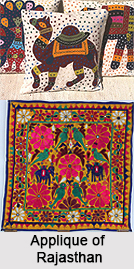
Traditionally, bead embroidery has been used on clothing and decorative textiles. It may be used in jewelry with the addition of structural supports such as bracelet bands. Other clothing accessories such as belt buckles and handbags can be embroidered with beads, and household items such as pillows or boxes may be embellished with bead embroidery. When used with hard surfaces, bead patterns are measured and planned with seam allowances and attached after embroidery by means of glue or epoxy. The motifs are stylized, generally an elephant with a howda, a camel and rider, a warrior on his horse, a women churning butter, and so on. In bead work, decorative items such as torans, Chaklas, long panels as well as pillow covers and indhonis (the base for water pots carried on the head) are created by women.
Origin of Bead Embroidery
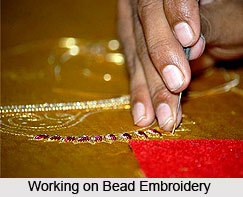 It is an historical technique which is previously used by emperors, kings, and nobles to decorate their clothes. This work was done by with silk, silver or gold threads which looked rich and royal. With beads some had used precious stones and gemstone in this technique. This craft is developed in the late 19th century with the use of imported Venetian beads. Bead embroidery on textiles is done to embellish the fabric in a few regions. In India special beadwork embroidery of the states of Gujarat and Rajasthan are very famous. Unlike in Gujarat state, where the bead embroidery shows only beads as the beads become the fabric, as it were, elsewhere mostly flowing or geometrical designs are worked with beads on fine fabrics.
Technique of Bead Embroidery
Three basic methods may be used to embroider with beads: individual beads may be sewn directly onto fabric, or several beads may be run through a needle before running through the backing, or else a line of threaded beads may be laid upon a fabric and secured with couching stitches. Many people use a needle and thread to stitch beads to the fabric, usually a fine needle with a small eye to facilitate easier passage through the small holes in many seed beads, a second technique uses a fine hook to chain stitch thread to the fabric, in Europe this technique is known as Tambour or Luneville embroidery, and is commonly used to bead haute couture garments. In India the work is called Zari or Aari and is used on garments and furnishings. In Zari and Aari work, the beads are attached to the top side of the fabric where the chain stitch is formed. In Aari work the thread is hooked through each bead as the stitches are formed. The Aari beading methods appear more difficult to master for those more used to working with a threaded needle but do have an advantage in speed over stitching beads with a needle, increased speed is possible as the thread is used from the spool so is continuous, there is no need to fasten of, cut new thread, thread the needle, and fasten on. Most beading onto fabric is worked with the fabric stretched tightly over a frame, this holds the fabric tight and provides a flat surface to work the embroidery on, and beads can add significant weight so some support is important. Using a frame means the embroiderer has both hands free for working. In Aari or Zari work the frame is often closer to the ground, and used while seated on the ground.
Method of Bead Embroidery
Bead weaving or stitching is one of the most enjoyable of beading techniques to learn. It will add more skills and detailing to the work and one can get some attractive applique.
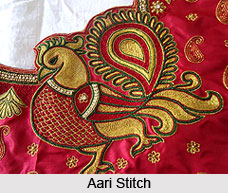
•Select the design and decide how big or small you want to make it.
•Decide the details you want to use in the designs and purpose of the designs so that one can easily choose the patterns or style according to the need.
•One can also use different styles of beads to get different effects. For example, Charlotte beads that are flat on the sides can add sparkle to the Beadwork.
•To add a lot of glamour, one can use these beads by themselves, or employ them in the design intermittently to create an occasional accent.
•One can also get beads in various finishes, including unlined or lined beads.
•After the selection of beads and designs, select the fabric.
•Use the threads and beads according to the fabric so that it can give an attractive look to the embroidery.
•Use accurate thread, needles, and a hoop or string to ensure that the fabric is tight enough while one works on it.
•With the use of thread and small needle, a large variety of patterns are created out of different coloured beads.