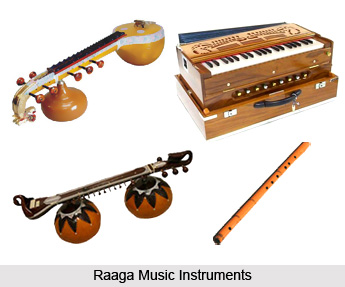
Miraj StyleTambura is a type of a stringed instrument used in Indian Classical Music. It is a long-necked Indian lute, which is unfretted and round-bodied. It has derived its name from the Persian word Tanbur. It possesses three different styles which are chosen according to the preference of the performers. This Indian musical instrument contains the vital element of music, drone. The harmonic or monophonic effect is continuously sounded throughout the piece, sustained or repeated, which establishes a tonality upon which the rest of the piece is built. The name `tanpura` is believed to have derived from `tana` that refers to a musical phrase and pura which means "full" or "complete". Thus the tanpura is an instrument which supports and sustains the melody by providing one precise tone, the basic note or key-note. Tanpura or Tambura works on the principle of Jivari.
Structure of Tambura
The Tambura is also commonly known as tanpura in the north, has a hollow neck with four or five wire strings. Structure of Tambura is slightly different in the north and south. The resonating bowl is made of wood in the southern variety, but in upper India it is of a large pumpkin (tumba). Whereas in the southern Tambura, the resonator and the neck are carved out of the same block of wood, in the north, a wooden neck has to be made separately and attached to the gourd. The rest of the instrument is more or less the same in both. However, the southern Tamburas are much smaller than the northern ones.
The northern Tamburas have the gourd of nearly 70 to 90 cm in girth and overall height of 105 to 120 cm. The strings used are: one of brass for Palt Mau two of steel (5a, Sa) and one of steel (Sai). At the lower end, the strings are fixed to a piece of wood, the langote, struck to the gourd. From here they pass over a bridge (Ghoda or Kudirai) to a notched ledge (jneru) and then through the holes of another ledge to the pegs. The pegs are two on the front and one or each side. While these are turned for grosser tuning, finer pitch adjustments are made by the sliding of beads, one for each string, near the lower end. Functionally the most important part of the Tambura is the wide bridge. Made of ebony wood (seesam), ivory or camel bone, it is curved in a direction right angles to the strings and sloping in the direction along their length. The whole bridge is made of one piece and stands on two broad legs; each of these bears a small hole into which fits a protrusion from the covering plank.
In the Hindustani classical music, the Tambura comes in different sizes: bigger "males" and smaller "females". The male instrument has an open string length of one metre; the female is sized down to 3/4. The strings are plucked one after another in a regular pattern to create a tonic resonance field. This Indian musical instrument is available with standard tuning. This instrument produces rich buzzing sound and is applied in order to attain the overtone-rich sound.
Styles of Tambura
The Tambura is designed in three different styles namely Miraj Style, Tanjore Style and Tamburi Style. Each style features different shapes as well as varied working pattern. The styles of Tambura are described as:
Miraj Style
It is the favourite form for Hindustani performers. Miraj style is usually available between three to five feet in length, with a well-rounded resonator plate (tabali) and a long, hollow straight neck. The round lower chamber to which the tabli and the neck (dandh) are fixed is actually a selected and dried gourd (tumba).
Tanjore Style
It is a south Indian style of Tambura, which is used widely by Carnatic music performers. It has a different shape and style of decoration, but is otherwise much the same size as the Miraj style. Typically, no gourd is used, but the spherical part is gouged out of a solid block of wood. The neck is somewhat smaller in diameter.
Tamburi Style
This style is much more popular recently, due to its small size and portability. It is two to three feet long, with a shallow resonator and a slightly curved tabali. It has about four to six strings. The small five-string Tamburi are tuned to the higher octave and are the preferred instruments for providing the drone for solo-performances by string-playing artists.