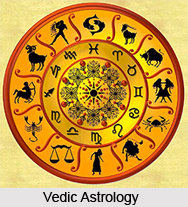
 The origin of astrology can be traced back to the Vedic ages in India. The reference of astrology or jyotisha is found in the Mundaka Upanishad that dates back to the ancient Mauryan times. As several of the Poojas and remedial measures prescribed in the Indian astrology are followed as per the Vedic system, it is also called Vedic astrology. Vedic culture is one of the primordial cultures and bears the history of at least 5000 years. This culture has its own unique theology, philosophy, arts, sciences, and literature which exist to this present day. Vedic or Hindu astrology is an integral part of Indian culture and has been practiced since time immemorial.
Influence of Greek Culture on the Origin of Indian Jyotisa
The Vedanga Jyotisa, one of the six supplementary appendices of Vedas, was annotated by Lagadha in the Mauryan period, with rules for tracking the motions of the sun and the moon. The history of Jyotisa commences with the interaction of Indian and Hellenistic cultures in the Indo-Greek period. The documented history of astrology begins with the interaction of Indian and Hellenistic cultures in the Indo-Greek period. The ancient treatises like the `Yavanajataka` or the Brihat-Samhita, date to the early centuries CE, the oldest astrological treatise in Sanskrit is the `Yavanajataka` contain the mention of `Jyotisa`. Recent explorations in the sky of scientific inventions and discoveries have proved astrology to be a branch of Vedic sciences.
Development of Astrology in India
astrology in India developed simultaneously with astronomy. Distinguished astronomers from the 5th century CE, like, Aryabhatta, contributed considerably in further developing astrology. This period is traced to be the commencement period of the classical age of Indian astronomy. Several ancient treatises on the same subject belonging to this era were also found. Besides the theories of Aryabhatta in the `Aryabhatiya` and the lost `Arya-siddhanta`, there is the `Pancha-Siddhantika` of Varahamihira. Other scriptures, like, Brihat Parasara Horasastra and Saravali by Kalyanavarman also mention the gradual development of classical Indian astrology. Epics, such as, `Mahabharata` mention astrology as well. According to it the then astrologers were successful in making accurate predictions of the planetary movements with the help of their divine intuition. The Bhishma Parva and Udyoga Parva of Mahabharata state numerous astrological descriptions and omens just before the Battle at Kurukshetra.  The descriptions of a period of draught with several planetary combinations were also stated there. Even very clear reference about two eclipses, a solar eclipse and a lunar eclipse occurring, creating a rare 13 day lunar fortnight were depicted in the scripture. According to various texts, the origin of Indian astrology was attributed to various gods and Rishis. The most popularly followed astrological classics today are the ones written by Rishis like Parashara, Varahamihira, Garga, Jaimini and their followers.
A glimpse into the origin of astrology will also lead one to the practice of the ancient sages such as Vashishta, Bhrigu, and Garga who were considered the masters of astrology. The basic school of Vedic astrology practiced in India is called the Parasara School of astrology, which was named after the last of the Rishis (great sages) of the Vedic age. After him several eminent people preserved the line of Vedic astrology. Notable amongst them was Satyacharya and in particular Varahamihira who wrote several important texts on astrology. Thereafter several other texts were composed which are also considered "classics" of Vedic astrology, such as `Saravali`, `Jataka Parijata`, `Sarvartha Chintamani`, and `Horasara`. All of these texts follow Parasara in their teachings.
Indian astrology was introduced in India at the very ancient period and was carried till date with various developments in modern times in this field. Even in the recent times the ancient scriptures written in the past are used to make accurate predictions .Astrology clearly defines the straight line between free will and predestination; warning one and all about the impending dooms or even bountiful blessings. It depends upon an individual as to how he incorporates astrological predictions within his system and changes his fate by the dint of his "karma".