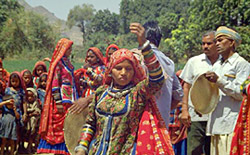
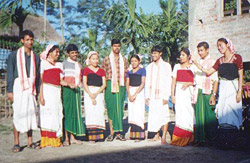
 The disintegration of the Deori tribes started after Burmese invasion that took place in the nineteenth century. They started migration and resettled in the districts of Dibrugarh, Tinsukia, Sivsagar and Lakhimpur. The Deoris are divided into three subdivisions - Dibongias, Tengapanias and Borgias. Dibongias speak Deori dialect whereas other groups speak Assamese language with some mixture of their own dialect. They are found to live on the banks of river. The word `Deori` is derived from the word `Deva` which means the Supreme divinity.
Origin of Deori Tribes
According to their report, the Deori tribal community is one of the four divisions of the Chutiya tribal member, and is also linked to the Eastern Bodo-Garo. There is also a legend popular in the whole of the Deori tribal community. It is believed that after being ill treated by the Mongol rulers, these Deori tribes came down to India via Tibet and Burma and then had taken refuge in the mountainous regions of Cachar Hills. It has also been said that the Deori tribe incorporates three groups - Tengapania, Borgoya and Dibongias and these three groups are ramified into twenty four separate clans. Though the Deori tribe is basically concentrated in Assam, the people of this tribe are also centered in some other states like Nagaland and Arunachal Pradesh.
Society of Deori Tribes
The Deoris are conservative regarding their traditions and have a strong feeling of oneness on the matters of socio-cultural affairs. They have kept their tribal virility, cultural identity and maintained most of their age old practices in one or the other form. Female initiation ceremony is one such practice which the people observe regularly. They have female and male initiation ceremonies. The Deoris are more bound by almost all their aspect of age-old cultural tradition. This has given them a separate identity amidst the changing world and they are able to survive with their uniqueness amidst the exploiting external forces and ethno-cultural mixture. Societal structure of Deori tribes is quite unique thereby drawing attention of most of the eminent anthropologists of the Indian subcontinent. One of the distinguished societal features of the Deori tribe is that all the member of the whole of the extensive family units resides under one roof. These Deori tribes increase the building as the number of family members` increases. Patriarchy is prevalent with the lineage following the patrilineal norms.
Marriage has been regarded as a significant institution in the society of the Deori tribes. These Deori tribes, like many other Indian tribes, follow the rules of endogamy quite ardently. Special rites of marriage are also being followed by the Deori tribal community. That is to say, the Deori male must pay the customary bride price to the family members of the prospective bride. Also if he cannot afford to pay such a lump sum of money, the custom of the Deori tribe is that he will propose to work in the house of the bride family for a scheduled period of time.
Religion of Deori Tribes
They follow animistic religion. In each village there is a common place for worshiping the God. It is called Thaan. Offering of pigs, fowls are made during religious ceremonies. Baliya Baba is their supreme God. They also believe in certain spirits for their well being. Forecast of the coming year`s happenings are done by the concerned spirits through the woman who is beheld by the spirits. This occurs during Bohag Bihu, which is a new year`s festival in the month of April, at the Thaan. Due to the impact of Hindus of Assam they have started to perform some Hindu rituals. In a Deori society there are no community shrines
The Deoris celebrate a number of festivals including Bihu which is considered by the entire community as a major festival. Magh Bihu and the Bohag Bihu are also the source of great entertainment to them. They celebrate these festivals with dance, songs and with much exuberance.
Deori Tribes
Deori tribes are one of the major plain tribes of Assam. Deori tribal communities have sustained their tribal identification despite the onslaught of modern day influences.