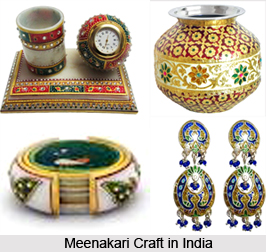
 Meenakari is basically an ancient form of art in India that has been praised since its introduction for the superb designs and combination of colours. From the prime age of this craft, the artisans were named as `meenakar` who were involved in creating different Meenakari items. In some work, the entire object, such as pendant, is covered with this exclusive technique. On a typical pair of `kara` bangles with three-dimensional `makara`, elephant, lion or bird head terminals, additionally decorated with diamonds, rubies, and emeralds, as they often were, is a dazzlingly opulent object that embodies a galaxy of goldsmith arts. A special type is `ek rang khula mina`, in which single-colour transparent enamel fills all engraved area, leaving gold outlines exposed around figural details. `Pachrangi mina` (five-colour enamel) is a special multicoloured style of enamelling. The five colours used are `safed` (opaque white), `fakhtai` (opaque light blue) from `fakhta` (a dove), `khula nila` (transparent dark blue), `khula sabz` (transparent green), `khula lal` (transparent red).
History of Meenakari
Meenakari is the art of decorating metal with enamelling. It was introduced by the Mughals though originated in Persia. Raja Man Singh of Amber brought this art to Rajasthan. He invited skilful meenakars from the Mughal palace at Lahore and established them in Jaipur, which became the centre of Meenakari later on in India. Meenakari design needs a high degree of skill and techniques. Colours like red, green and white, dominate this art of enamelling. Nathdwara, Bikaner and Udaipur are the famous centres for silver Meenakari. Pratapgarh is known for glass enamelling. Delhi and Varanasi are also important centres for exclusive Meenakari designs. In India, Meenakari work has developed in the places like Punjab and Lucknow including the other Meenakari centres of India.
Techniques of Meenakari Art
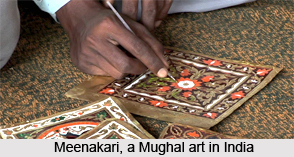 The design for the Meenakari in India is made on the metal surface by the craftsmen called `chitras`. The design is engraved by the `gharias` such that depressions are created. Sometimes the Meenakari is combined with the art of `Kundan` to make the created articles an amalgamation of enamelling and stone carving. After the design is created the enameller applies different colours with brushes on the engraved design. The base is first covered by white or pink enamel, upon which different colours are applied in order of their hardness. It is then heated to enhance the richness of the colours. `Gulabi mina` (pink enamel) is derived from `gulab` (rose) which has been popularly associated with the Varanasi enamelling style. It includes areas of painted enamel, generally flowers, executed in translucent pink on an opaque white ground. All other enamelled areas on the object are created in the `champleve` style, which makes this a mixed style of enamelling. The technique requires at least five separate enamel applications.
When a single transparent coloured enamel is used to fill the ground around an opaque figure, various colour of ground like `lal zamin` (transparent red ground), `sabz zamin` (transparent green ground), `nil zamin` (transparent blue ground) are chosen to contrast with and set off that of the subject. `Bandh mina khaka` (opaque cartouche or outline) is a technique in which the figure in transparent colour is surrounded by an opaque enamel cartouche. The object when ready is polished and cleaned. Generally hand burnishes are used to cover any exposed metal.
Forms of Meenakari Art
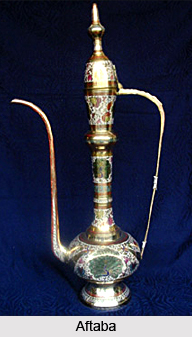
Besides jewellery other items which were known for their Meenakari work were various shaped huqqas, pandans, flasks, sprinklers and a lot more.
Huqqas were a favourite item for the Meenakari Artists. Various hues and ambitious designs were used in the Meenakari Art which was part of the huqqas. Different shaped huqqas with the engraved Meenakri work were made during the Mughal period.
Pandan is another piece of art work which sees profuse use of meenakari work. Pandans of the Mughal era are found in all the three metals namely gold, silver and copper.
In conclusion it can be said that both silver and gold metals are used as the base for Meenakari work in India. At present time, Meenakari is done in the metals like silver and copper to suit the need and style of the modern people. In addition to the jewelleries and other items, the Meenakars create exclusive items that serve the decorative purpose. The items that are created with amazing artistry include Meenakari bowl set, chowki set, Hand Casted Meenakari Chowki with White alloy metal, Meenakari arm chair, Meenakari almirah, Meenakari roman chair, Meenakari gun box cum seater, utility box thrones, dining set, decorative frames, key holder, photo frames, ash trays, pen holder etc.