Introduction
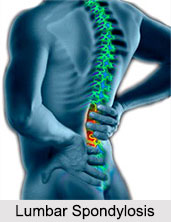 Lumbar Spondylosis is a state where the affected person feels pain in the lower portion of his back due to deteriorative changes in the inter-vertebral discs and facet joints. It affects people normally above 40 years of age. Generally, various vertebrae levels are involved in lumbar spondylosis. The lumbar spine carries a majority of the weight of the body; hence, chronic forces constitute the function and structure of this part of the spine. Spondylosis is usually portrayed by movement of one vertebra over other, which leads to the contracting of the canal. The nerves which venture out of the spine get compressed and thus the affected individual acquires the symptom.
Symptoms of Lumbar Spondylosis
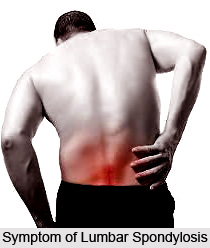 Lumbar spondylosis is the degeneration of the nerves in the lower part of the body that reduces the ability of the involved segment to proceed through its normal range of motion. Compression of the nerves which are within the spinal canal or the nerves that exit the spinal canal leads to pain, numbness or weakness in the legs, buttock or bowel and bladder. In addition to that, abnormalities of gait can also occur. The common symptoms of lumbar spondylosis are recognized to be back pain and stiffness of the lower region of the body. Conversely, lumbar spondylosis is usually termed as asymptomatic, with no particular diagnostic or predictive significance.
However, no certain symptom of lumbar spondylosis can be identified as it is usually associated with back or sciatic pains. The disorder is caused in an individual when there is a marked narrowing of the canal over a few segments and when the bone, disk and the ligaments obtrude into it. This condition is termed as lumbar spinal stenosis. The nerve roots of the cauda equina are compressed. When the misalignment of the vertebrae causes stretching of the joint capsules where the vertebrae are adjacent, a pain can occur. Furthermore, the event of backward protrusion of an intervertebral disk is distortion of the local ligaments is a common cause. The emerging nerve root is compressed and thus pain, weakness and numbness in the area are experienced.
Symptom of lumbar spondylosis mainly includes low back pain. Though, low back pain in an individual can be divided into two main types - mechanical type pain and compressive type pain. Mechanical type pain is a result of the injury to the disc, the facet joints, the ligaments or the muscles of the back. Mechanical pain is also caused by disc degeneration. This type of pain starts near the lower spine. Mechanical type pain may also spread towards the buttock and thigh areas and extends below the knee. On the other hand, compressive type pain occurs when the nerve roots that leave the spine are irritated or pinched. Compressive pain can be caused for a herniated disc. The nerves that leave the lower lumbar spine joint to form the Sciatic nerve. This nerve provides sensation and controls the muscles of the lower leg. The foremost signs of compressive pain are associated with the pressure on a nerve root that includes numbness in the area complete by the nerve.
Symptoms of lumbar spondylosis depend on where the spine is affected by spondylosis or spinal osteoarthritis. These symptoms range from mild to severe and may become chronic or even disabling.
The major symptoms include:
• Frequent pain
• Morning low back stiffness
• Pain that decreases with rest or after exercise
• Low back tenderness or numbness
• Sciatica (mild to intense leg pain)
• Weakness, numbness, or tingling in the low back, legs, or feet
• Difficulty in walking
• Bowel or bladder problems
Spondylosis affects both men and women and the lumbar and cervical spines are more frequently affected than the thoracic spine. The curvature of the latter prevents spondylosis from impinging on the spinal cord. Furthermore, lumbar and cervical spondylosis frequently occurs simultaneously in the same individual.
Causes of Lumbar Spondylosis
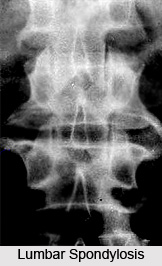 Lumbar spondylosis is a disease which affects an individual in the later life. The lumbar spine carries most of the weight of the body. When an individual reaches a ripe age the lumbar discs and associated ligaments undergo aging which result in the frequent narrowing of the disc spaces. Thickening of the ligaments that surround the disc and those that surround the facet joints develops. This ligamentous thickening eventually is calcified. Compromise of the spinal canal or of the openings through which the spinal nerves leave the spinal canal can occur.
Various Causes of Lumbar Spondylosis : The causes of lumbar spondylosis can be identified with a wide assortment of factors. The major factors that are held responsible for the development of lumbar spondylosis can be concluded as old age, obesity, prior injury, heredity and slippage of one vertebra on another.
The degenerative changes within the intervertebral discs are also the causes of lumbar spondylosis. In the body, the soft, elastic material dries out and loses height. Thickening of the ligaments that surround the disc occurs. In addition to that alterations of the alignment of the joints that connect the back of the spine are also seen. Other ligaments undergo further degenerative changes, thickening and potential chemical change. All these symptoms occur when an individual experiences old age. Lumbar spondylosis emerges to be a non-specific aging phenomenon.
As a person ages, the healing ability of the body decreases and developing arthritis at that time makes the disease progress faster. It is seen that persons reaching over 40 years of age are more prone to developing lumbar spondylosis.
Excessive weight also plays a foremost role in causing lumbar spondylosis. Overweight puts excess load on the joints as the lumbar region carries most of the body"s weight, making a person prone to lumbar spondylosis.
Other factors such as sitting in one position for prolonged time puts pressure on the lumbar vertebrae and highlight the risk of developing the disease.
Lumbar spondylosis can be treated in various ways. In addition to the appropriate diagnosis, it can also be by treated by Yogic Asanas such as Bhujangasana, Salabhasana as well as Surya Namaskara. Changing and improving one"s lifestyle such as doing regular exercise, giving up smoking, modifying work habits can also help. However, it is advisable to consult the doctor before following any particular regime.
Diagnosis of Lumbar Spondylosis
For the clinical diagnosis of lumbar spondylosis, a thorough investigation is necessary to ensure. A thorough physical test including tests like X-rays, CT scans, and blood and urine tests can help diagnose the problem.
Treatment of Lumbar Spondylosis
 The onset of the lumbar spondylosis is very slow and gradual. This disorder of the low back region of the body particularly generates no symptom. Thus, this complaint is hard to diagnose and provide effective treatment. However, spondylosis may lead to disabling hurtful pain, limited motion, and partial paralysis in affected areas of the body. If neglected for a longer period of time, it can become a severe problem and should be treated as soon as possible. Proper diagnosis leads to effective treatment of lumbar spondylosis. Lumbar Spondylosis can be treated through Ayurveda, naturopathy, homeopathy, yoga as well as meditation.
Treatment through Conventional Method : The most common treatment of lumbar spondylosis is by conventional method. Intake of nonsteroidal anti-inflammatory drugs (NSAIDs) can help in rectifying the ailment of spondylosis. Moreover, different surgical procedures are also employed to put right the difficulty of low back pain. Spinal deformity is removed through several methods including spinal decompression, instrumentation and bony fusion. Surgical decompression of the affected nerves is done to provide relief from leg pain and paralysis. However, these conservative ways are regarded to prevent the lumbar spondylosis for a short period of time. After undergoing these treatments and even after surgery, temporary relief of back pain is received. The patient is again seen to develop aching thigh and leg pains along with severe back pain, which restrict mobility of the individual. In addition to that, braces are also seen to provide relief to the patients. Post-operatively patient is given brace and gentle mobilization.
 Treatment through Alternative Systems : Treatment of lumbar spondylosis can be through other alternative systems such as physical modalities and also modifications. Alternative therapies such as chiropractic and acupuncture can be used to reduce pain. Physiotherapy also provides support to the degenerative spinal condition. As degenerative lumbar spine produce back pain and lumbar canal it contains the nerves and blood vessels. Stenosis produces thigh and leg pain due to venous stasis in the spine causing congestion of the nerve roots. The degenerative spinal level and posterior lumbar inter body fusion (PLIF), posterolateral inter transverse fusion with autologous bone graft provides good fusion.
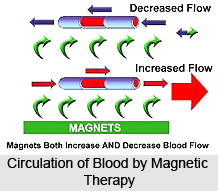
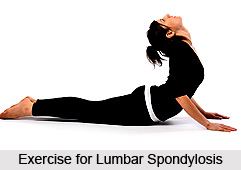 Treatment through Homeopathy and Yoga Asanas : Homeopathy has played an essential role in curing this musculoskeletal problem. Yoga is another essential means for the treatment of lumbar spondylosis. Yogic therapy reduces the lumbar spondylosis. When the lumbar spondylosis results in sciatica pain, the North Pole of the magnet should be applied to the most painful spot in the lumbar region and the South Pole to the terminal point of the pain. South Pole oil should also be used.
Treatment of lumbar spondylosis by yoga asanas also proves to be remedial measures. However, the asanas such as forward bending asanas should be avoided. The backward bending postures give quick relief. Asanas with backward bending like Bhujangasana, Shalabhasana, Dhanurasana, Supta Vajrasana, Gomukhasana, Ardha Matsyendrasana, Ushtrasana, Matsyasana and Chakrasana are helpful in this disease. Furthermore, long and deep inhalation and exhalation can be practised when the pain reduces. Surya Namaskara is another method of reducing the pain and curing lumbar spondylosis. Acupuncture/Acupressure is another alternative source of medication that treats the pain. The energy force or Chi is enlivened by Acupuncture. Acupuncture needles cause the body to release certain neurochemicals, such as endorphins or serotonin, and they help in the healing process.
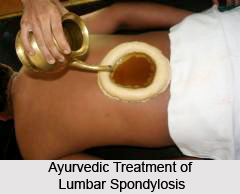
Ayurveda is the ancient Indian holistic medical science that deals with body, mind and soul in health and disease. It is based on the principles of Panch-Mahabhoota that includes space, air, fire, water and earth and Tri-Dosha that is the three biological humors- Vata, Pitta and Kapha theories. Through these aspects, Ayurveda prevents and cures diseases. Nadi shodhana and Ujjayi pranayama accompanied with exercises of back and waist described in Sukshma Vyayama can yield special benefit.
Treatment through Naturopathy : Treatment of lumbar spondylosis through naturopathy has provided beneficial result. In nature cure treatments, fomentation with Hot and Cold or Infra Red Lamp on the painful region gives advantage. Applying of Wet pack after giving local steam to the painful region also gives immediate relief. Hot and Cold Hip Bath, Steam Bath and Immersion bath are its specific treatment. Certain dietary changes such as fast therapy or juice therapy can also be helpful for this disorder. Other means of curing lumbar spondylosis includes use of thin mattress on hard bed is advised instead of using very thick mattress. Constant sitting for a longer period should be prevented in this disease. The back should be kept erect while sitting in a chair to avoid the disease to recur. Lumbar spondylosis can be treated with herbal remedies and supplements. As herbs are natural they offer relief to the affected area of the body.