 Considered as one of the most ancient Indian traditional sports, Kabaddi started its journey, almost 4,000 years ago. This is a team game that requires both skill and power on behalf of the players, and it also combines the characteristics of wrestling and rugby. Kabaddi in India has quite a long history that dates back to the pre-historic times.
Naming of Kabaddi
Kabaddi is also known as "Chedugudu" or "Hu-Tu-Tu" in southern parts of India, "Hadudu" (Men) and "Chu - Kit-Kit" (women) in eastern India, and as Kabaddi in northern India. The sport has earned a lot of popularity in the other Asian nations like Nepal, Bangladesh, Sri Lanka, Japan and Pakistan.
Legends Attached to Kabaddi
According to a legend, this game came into existence, when a boy hit another boy for his candy. The boy who was hit chased the boy who hit him, and hit him back and ran away. The feature of holding the breath while chasing, was added later when the game evolved. Kabaddi is the game, where one person play against seven people. Kabaddi is also known as the "Game of the Masses" and it has simple, easy to comprehend rules. The game of Kabaddi requires minimum equipment while having all the ingredients of thrill and excitement and audience appeal.
In India, Kabaddi is quite famous and popular in the state of Punjab. There is also a popular belief that the game has its roots in the way Abhimanyu was killed in Chakravyuha by the Kauravas. Kabaddi is a rather simple and inexpensive game, and it does not require a massive playing area, or any expensive equipment. There are also some other ancient scripts that refers to the existence of Kabaddi in India
Kabaddi is probably the only game of offence and defence in which attack is an individual attempt, while defence is a combined effort. The Tamil Language speaking people know the game in various names like Kabaddi, Sadugudu, Gudugudu, Palinjadugudu and Sadugoodatthi (Tamil). The word `Kabaddi` may have originated from the Tamil words kai (hand) and pidi (catch).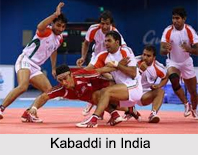
History of Kabaddi in India
During the period of its inception, Kabaddi was aimed at developing self-defense, in addition to respond to attack and reflexes of counter attack by individuals and by groups or teams. A dramatized version of the great Indian epic, the Mahabharata, has made an analogy of the game to a tough situation faced by Abhimanyu. The situation was that the heir of the Pandava kings, Abhimanyu was surrounded by his enemies on all sides and he tried to get out of their Chakravyuha.
There are also some other ancient scripts that refer to the existence of Kabaddi in India. In Mahabharata, Arjuna had a unique talent in the game of Kabaddi, as he was able to go inside the wall of enemies, destroy them all and come back unscathed. According to the Buddhist literature, Gautam Buddha used to play Kabaddi for recreation. Apart from those manuscripts, history also reveals that princes of yore loved playing Kabaddi and took the game as a means to display their strength and won their brides. With due course of time, the game earned a lot of popularity in the Southern Part of Asia.
 Modern Kabaddi in India
In modern times, Kabaddi in India attained National status in the year 1918. The state of Maharashtra is considered to be a pioneer for bringing the game to the National platform. The standard rules and regulations for Kabaddi were also formulated in 1918; however, the rules were brought out in print in the year 1923. An All India Tournament was also organized at Baroda following these rules, in 1923. Since then, the journey of Kabaddi in India has always been towards success and popularity; numerous tournaments are now organized all over India throughout the year. The game got international exposure for the time during the 1936 Berlin Olympic Games. The game was also introduced in the Indian Olympic Games at Calcutta, in 1938.
Formation of All India Kabaddi Federation
With a view for better management of Kabaddi, the All India Kabaddi Federation (AIKF) came into existence in 1950. The AIKF has been conducting National level championships according to the laid down rules and regulations, on a regular basis from the year 1952. The first men`s Nationals were held in Madras (now Chennai), after the formation of the Amateur Kabaddi Federation of India (AKFI) and the women`s Nationals were also held in Calcutta. Both the championships were held in the year 1955. During the National Championships at New Delhi in the year 1954, the rules and regulations of Kabaddi in India witnessed some modification.
Formation of Amateur Kabaddi Federation
The game of Kabaddi was included in the curriculum of the Indian University Sports Control Board (IUSCB) as a main sports discipline in the year 1961. Kabaddi in India got further recognition when the School Games Federation of India (SGFI) decided to include it in the school games, in 1962. This body is responsible for organizing state and national level competitions for school going children in various sports of India, on a regular basis. In the year 1971, the National Institute of Sports (NIS) included Kabaddi in the curriculum of Regular Diploma courses. The Amateur Kabaddi Federation came into existence in the next year, in 1972. This body was formed with a view to popularise the game in the neighboring countries and also to organize regular National level tournaments. The sub-junior and junior sections were included in Kabaddi national level tournaments, as a regular feature, only after the formation of this body.
Formation of Asian Amateur Kabaddi Federation
The Indian national men`s Kabaddi team started visiting the neighbouring countries with a view to further improve the status of Kabaddi in India. It toured Bangladesh in 1974, as part of the cultural exchange program to play five test matches in different parts of the country. The Bangladesh National men`s Kabaddi came for a return visit in the year 1979 and played five test matches in India. India played an important role in the formation of the Asian Amateur Kabaddi Federation (AAKF) in 1978. The AAKF was established during the silver jubilee celebrations of National Kabaddi Championships in India, held at Bhilai, Chhattisgarh. Kolkata was the venue for the first Asian Championship in Kabaddi in 1980. This helped a lot in further improving the entire scenario of Kabaddi in India.
Tournaments Played by Indian Kabaddi Teams
Kabaddi in India saw the introduction of Federation Cup Kabaddi matches in the year 1981. The game was included as a demonstration game in the IX Asian Games hosted by India in the year 1982. In 1984, India organised an open Inter-National tournament at Mumbai and an international invitation Kabaddi Tournament was also organized, during the Tri-centenary celebrations of the city of Calcutta. Kabaddi was included as a regular sports discipline by the South Asian Federation (SAF) from the year 1984. Being played in the SAF Games at Dhaka, Bangladesh for the first time, Kabaddi is being included in every SAF Games that is organised once in every two years.
The associations working for management of Kabaddi in India organised the second Asian Championship at Jaipur, Rajasthan. India was also instrumental in including Kabaddi in the main disciplines of the XI Asian Games held at Beijing, China in 1990. This was a major landmark in the history of Kabaddi in India, as India won the Gold Medal in this championship. India also won the Gold Medals in the succeeding Asian Games held in 1994 at Hiroshima, Japan and in the Asian Games held in 1998 at Bangkok in Thailand. India organised an International Women`s Kabaddi tournament, named the Nike Gold Cup, in 1995. India played an important role in introducing the game of Kabaddi to the African countries, while hosting a demonstration sport in the Afro-Asian Games, in 2002. India also successfully took part in the first World Kabaddi Championship held at Hamilton, Ontario, Canada. In 2014, Pro Kabaddi League has been introduced in India. First tournament has been played in 26th July 2014.
Kabaddi World Cup in India
Kabaddi in India touched another milestone in 2004, when India hosted the first ever Kabaddi World Cup, in Mumbai. India became the winner of the World Cup, as well. India has produced a number of talented Kabaddi players, so far, who have earned international recognition.
Renowned Kabaddi Players in India
Some of the outstanding players include Balwinder Phiddu, Shri Sadanand Mahadeo Shetty, Shakuntla Panghar Kholavakar, Shri Shantaram Jaatu, Kumari Monika Nath, Mamatha Poojary, Rambir Singh Sangwan, Hardeep Tauo Toganwalia Shermi Ulahannan, Janardan Singh Gehlot Balwinder Singh, Sandeep Kandola Shermi Ulahannan, Kumari Maya Kashi Nath, Rama Sarkar, Shri Sanjeev Kumar, Sunder Singh, Shri Ramesh Kumar, Pardeep Narwal, Manjeet Chillar, Anup Kumar, Sandeep Narwal, Nitin Tomar, Ajay Thakur etc.