
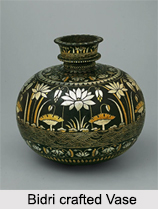
 India has a rich history in its culture where art and crafts are as diverse as its culture. All the crafts are segregated into each Indian state that reflects influence of variant ancient empires. Bidri is a form of Indian craft originated at Bidar in Karnataka. It is a beautiful amalgamation of various metals like zinc and copper containing pure qualities of both metals.
Origin of Bidri Craft
Exemplary of the traditional excellence, craftsmanship of Bidri is a legacy that started almost 2000 years ago. It was originated in Bidar under the attributions of the Bahmani Sultans who reined the lands of Bidar between 13th to 15th centuries. The styles and techniques of Bidri have an influence of Persian art. It had its recognition in India in the form of utensils by the noted Sufi Khwaja Moinuddin Hasan Chisti. It began to get developed in the Bahmani kingdom with an amalgamation of influences driven from Arabic, Persian and Turkish art with local styles.
 Abdullah bin Kaiser, an Iranian craftsman was invited by the Bahmani Sultan Ahmad Shah for working on decorating courts and royal palaces. As per some accounts, Kaiser collaborated with the local craftsman to work on Bidriware. Thus, the unique and charismatic craftsmanship of Bidri had its inception. It was a symbol of royalty and wealth back then. Although, it is still appreciated and considered a high form of intense craftsmanship around the globe.
Evolution of Bidri Craft
Bidri in India is essentially the formation of brass alloy comprising of zinc, copper, lead, tin and traces of iron. The usage of lustrous metals gives the created items of Bidri work a sheen that is predominantly the distinctiveness of this particular art form. This craft is practiced in India hugely and the creations are well appreciated worldwide for the stunning beauty of the items made from Bidri. While the artisans create silver designs on a metal ware, sometimes white silver is used to adorn the designs on black metal that give the items a proper ethnicity of the Bidri culture. This craft not only deals with metals but exclusive designs are made on cloth to accelerate this craft a pace further. The embroiderers attempted to create embroidery with the same effect of Bidri by creating silver embroidery on black cloth. The stitches and the elements needed for this embroidery work are same as Zardozi.
Types of Bidri Craft
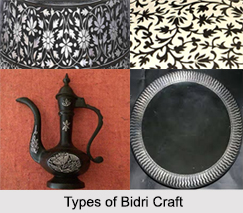
There are various types of Bidri craft that varies from one another. All of the types have their own charm authentically. They are:
•Teh Nashin: This includes a thick gold or silver inlay into deep engravings on a surface of base metal. This happens to be the most common type of early bidri and practised still now. It is done against black background and the designs are flushed on the surface irrespective of any relief. There are mostly floral patterns which are engraved on surface of metal ware and inlaid with silver after that.
•Aftabi: This includes silver inlay on background while all the designs tend to appear in black. It requires high skills and consumes a lot of time. This uses silver sheets instead of wires that covers up large spaces of background compared to the wires.
•Tarkashi: This is solely plain wire work. The grooves needed for designs are made on surface. Thick silver wires are needed according to the designs. It is then inlaid on black surface. It is commonly recognized as phooljhadi work.
•Zar Nashin or Zar Buland: This refers inlaying with high or low relief. Silver is inlaid on a lead pad so that patterns stand up from the surface like 3D.
 Specimen of Bidri Craft
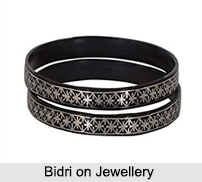
The crafts of Bidri have various specimens like textiles, utensils, showpieces and so on. The Bidri patterns are embroidered into fabrics and ornaments like necklaces and earrings. Lamp shades, wall plates, wine decanter, hookah are some common specimen in Bidriwares.
Bidri Craftsmen
The first person to win national award for Bidri craft was Syed Tassaduq Hussain in 1969. Followed by that, other notable artists like Abdul Hakeem, Shah Majeed Quadri, etc have won national awards too. Shah Rasheed Ahmed Quadri offered live demonstration of Bidri art on Republic day in the year 2011. The Indian Government has awarded him with Shilpguru award in 2015.
Contemporary Bidri Craft
The Bidri art in India has gained its recognition as the Government has formulated several new policies to boast up the artistic production of the traditional industries. The market scenario defines that Bidri work has a great market possibility in India as well as in the other sectors of the world as far as the craftsmanship is concerned. The artistic pieces of Bidri work are popular amongst the tourists.
Bidri in India
Bidri is an age old famous handicraft from Bidar, Karnataka. It is rich in artistic appeal and has an aesthetically crafted charisma.