
The vttaraga visayam va cittatn sutra explains about the nobility of the luminous individuals who have been successful in achieving the state of absolute self-realisation and oneness with Almighty. If a sadhaka is victorious in contemplating over one`s state of mind, he can attain transcendentalism. Likewise, the individual must also ponder over every stage of yogic practice, to keep the conscience free from any kind of craving, or worldly yearnings.
Vita devoid of, free from
Raga desire, passion, love, affection
Visayam an object
va or
cittam consciousness
Or, by contemplating on enlightened sages who are free from desires and attachments, calm and tranquil, or by contemplating divine objects.
Vyasa, Suka, Sankara, Ramanuja, Madhva, Vallabha, Chaitanya, Sri Aurobindo, Ramana Maharsi and Sri Ramakrishna, are examples of men of enlightenment. If the sadhaka ponders on the serene, pure state of such divine souls and follows their practices, he earns confidence, achieves firmness and develops a desireless state of mind.
Similarly, one can also contemplate each stage of an asana or each movement of breath in order to bring the citta to a state of desirelessness. If consciousness is kept free from desire, it becomes chaste. Mere withdrawal from the world does not in itself achieve this aim.
Vttaraga visayam va cittatn
This is the thirty-seventh yogic sutra which is contained in the Patanjali Yoga Sutras.
Recently updated articles in Yoga
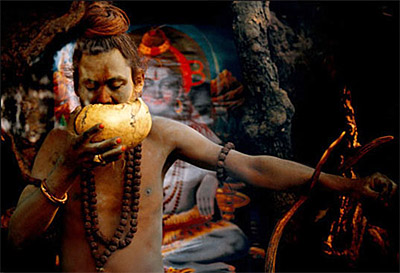
Khanda Manda Yoga
Khanda Manda Yoga is a difficult form of yoga where the Yogi cuts off his own arms and legs with a sharp cleaver, that is axe-like knife, and throws t...
Kaivalya Pada
Kaivalya Pada, the fourth chapter of Patanjali Yoga Sutra denotes an absolute, indivisible state of existence of the Yogi. The Kaivalya Pada is someti...
Vibhuti Pada
Vibhuti is the Sanskrit term for “power” or “manifestation.” In this third chapter, Patanjali introduces the final three limbs of Aṣṭanga Yoga, collec...
Sadhana Pada
Sadhana Pada in Patanjali Yoga Sutra denotes the idea of practicing yoga that leads to spiritual illumination. Sadhana, the Sanskrit term for “practic...
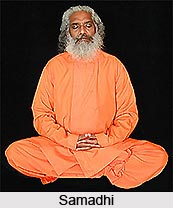
Samadhi Pada
Samadhi Pada is the first chapter of Patanjali Yoga Sutra. In this chapter, the author explains the essence of yoga, the nature of samadhi, and the me...
Related articles in Yoga
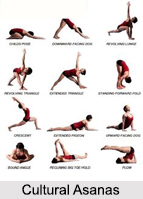
Cultural Asanas
Cultural Asanas refer to the daily physical exercise postures that train the body and mind in Yoga Practice.
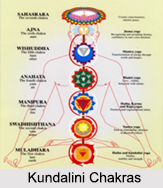
Kundalini Chakras
Kundalini Chakras are psychic energy centres or vortices, which connect between our psychic and physical energy systems.
Patanjali Yoga Sutras
Patanjali’s Yoga Sutras presents a foundational guide to the philosophy and practice of yoga. Through concise aphorisms, it outlines the nature of the...
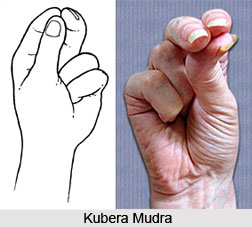
Kubera Mudra
Kubera Mudra, a form of Hatha Yoga, leads to the elevation of mental peace and physical relief by proper practice and cleanses frontal sinuses.