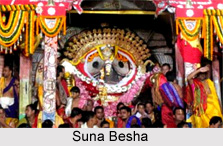
 Suna Besha is a golden attire of Lord Jagannath. Suna Besha is observed five times in a year. Suna Besha is commonly observed on Pausa Purnima, which is in the month of December. Others are Dola Purnima, Bahuda Ekadashi, < b>Karthik Purnima and Dasahara.
The last Besha is observed during Rath Yatra on the chariot in front of Jaganatha Temple after returning from Gundicha Temple, other four Besha are observed inside temple on Ratna Singhasana. There, Lord Jagannatha was held with the gold.
•On 10th bright day of the month of Aswmin (October) on Bijayadasami
•On 12th bright day of the month of Asadha (July) on the return of the Lord to the temple after the famous Rath Yatra.
•On full moon day of the Kartika (November) the deities are decorated with gold ornaments inside the temple.
•On the full moon day of Falguna (March) the deities also decorated with gold ornaments known Suna Besha.
On the day of Bada Ekadasi, the 11th day of the bright fortnight in Asadha, the deities, on their chariots took the golden attire or the suna besa. Suna Besha has been observed since 1232. During the reign of Anaga Vima Dev the king of Utkal, Sri Jagannath declared as State God. The Gods are decorated with various gold ornaments during Suna Besha. The total weight of the golden ornaments is more than two quintal or 208 kilograms.
According to the history of Jagannatha Temple, Suna Besha was introduced during the era of King Kapilendra Deb in 1460 A.D.
Suna Besha is generally associated with the returning of the lord and his companions to the temple from his Aunt"s home after the Car festival.
Suna Besha is on the 11th day of the bright fortnight of Ashadha (June-July), this adornment takes place in the respective chariots of the Lord, his brother and sister near the Singhawar. All the three deities are bejewelled with gold ornaments and the Lord Jagannath and Balabhadra appear with hands and feet made of gold. While Lord Jagannath holds a gold Chakra (disc) in his right hand and a silver conch in the left hand, Lord Balabhadra appears holding a gold plough in the left hand and a gold mace in the right hand.
One of the popular adornments of the Lord, the Suna Besha is witnessed by millions of people. Apart from the above mentioned occasion of "Home Return" of the Lord, the Gold adornment of the Lord Jagannath of Puri is also done on festivals like Dashahara, Kartika Purnima and Pausa Purnima.