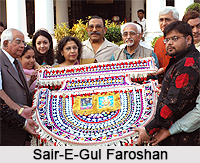
 Sair-E-Gul Faroshan, also known as Phoolwalon Ki Sair, is a three-day festival symbolizing communal harmony in Delhi. This is comparatively a recent festival, started by the Mughal Emperor, Muhammad Shah Rangila, about 150 years back. The festival was stopped by the British in 1942 but was again revived in 1962.
The origins behind the Phool Walon-ki-Sair Festival are quite old. The festival came to be celebrated when the grieving queen of Akbar Shah II took a vow. She pledged that if her son, who was exiled to Allahabad by the British, was allowed to return to Delhi, she would make an offering of a four-poster flowerbed at the holy shrine of Khwaja Bakhtiyar Kaki at Mehrauli. When the British finally relented, the queen carried out her promise by creating an exquisite flower canopy. The local flower sellers added an intricate flower Pankha at their own cost, which was then carried in a huge procession to the saint`s tomb. From then, the tradition to take the procession at both the dargah as well as the nearby shrine of Devi Jog Maya has evolved. Floral tributes are offered at these two sacred sites during the festival.
Practically everyone in Mehrauli (a suburb of Delhi) observes this festival. Muslims come from distant lands on pilgrimage to Kaki`s Tomb. Kaki or Qutub sahib earned the sobriquet Kaki because during his long hours of meditation, he sometimes forgot to eat and had to be fed with cakes-kaki. People still tie coloured strings to the trelliswork to beg favours of the saint. On his death anniversary, qawwalis are sung and the poor are fed. The cultural programmes take place at Jahaz Mahal built by the Lodhis on the banks of Shamsi Talab at the end of the Mehrauli Bazar. Behind Adham Khan`s (Emperor Akbar`s foster brother) tomb, stands the temple of Jog Maya. Nothing remains of this temple except the name and the stone idol.
Village boys entertain visitors by jumping into an adjoining bauli from seemingly dizzy heights. Kathak is performed on the streets. Fire dancers also perform on the streets during the procession and add a mystic allure to the proceedings. A huge procession, led by fire dancers, takes the flower pankhas through the streets of Mehrauli. The huge pankhas are made of palm leaves, decorated with tinsel and flowers. They move towards the two holy places. There is all-pervading ambience of fun and merriment.