 Lhabab Dhuechen also called "Buddha Sakyamuni`s Descent Day" is one of the most auspicious days for the Bhutanese. According to Tibetan tradition, it is one of the four Buddhist festivals commemorating four events in the life of the Buddha. The other three are Losar Festival, Saga Dawa Festival and Chokor Duchen. Lhabab Dhuechen festival symbolizes the Descent of Buddha from the heaven of the thirty three Gods after visiting his mother. `Dhuechen` means festival, `Lha` means heaven and `Bab` means descent.
Mythology of Lhabab Dhuechen
Legend says that Queen Maha Maya, the mother of Lord Buddha, did not live long after his birth and took rebirth in Trayastrimsa or the heaven of the thirty Gods. After attaining Enlightenment, Lord Buddha came to know about the whereabouts of his mother through spiritual powers and at the age of forty-one ascended to the heavens along with thousands of his followers. Lord Buddha stayed in heaven for three months during which he delivered sermons to his mother and other celestial beings. Lord Buddha had left one of his disciples behind on earth. The name of the disciple was Maudgalyayana and he was his representative. This disciple and other devotees of the Lord could not bear the long separation and longed to hear his preaching. Maudgalyayana, who possessed miraculous powers, was exhorted to go up to the heaven to request the Lord to return back to the earth. The Gods were not willing to let Lord Buddha return back to earth but Maudgalyayana suggested that as the earthly beings did not have the powers to visit heaven, the celestial beings could come to the earth to attend his preaching. Lord Buddha finally relented and descended to the earth at a place called Sankasya along a triple ladder that was prepared by Viswakarma, the God of Machines.
Celebration of Lhabab Dhuechen
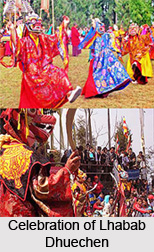
It falls on the 22nd day of the ninth month on a Tibetan calendar. The festival of Lhabab Dhuechen is celebrated with great vigour and enthusiasm. Ladders are painted afresh on rocks around many monasteries and butter lamps are offered to symbolize the event. It is believed that on this day, the effects of positive or negative actions are multiplied ten million times. It is a significant part of Tibetan Buddhist tradition to engage in virtuous activities.