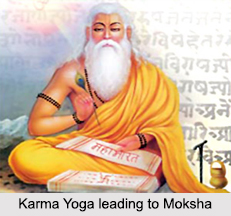
 Karmanye Badhikarosthe Maa Foleshu Kodachano, Maa Karmofolohetu Bhurmate, Sangohosto Kormoni"
To work relentlessly without the least expectation of anything is the central idea of Karma Yoga, which different Yogis and great souls in order to make life beautiful have addressed a number of times. "Karma Yoga is the dedication of all actions and their fruits unto the Lord". Quite ideally therefore Karma Yoga is identified as the "performance of actions dwelling in union with the Divine", while offing connection and remaining balanced even in the course of failure and success. Karma Yoga is therefore the selfless service to humanity. The Yoga of action, Karma Yoga thus purifies the heart and prepares the Antahkarana for the greater purpose of receiving that divine light.
Bhagavad Gita, affirms that the path of action or the `karma yoga` is one of the doctrines of the Gita, through which Nirvana can be attained. This path of `Moksha` supports the performance of actions with balance-mind. It is considered to be the `golden-mean` amid attitudes of `pravritti` and `nivritti` (action and withdrawal). This path can be followed by only those people who are beyond `faint- heartedness` (hridaya-daurbalyam).
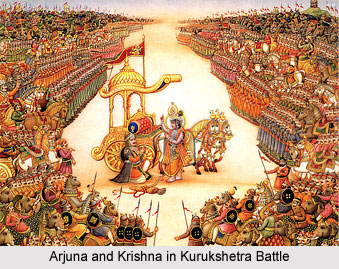
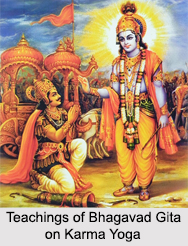
However, the overriding fact, the basis of Bhagavad Gita and its philosophical discourses had its roots in Mahabharata, the great epic poem by Ved Vyas. The fact can never be ignored that it was Lord Krishna instructing Arjuna, the mighty warrior of archery, on despondency and dejection. Arjuna had in the initiation of battle of Kurukshetra, completely turned a confused child, suffering from dichotomy whether to fight his friends as foes or not. His questions barraged his charioteer Krishna, who in turn took up the task to enlighten Arjuna on perfect knowledge, enlisted in various sections and verses. The following portion is concerned with the path of action, Karma Yoga in Bhagavad Gita. Arjuna questioned his Lord that if wisdom is above action, why is Krishna advising him to engage in such a horrendous fight. Krishna`s language was perplexing Arjuna and confusing his every reason. Therefore, he pleaded to tell him the only way by which Arjuna might, without doubt, secure his spiritual welfare.
Lord Shri Krishna then replied that in this world, there resides a twofold path. There is the one, a Path of Wisdom for those who are engrossed in meditation and then there is the second, a Path of Action for those who are engrossed in work. "No man can attain freedom from activity by refraining from action; nor can he reach perfection by merely refusing to act." One cannot even for a moment remain actually inactive, because the Qualities of Nature will compel him to act whether he wishes to or not. One who remains motionless, refusing to act, but all the while pondering over sensuous objects that deluded soul is merely a pretender.
Yet, Krishna warns Arjuna through the Karma Yoga, path of action, not to become intimidated, because, one whose mind controls his senses, he is showered with honours; because, he is thereby embarking on to practise Karma-Yoga, the Path of Right Action, keeping himself always unattached. Bhagavad Gita instructs one to perform one`s duty as prescribed; "for action for duty`s sake is superior to inaction". Even merely sustaining of the body would become unimaginable if man remained inactive. In the physical world people are enchained by action, unless it is performed as a sacrifice. Hence, Krishna advises Arjuna to let his acts be done without attachment, as an action of sacrifice only.
In the beginning, when God created everything by sacrificing Himself, He said to them: "Through sacrifice you can procreate, and it shall satisfy all your desires. Worship the Powers of Nature thereby, and let them nourish you in return; thus supporting each other, you shall attain your highest welfare. For, fed on sacrifice, Nature will give you all the enjoyment you can desire. But he who enjoys what she gives without returning is, indeed, a robber." A sage who enjoys the food that remains after the sacrifice has been made, is freed from all sin; but the selfish who spreads his feast only for himself feeds on sin only.
Bhagavad Gita`s Karma Yoga, or path of action speaks that every creature is the product of food, food is the product of rain, rain comes by sacrifice and sacrifice is the noblest form of action. Every action originates within the Supreme Spirit, which is Imperishable and in sacrificial action the all-pervading Spirit is consciously present. Hence, he who does not assist in the revolving wheel of sacrifice, but instead leads a sinful life, rejoicing in the satiation of his senses, breathes in vain. On the other hand, the soul who meditates on the Self, is happy to serve the Self and rests gratified within the Self; there remains nothing more for him to achieve. He has nothing to benefit by the performance or non-performance of action. His welfare depends not on any contribution that an earthly creature can make. Hence, it is Lord Krishna`s solemn advice that one performs one`s duty perfectly, without caring much for the end-results; because, he who does his duty disinterestedly, attains the Supreme. Even for the sake of enlightening the world, it is one`s duty to always act. Whatever a great man does, others imitate. People conform to the standard which he has set.
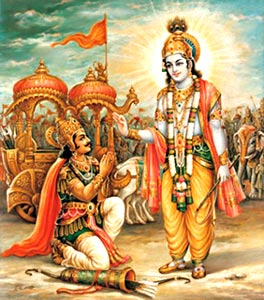 Krishna continues to preach Arjuna that there is nothing in this universe that Krishna is compelled to do; nor anything for Him to achieve. And, yet He is persistently active. If Krishna were not to act without ceasing, people would gladly repeat to do the same. And if the Lord were to refrain from action, human race would be utterly ruined. He would be primary to lead the world to chaos and destruction would come after. According to Karma Yoga, the path of action in Bhagavad Gita, as an ignorant acts solely of his fondness for action, so should the wise act without such attachment, fixing their eyes, only on the welfare of the world. But a wise man should not distract the minds of the ignorant, who are attached to action; Krishna advices to let him perform his own actions in the right spirit, with concentration upon Him, thus inspiring everybody else to do the same. "Action is the product of the Qualities inherent in Nature." It is only the ignorant man who, misguided by personal egotism, states: "I am the doer." But he who comprehends correctly the relation of the Qualities with action, is not attached to the act, because he perceives that it is barely the action and reaction of the Qualities among themselves.
Lord Krishna implicates through his path of action, or Karma Yoga that those who do not understand the Qualities are interested in the act. Still, the wise man who cognises the truth, should not agitate the mind of him who does not. Thus, coming back to Arjuna`s context in Bhagavad Gita, Krishna urges him to fight back. This truthful action can only be possible when Arjuna safely surrenders his actions to Krishna, concentrating his thoughts on the Absolute, free from selfishness and without anticipating any reward, with mind devoid of excitement. Those who always act in accordance with Krishna`s principles, firm in faith and without quibbling, they too are freed from the bondage of action. But they who mock at His words and do not keep it, are ignorant, devoid of wisdom and blind. They seek but their own destruction. Even the wise man acts in lineament with his nature; indeed, every creature acts according to his or her nature. In such an instance, there can be no use of compulsion. Love and hate which are enkindled by the objects of sense, arise from Nature; Krishna sternly debars Arjuna not yield to them. They only obstruct the path.
Karma Yoga, Bhagavad Gita`s path of action states that it is better to perform one`s own duty, however lacking in merit, than to perform that of another`s, even though capably. It is better to die doing one`s own duty, for, to do the duty of someone else`s is fraught with danger. Arjuna enquired at this point from his Lord to explain to him, "what is it that drives a man to sin, even against his will and as if by compulsion?" Lord Shri Krishna laid down his able reply that it is primarily desire, it is aversion, born of passion, leading one to sin against his own will. Desire devours and corrupts everything it touches in its path. It is man`s greatest enemy. As fire is shrouded in smoke, a mirror by dust and a child by mother`s womb, so is the universe enwrapped in desire. It is the wise man`s perpetual enemy; it defiles the face of wisdom. It is as voracious as a flame of fire. Desire cuts through the senses, the mind and the reason; and with their help destroys wisdom and befuddles the soul. Thus, Krishna warns Arjuna to first control his own senses and then slay his own desire; for it is full of sin and is the destroyer of knowledge and wisdom.
Karma Yoga, or path of action speaks that the senses are always all-powerful. But beyond the senses is the mind, beyond mind is intellect and beyond and greater than intellect is He. Thus, addressing Arjuna as `Mighty-In-Arms`, Krishna says that knowing Him to be beyond the intellect and, by His help, curbing one`s personal egotism, he can kill his enemy, Desire. The path to this is although extremely difficult.
 There are several religious duties laid down by the sacred texts. The