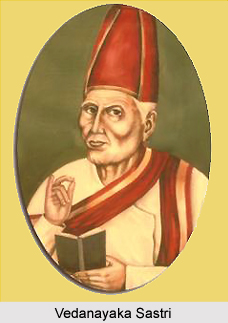
About Vedanayaka Sastri
Vedanayaka Sastri was a famous Tamil Poet from Tanjore. Born in Tirunelveli in 1774 as the son of Devasahayam Pillai, a Catholic of Shaiva Vellala background, Vedanayaka Sastri initially received schooling in the traditional Tamil manner in Puliyangudi in the Tirunelveli district. In 1785, after Devasahayam Pillai converted to the Evangelical Protestantism propagated by the Halle missionaries, the eleven-year old boy was sent to Tanjore with the celebrated German Protestant missionary Christian Friedrich Schwartz. Following instruction on a personal basis with Schwartz, Sastri attended the missionary school in Tanjore. In 1789 he was sent to the theological seminary for Indian catechists at Tranquebar, where he studied theology, astronomy, anatomy and mathematics with C.S. John and other German missionaries. In 1794, at the age of nineteen, he was appointed to the head mastership of the Tamil seminary Schwartz had established in Tanjavur for training Indian catechists. There Sastri taught mathematics and astronomy, and trained catechists.
Sastri spent the major portion of his life in the city of Tanjore in the seventeenth and eighteenth centuries, under the rule of the Telugu Nayakas and the western Indian Marathas, Tanjore was an important cultural centre and the site of a great flowering of literature, drama, dance, music and other arts. The literature that was developing in Tanjore at this point in time highlighted the heterogeneous world of South India in the eighteenth century, a time of heightened social and cultural changes inspired by encounters among peoples of various ethnicities, including Europeans.
Vedanayaka Sastri`s career as a literary figure was shaped by his unique position in the development of the Tamil Protestant church in Tanjore at an important time in its history. Although he was a major agent of the Halle missionaries in the dissemination of European learning and was familiar with English, he mostly devoted his time to to writing, performing and expounding original Tamil works. While he wrote several prose tracts and pamphlets in Tamil, and even a Tamil textbook of arithmetic, his major works were in poetic, literary and musical genres. These included short poems which put together doctrinal material for the use of catechists, religious poetry for children to recite, poems for Tamil Evangelical festivals and family occasions, and more than 500 devotional hymns. The hymns were written mainly for use in personal worship, but some of them were composed in the Raagas (melodic type) and Talas (beat pattern) of classical South Indian Carnatic music. In several of his works he incorporated material and ideas from European scientific systems, especially mathematics, astronomy, geography, anatomy and natural history. Congregations of that time greatly appreciated the poet`s public performances of his works.
The range and originality of Vedanayaka Sastri`s writings were remarkable by any standard. It is for his achievement as a poet that Sastri was celebrated in his own time and continues to be remembered in Tamil literary history.
Works of Vedanayaka Sastri
Works of Vedanayaka Sastri appeared in print only towards the mid-nineteenth century. The first that is heard of his published works is in 1853, when the American missionary E. Webb published a collection of original Tamil hymns, crediting Sastri with the authorship of most of the hymns. It appears that Sastri`s hymns were transmitted mainly through hand-copied manuscripts and an oral performance tradition. Sastri`s longer works, too, were published at irregular intervals, mostly after 1850, and under a number of sponsorships, including the SPCK Tract Society, the Madras Religious Tract Society, and individual Tamil Evangelical patrons. For instance, the poem Nanavula, written in 1835, was not published till 1885, and in a letter of 1862 Sastri thanks a `Police Commissioner Yesudasa Pillai of Tandalaiyarpet, Madras, for undertaking to publish the first part of Jepamalai the liturgical song-collection.
During the poet`s lifetime, he and his sons, his daughter, and singers and accompanists performed the longer works in public musical-discourses. After his death, the sons and grandchildren carried on the tradition of such performances. Over time, Sastri`s hymns re-entered the church and today they continue to be sung by Tamil Protestants in church and in personal devotions, while his major poems are noticed in histories of Tamil literature.
The majority of the nearly thirty-five titles among Sastri`s writings that are likely to have been prose works are controversial tracts. Some of these are records of debates with Muslim, Hindu and Catholic theologians and scholars and others are original prose arguments written in the contexts of particular controversies. It has been noted that the prose of religious debate and controversy was developed and put to new uses in the Indian regional languages in the colonial context, in the mid-to-late nineteenth century. Sastri was one of the intellectuals who participated in this transformation of a traditional model. The poet`s prose writings were the ones that were printed early on, and repeatedly, by the missionary presses. For example, Kuruttuvali (The Blind Way), a work attributed to Sastri and the American missionary Miron Winslow, criticising important aspects of Tamil Shaiva doctrine and practice, was published by the American Missionary Society; it underwent thirteen printings between 1833 and 1866,and was widely disseminated in the Tamil region. Sastri`s best known controversial writings against Hindu and Catholic practices and doctrines were actually poetic works such as Castirakkummi.
At the end of the eighteenth century, Sastri was a forerunner of the new generation of Western-educated Indian intellectuals who would contribute to Tamil India`s transition to modernity. His writings show that he had tremendous confidence in his talents as a Tamil poet and intellectual. Vedanayaka Sastri wrote in nearly all of the major traditional and contemporary literary genres, and he always tried to differentiate between Tamil Protestant poetry and the works of `worldly` poets. Sastri included in his works not only `religious` material but also a good amount of material on social issues and new knowledge systems. Thus, through his poems Sastri managed to build a vision of the Tamil Protestant religion, with its new ideas and teachings that were emerging in South Indian society.
Hymns and Bhakti Devotional Poetry of Vedanayaka Sastri
Hymns and Bhakti Devotional Poetry of Vedanayaka Sastri were among his most prolific works. During his time, in nineteenth-century Tamil Nadu, expressions of such devotion through songs and hymns were a common feature shared by Hinduism and other religions. This system had been established in the Tamil region in the sixth and seventh centuries, with the hymns of the Nayanmars and the Alvars, the poet-leaders of the Shaiva and Vaishnava bhakti movements. By the last quarter of the eighteenth century, when Sastri was growing up in Tanjore, Tamil Protestants sang mainly German hymns in Tamil translation, in European melodies, from the Fabricius Hymn Book. This was a compilation of J.P. Fabricius that included several of his own translations. When Sastri began to compose his original hymns and songs for the Church, they were received positively by the missionaries who continued to be open to Tamil poetry and to Tamil singing styles.
Though Vedanayaka Sastri had great reverence and admiration for the German texts in translation that had been formative in his Pietist education, he went on to compose a large number of new Tamil hymns for the Evangelical church. A major reason for these compositions was the need that he and the other Tamil members of the church felt for a body of original Tamil songs with which to praise God and express their devotion to Him. Tamil hymns had to be original poems, preferably songs, composed in Tamil meters, genres, melodies and beat-patterns. The hymn translations of Fabricius and other missionaries were not true Tamil poems in the above sense. Sastri`s hymns fulfilled the prosodic and stylistic requirements of Tamil verse, including etukai and monai (forms of alliteration and rhyme), ornate description, and the patterned placement of words in each segment. They were true Tamil songs, since they were set to Tamil (Carnatic) Raagas and Talas.
The Tamil Protestants referred to the European hymns in translation by the term Nanappatal (hymn of Wisdom), a modification of the traditional terms for `hymn` (Patikam, Pattu) in the Hindu Bhakti traditions. Sastri`s new creations, however, were called Nanakkirttanai or Nanapatak Kirttanai (Kirttanais of Wisdom). The majority of Sastri`s hymns were composed not in older Bhakti hymn styles, but in the Kirttanai genre, a new eighteenth-century song form developed and perfected in Tanjore. The range of the Kirttanai was broader than that of the traditional hymn. Kirttanais usually contained devotional themes and simple lyrics which made them easily understandable to the common and uneducated people. They ranged in musical complexity and difficulty from those that could be performed only by classically trained professional musicians (Vidvan), to others that could be sung in a simple, often congregational (bhajana) style. In Sastri`s hands the Kirttanai became the standard form of the Tamil Protestant hymn.
Vedanayaka Sastri as an Evangelical devotional poet was greatly influenced by the Tamil ideal of the Bhakti poet. The Shaiva Bhakti poets composed not only the words of their hymns but their melodies and rhythmic patterns as well. Vedanayaka Sastri found the ideal of the Bhakti poet perfectly compatible with the Biblical and Evangelical ideal of the poet of divine song. For the forms and themes of his Tamil Protestant hymns, Sastri drew mainly on Shaiva Bhakti genres. These were conventions with which the poet was most familiar because of the Shaiva Vellala background that he shared with a large number of the Tamil Evangelical congregations. Sastri used stylistic elements from the major Shaiva poets, including Manikkavacakar, Tayumanavar and Arunakirinatar, renowned mystics, each of whom is well-known for achievements in a different aspect of poetic composition. He included his own name and made autobiographical references in the final, `signature` verses of his poem. In doing this, Sastri followed the standard practice of older Tamil Bhakti poets.
Though Vedanayaka Sastri had great reverence and admiration for the German texts in translation that had been formative in his Pietist education, he went on to compose a large number of new Tamil hymns for the Evangelical church. A major reason for these compositions was the need that he and the other Tamil members of the church felt for a body of original Tamil songs with which to praise God and express their devotion to Him. Tamil hymns had to be original poems, preferably songs, composed in Tamil meters, genres, melodies and beat-patterns. The hymn translations of Fabricius and other missionaries were not true Tamil poems in the above sense. Sastri`s hymns fulfilled the prosodic and stylistic requirements of Tamil verse, including etukai and monai (forms of alliteration and rhyme), ornate description, and the patterned placement of words in each segment. They were true Tamil songs, since they were set to Tamil (Carnatic) Raagas and Talas.
The Tamil Protestants referred to the European hymns in translation by the term Nanappatal (hymn of Wisdom), a modification of the traditional terms for `hymn` (Patikam, Pattu) in the Hindu Bhakti traditions. Sastri`s new creations, however, were called Nanakkirttanai or Nanapatak Kirttanai (Kirttanais of Wisdom). The majority of Sastri`s hymns were composed not in older Bhakti hymn styles, but in the Kirttanai genre, a new eighteenth-century song form developed and perfected in Tanjore. The range of the Kirttanai was broader than that of the traditional hymn. Kirttanais usually contained devotional themes and simple lyrics which made them easily understandable to the common and uneducated people. They ranged in musical complexity and difficulty from those that could be performed only by classically trained professional musicians (Vidvan), to others that could be sung in a simple, often congregational (bhajana) style. In Sastri`s hands the Kirttanai became the standard form of the Tamil Protestant hymn.
Vedanayaka Sastri as an Evangelical devotional poet was greatly influenced by the Tamil ideal of the Bhakti poet. The Shaiva Bhakti poets composed not only the words of their hymns but their melodies and rhythmic patterns as well. Vedanayaka Sastri found the ideal of the Bhakti poet perfectly compatible with the Biblical and Evangelical ideal of the poet of divine song. For the forms and themes of his Tamil Protestant hymns, Sastri drew mainly on Shaiva Bhakti genres. These were conventions with which the poet was most familiar because of the Shaiva Vellala background that he shared with a large number of the Tamil Evangelical congregations. Sastri used stylistic elements from the major Shaiva poets, including Manikkavacakar, Tayumanavar and Arunakirinatar, renowned mystics, each of whom is well-known for achievements in a different aspect of poetic composition. He included his own name and made autobiographical references in the final, `signature` verses of his poem. In doing this, Sastri followed the standard practice of older Tamil Bhakti poets.