
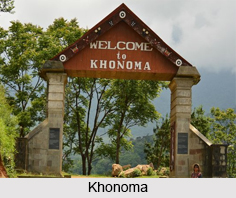
 An Angami Naga village, Khonoma is known to be the first ever green village in India. Estimated to be almost 700 years old, the village of Khonoma spreads over an area of 123 sq. km. With a hilly terrain that ranges from gentle slopes to steep, Khonoma has rugged hillsides. The hills are covered with lush forestland, rich in various species of flora and fauna. The state bird, Blyth"s tragopan, a pheasant now nationally endangered is found here.
Khonoma
The village of Khonoma in the north eastern state of Nagaland is known to be the first ever green village in the country.
About Khonoma village
An Angami Naga village, Khonoma is known to be the first ever green village in India. Estimated to be almost 700 years old, the village of Khonoma spreads over an area of 123 sq. km. With a hilly terrain that ranges from gentle slopes to steep, Khonoma has rugged hillsides. The hills are covered with lush forestland, rich in various species of flora and fauna. The state bird, Blyth"s tragopan, a pheasant now nationally endangered is found here.Demographics of Khonoma
The medium sized village of Khonoma is located in the Kohima district of the state of Nagaland. As per the reports of Census India 2011, the total population of the village is 1943 out which the females are more than males at a number of 1024 to 919 respectively. There are a total of 424 households and the village is divided into three thinous or clan, namely Merhuma (M-Khel), Semoma (S-Khel) and Thevoma (T-Khel).
Compared to Nagaland, the village of Khonoma has a higher literacy rate of 83.41 percent to the state average of 79.55 percent. In Khonoma, the male literacy stands at 93.72 percent, while female literacy rate was 74 percent. As per constitution of India and Panchyati Raaj Act, Khonoma village is administrated by Sarpanch or the head of village, who is elected representative of village.
Compared to Nagaland, the village of Khonoma has a higher literacy rate of 83.41 percent to the state average of 79.55 percent. In Khonoma, the male literacy stands at 93.72 percent, while female literacy rate was 74 percent. As per constitution of India and Panchyati Raaj Act, Khonoma village is administrated by Sarpanch or the head of village, who is elected representative of village.
Festivals of Khonoma
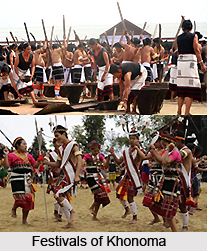 Festivals are part and parcel in the lives of the people of Khonoma, Nagaland. It is the time when people take respite from mundane activities and bask in the fun of vivacity of these festivals. Some of the main festivals of Khonoma are enlisted below:
Terhunyi (harvest festival)
Observed in the month of Rude (December), Terhunyi marks the commencement of a series of festivals in tandem. At the time of this festival, harvest crops of the year are brought out and gratitude offerings are made to the almighty seeking blessings for good harvests. Since they have worked hand in hand, it is also the time to thank each other. Generally, celebration goes on throughout the full lunar month. Sometimes it is also feted for ½ of the lunar month. The date of commencement of this festival is decided after consulting with one another.
Special rites are performed during Terhunyi. On the 1st day of this festival, all married females bring meat and rice brewage to their paternal homes and also to their brothers. In return they are provided with the same food. 3rd day is the time when the first-born child of a married woman is given his or her share of meat known as nou noupfi. The food is cooked by the parents of the woman and is consumed by the man"s relatives.
Sekrenyi (festival of sanctification)
Sekrenyi is observed just after Terhunyi. It is one of the significant festivals of Khonoma that is held on the following month of January or Doshi. February is the time to celebrate Sekrenyi. It is the festival that sanctifies men. The entire community is imbued into the tempo of the festival celebration. The people of Khonoma fete this festival to possess good fortune, and to acquire blessings in the lives of the people. In the bygone era, the festival continued for 10 long days. Nowadays, it has been curtailed and is celebrated for six days only.
Sutsiakru
This is a festival associated with sowing the millet crop when people observe `genna` with no or restricted activity. A common assumption is that no unfortunate incident should occur on this day. If any such thing happens, the whole festival stands cancelled. Some other day is then fixed for its celebration.
Ngonyi
Being held in the month of April, it marks the successful completion of sowing season. It is one of the unique festivals of Khonoma when people take respite from the hardcore agricultural activities. Although no special rites are observed, during this festival people rightfully show their gratitude to the deities. Feasting, hunting, fishing, collecting insects and crabs also form a part of this festival.
Thekranyi
This is a festival celebrated by the youths. Thekranyi festival begins with ritualistic clearing of paths by the villagers. Moreover in the evening they go and clean the burials of their close relatives. In the following day, in the early morning the ancestral worship known as Kijie is observed in and around the dwellings and graveyards.
Sunyi
Sunyi is another significant festival when ancestors and deceased family members are remembered and also paid homage by the descendants.
Liekhwenyi
Liekhwenyi is a festival for children especially the girl child. Numerous rites are feted in order to protect and preserve the crops. This rite is known as Piaketho. Another day is observed as Lieru for preventing the ripened grain from being destroyed.
Suliede
This is an important rite since no crop harvesting can proceed without observing Suliede. In the morning, an aged woman goes to the field to cut millet thereby commencing the beginning of harvesting season.
Recently updated articles in States of India
Bandare Waterfalls, Meghalaya
Bandare Waterfalls in South Garo Hills, Meghalaya, is a secluded natural attraction surrounded by dense subtropical forests and rugged mountain terrai...
History of Thissur District
Early History of Thissur District explains flourishing of the port cities. Now these port cities are transformed into archaeological sites.
Tippi Orchid Research Centre, Arunachal Pradesh
Tippi Orchid Research Centre in Arunachal Pradesh is renowned for its rich collection of exotic and endangered orchids. Surrounded by lush rainforest...
Tourism in Nashik District
Pilgrimage tourism in Nashik district involves visiting the various places of Hindu and Jain worship located here. Some of the holiest sites for Hind...
Mangadu, Kerala
Mangadu in Kerala’s Kollam district is a significant megalithic site known for its urn burials, cist burials, menhirs, and stone circles. Excavations...
Related articles in States of India
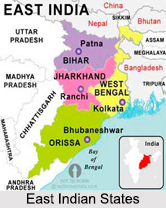
East Indian States
East Indian States comprises of Bihar, Jharkhand, West Bengal, Odisha and also the Union Territory of Andaman and Nicobar Islands. It defines the cult...
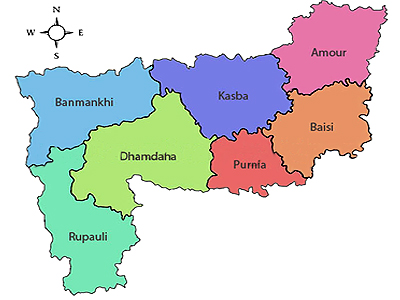
Purnia District in Bihar
Purnia District is located in Bihar and extends from River Ganga to Nepal. The district has a rich Hindu history and glorious past.
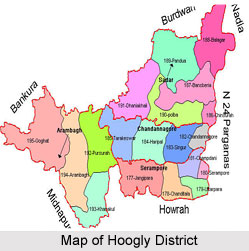
Hooghly district
Hooghly District along the bank of the river Hooghly is one of the principal trading ports of West Bengal.
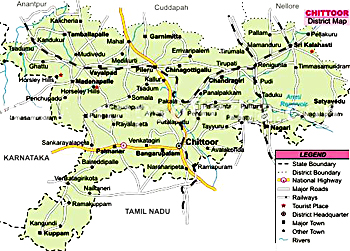
Geography Of Chittoor District
Geography of Chittoor district is spread along the topography of the land which is divided into two natural divisions; Chittoor has a dry and healthy...
Districts of West Bihar
Districts of West Bihar is comprised of medieval monuments that were built by the different governors of Mughal era.