
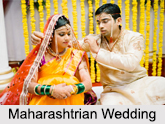
 Maharashtrian Weddings are elaborate and charming affairs with light moments. The people of Maharashtra believe in the equal bondage of love and dedication between both the husband and wife. Maharashtrian wedding is one of the simplest and least fussy ceremonies in India with most of the rituals performed early morning.
Maharashtrian Wedding
Maharashtrian Weddings are filled with rituals that are quite simple yet vibrant. They are one of the most simple and unfussy in the whole country.
Introduction
Maharashtrian Weddings are elaborate and charming affairs with light moments. The people of Maharashtra believe in the equal bondage of love and dedication between both the husband and wife. Maharashtrian wedding is one of the simplest and least fussy ceremonies in India with most of the rituals performed early morning.Pre Wedding Rituals of Maharashtrian Wedding
 There are several colorful and interesting pre-wedding rituals that take place in a Maharashtrian wedding. Some of the prominent and important rituals of Maharashtrian wedding are given below -
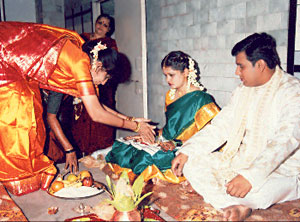
Sakhar Puda: Sakharpuda is basically an engagement ceremony that takes place a few days before the wedding. For this ceremony, the groom`s parents give the bride a saree as a token of her acceptance in their family. Her arms are adorned with green glass bangles, symbolizing her engagement. She is then given a packet of sakhar puda or sugar, which symbolizes the spreading of sweetness in their lives. Invitation cards are conventionally printed after this ceremony. The factual meaning of Sakhar Puda is a packet of sugar that is exchanged between the two families.
Kelvan: A couple of days before the wedding, a feast is arranged called the Kelvan, is organized in both the bride`s as well as the bridegroom`s home for the complete family gathered in that home. A puja of the Kuladevta or the family deity is also performed in the evening before the wedding.
Haldi: Haldi is yet another custom special to Maharashtrian. The bridegroom and the bride have their own celebrations in their individual homes. Women from each of the families get together to apply a mixture of turmeric, sandalwood and cream to the face and body of the bridegroom and the bride. The soon-to-be bride and the groom then take a ceremonial bath in their individual homes and are not permitted to go out of the home after this ceremony.
 Chuda: Chuda is a ceremony specially done for the bride and her women friends to share the fun of wearing bright and sparkling green bangles. Green glass bangles are considered propitious because green is the color of new life, creativity, everlasting relationship and rejuvenation. A bangle man is invited to the home and each woman chooses her own, amidst songs, laughter and jokes. The bride is given the green glass bangles ceremonially and with her mother`s help, she wears them mixed together with gold, pearl or diamond bangles as according to the status of the family. The bride can remove the chuda only one month after the wedding. Married women adorn themselves with such chudas on all festive or religious occasions.
Mangalsutra: Five married woman come with a copper vessel and mango leaves that are weaved together over a coconut and filled with holy water go round the place arranged with neem twigs from left to right five times. The bride is sitting in the center while this ritual is being performed. Then these ladies pour the holy water, which is a symbol of driving away evil spirits. After the bath is given to the bride her maternal uncle comes, breaks the neem twigs, and asks the bride to leave and enter the house.
Antarpat Ceremony: Antarpat is actually a silk shawl that is used to separate the bride and the groom till the actual moment of their marriage. Her mama brings the bride to the venue. The Bride is also accompanied by two of her sisters carrying an oil wick lamp and a kalash full of water, decorated with mango leaves with a coconut sitting high on the top. After the lavish meal, the boy goes centre-stage for the antarpat accompanies by all of his sisters carrying an oil wick lamp and a kalash filled with water, festooned with mango leaves with a coconut placed atop. The bride looks westwards and the groom faces towards the east.
The boy and girl hold a heavily decorated garland throughout the ceremony. This ritual is a set of eight series of mantras, with invocations to almost all Gods and Goddesses. After each series is over the priest recites: "Shubha Mangala Saavadhaan!"
The guests throw rice on the bride and the groom. This is for the first time that the bride and the groom see each other. They exchange the garlands. The sisters dip their fingers into the kalash and wipe the eyes of the bride and groom.
Maharashtrian Post Wedding Rituals
 The post wedding rituals of maharashtrian people is different from other states of India. The following are the steps involved in the Post Wedding Rituals:
Manpan: The families of both exchange gifts in this ceremony.
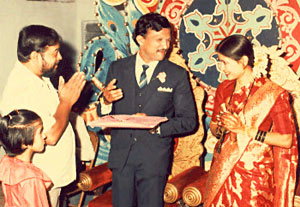
Reception: The bride wears shalu - jari brocaded silk sari and jewellery presented to her from the groom`s family while the groom wears clothes gifted by the bride`s family. A feast is organized for the guests where all give wishes to the couple along with gifts and bless them.
Varat: Here the bride bids goodbye to her family. The groom picks up the silver idol of parvati that is still sitting on gaurihar. The couple touches the feet of elders then sit in their vehicle in a vehicle and the procession, with a band and fireworks, goes to the groom`s place.
Grihpravesh: The couple comes to the doorstep and the groom`s mother does aarti of the couple. The bride topples a measuring vessel filled with rice. It signifies that the bride will bring luck and prosperity, which will flow in the house like the rice flowing out of the toppled vessel. The couple sits and the groom places the silver idol of Parvati that he carried and places it in a plate of rice and writes the bride`s new name. The groom`s mother sits between the couple and sees the bride`s face in the mirror - this is called soonmukh baghane. The couple gives sugar to all present and they have to take names in verses several times.
Tond Dhune: Tond dhune, the bride`s mother gives a sari and a jewellery piece usually made of pearl to the groom`s mother along with a tea set on the next day after the wedding.
Vyahi Bhet: Vyahi bhet, bride`s father gives a gift made of silver to the groom`s father.
Halad Utaravane: Next day morning, five suvasinis do the same as halad chadhavane but in reverse order. This is to signify that now the couple is free to go out. The groom mother unties Kankan - halkund tied on the couple`s hand.
Tikhati Mejwani: Among non-vegetarian Maharashtrians, a non-vegeterian feast is organized at both the families separately for the close relatives within a day or two.
Maharashtrian Wedding Ceremony
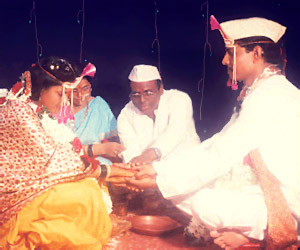 The actual marriage ceremony starts with a muhurta patra that is set up to measure and maintain the time before the auspicious moment of the marriage. Drop by drop, the water trickles down counts the seconds while the bride, ready and dressed in a yellow or green sari and a half moon painted on her forehead for luck, worships Goddess Parvati, who is the goddess of marital bliss in an anteroom until she is asked to come onto to the dais.
The venue is decorated with flowers and a havan is prepared. The priest sits on the north direction of the altar, the bride sits on his right and groom sits on his left. As the propitious time for the wedding approaches, the brides` mother brings her to the mandap. The approach to the mandap is indeed an intricate one as they bride and the groom are not permitted to see each other again.
Seemaan Pooja: After the grooms` procession arrives at the bride`s place, a seemaan pooja is performed. This is when the bride`s parents wash the feet of the groom and his parents and conventionally welcome the folks of his family. The groom is given gifts by the parents of the bride. These usually include ring, watch, gold chain and others.
Sannkalp: The groom shows his wish to enter a life of a householder. The priest thus blesses him and ensures that his desire will be fulfilled. The bride and the groom ask for the blessing and consent of the elders to marry, which is granted and they are gifted with clothes, jewellery etc. The parents of the either parties greet each other and they are given madhuparka, which is a kind of fruit salad with honey, yogurt, ghee and milk.
Kanyadaan: The bride`s father offers her hand in the hands of the groom. The mother of the bride pours water into the palms of the couple. This is a symbol that the father of the bride has offered his daughter to the Groom. The groom then holds the right shoulder of the bride in the gesture of acceptance. The groom then assures the bride`s father that he will be truthful and will take care of his wife for the rest of his life.
Mangalsutra Bandhan: The groom ties the mangalsutra around the neck of the bride. Mangal sutra is a necklace made up of golden pendant and black beads with alternative gold ones. This is believed to be a married woman`s most precious possession. The groom then applies kumkum on the forehead of the bride and she in turn applies a tilak made of sandalwood paste on the forehead of her husband. The grooms mother gifts the bride a silk sari, along with toe rings etc. The bride then comes back to the mandap after changing in to the new sari as an acceptance into her in-laws household.
Vivah Homa: The priest lights the fire in the altar and a stone is kept facing the west, a pitcher filled with water to the northeast, four kusha or grass blades, are spread to the northern direction of the fire. On them two small metal bowls containing ghee is placed. One of these pitchers is to be filled with water and the other with ghee melted in the fire. The priest then lights fire that is called yajoka. The groom then takes two darbhas, dips them into the bowl of water, and sprinkles them over the ghee and around the fire. This is a purifying sign. Then he offers the pavitrika of the darbhas to the fire in the name of Skanda, the heroic deity. He takes the jug of ghee and pours a portion into the fire as surrendering to Prajapati, the God of creation.
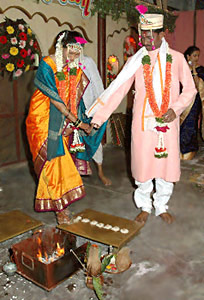 Satpadhi: This is the ritual where the two walk together the seven steps. The groom takes the left hand of the bride in his right hand and they take seven steps together in the southeast direction. A heap of rice is kept at every step and the couple step on this heap at every step. The ritual is symbolic of their married life and is an exchange of vows between them. At the end of the ritual the groom chants mantras to forgive him for any flaws in the conduct of the homa.
Praneetapatra is a large container of water known, as is taken around the fire in an anti clockwise direction, after which the water is sprinkled in all direction and also on the heads of the bride and the groom. The seven steps across the sacred fire is the most common ritual in all Hindu marriages.
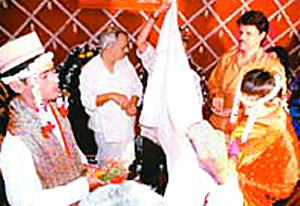
Marriage Ceremony: At long last, the swastik-marked antarpat or the white cloth is held up between the couple. Her maternal uncle brings the bride to the dais and the mangalashtakas or the eight blessings are chanted. When the recitation is over, the cloth is removed amidst a crescendo of shehnais and the bride and groom exchange garlands called varmalas. This is also the `darshan` of a bride and groom for the first time as man and wife. At the time of removing the Antarpaat, the people attending the wedding shower the couple with Akshata or unbroken rice. It is essential that the grains should be whole, as they are symbolic of the blessing from the attendees. The couple garlands each other. Alike most Hindu marriages seven rounds around the havan are called the Saptapadi.
Laxmi Narayan Puja: One of the most significant events after the marriage is Laxmi Narayan Puja. The bride and the bridegroom are considered to be Goddess Laxmi and Lord Narayan respectively and worshipped. After this ceremony the bride is properly handed over by her parents to the bridegroom in a ceremony called kanyadaan.
Karmasamapti: This ritual indicates the conclusion of the ceremony. The bride`s father is the one who concludes the marriage ceremony. He takes water from his left hand and passes it over to his right hand, chanting a mantra, which appeases the Gods, so that they shower blessings on the wedding of his daughter. The bride and the groom ask God to bless their marriage.
Grihapravesh: The groom`s mother welcomes the couple. She washes the couple`s feet with milk and then water. After the aarti is performed, the bride enters the house by kicking a glass of rice. The couple enters the house putting their right foot forward. The family sits and talks for sometime after which the couple is shown their room.
Costumes of Maharashtrian Weddings
The Maharashtrian Wedding attire is as usual gorgeous and eye catching as the wedding dresses in other communities. The bride wears a conventional Maharashtrian green coloured Paithani saree with the typical Maharashtrian seven pearl studs and green bangles, considered to be very fortunate for any function. The bride wears toe rings, nose ring and a bright bindi.
A Marathi groom generally dressed in a Dhoti-Kurta with a piece of decorated red and gold cloth across his right shoulder. This decorated cloth is tied together with the bride"s saree Pallu when the couple takes the seven rounds around the sacred fire to strengthen their matrimonial bond.
A Marathi groom generally dressed in a Dhoti-Kurta with a piece of decorated red and gold cloth across his right shoulder. This decorated cloth is tied together with the bride"s saree Pallu when the couple takes the seven rounds around the sacred fire to strengthen their matrimonial bond.
Recently updated articles in Weddings in India

Iron pillar of Delhi
The iron pillar of Delhi is a structure 7.21 metres (23 feet 8 inches) high with a 41-centimetre (16 in) diameter that was constructed by Chandragupta...
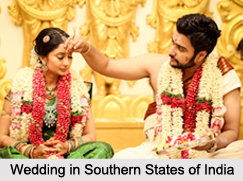
Wedding in Southern States of India
Wedding in Southern States of India depicts fun, revelry and extravagance along with following the basic tenets of the Hindu traditions.
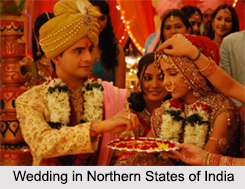
Wedding in Northern States of India
Wedding in Northern States of India includes many customs and rituals performed on the wedding day.

Koachitu Poorathu
Koachitu Poorathu is an Indian traditional form of sport. It is mostly played by the bride and the grooms during the time of marriage.
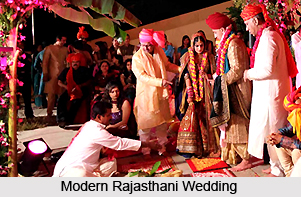
Modern Rajasthani Wedding
Modern Rajasthani wedding comprises vibrant celebrations and exquisite rituals which make the event greatly enjoyable. Dazzling and colourful decorati...
Related articles in Weddings in India
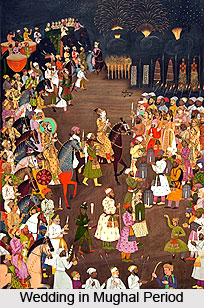
Wedding in Mughal Period
Wedding in Mughal period were a matter of pomp, show and extravagance of the interesting period of Indian History.
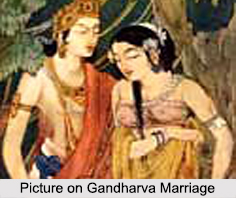
Gandharva Marriage
Gandharva marriage finds enough mention in Hindu mythologies and epics and involves exchange of garlands.

Prajapatya Marriage
Prajapatya marriage is a type of Hindu marriage which includes performance of religious duties jointly by a man and a woman.
History of Indian Wedding
History of Indian Wedding dates back to the 4th century. Several historical records say that marriage makes the society smoother to function.