Rituals of Barah Wafat
In 622 A.D. Mohammed along with his followers went to Medina. This flight from Mecca to Medina is known as Hijrah and marks the beginning of the Islamic era. By 630 AD, Islam came to be accepted as a religion and Muhammad as ruler by a large number of people. However, in 632 A.D. Muhammad led the pilgrimage to Mecca, preached his farewell sermon and died soon after.
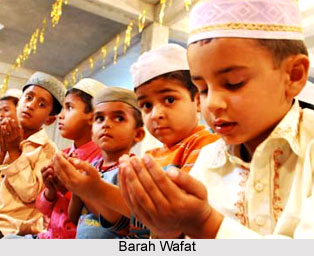 The name, Barah Wafat, indicates the twelve days of sickness of the Prophet, which ended in his death. On this day, there are no grand celebrations, as the birth and death anniversary of Prophet Mohammed coincidently falls on the same day. Hence, Muslims spend this period in spiritual activities. The Quran is recited for the twelve days of this festival. The stories of his birth and death and of miracles performed by him are narrated. In the evenings, people assemble and have sacramental meals along with porridge of rice cooked in milk and even the `Sayidut-Tam`; favourite dish of prophet is prepared. `Namaz`, prayer, is offered throughout the night. `Fatihah`, prayer, is read over food in the name of the Prophet. Sweetmeats are distributed and friends and relatives are invited to feasts.
In some mosques, a ceremony known as `Sandal Rite` ceremony is performed. The symbolic footprints of the Prophet engraved in a stone are worshipped. A representation of `Buraq` the horse on which Prophet Mohammed is said to have ascended to his heavenly abode is placed near the footprints and anointed with sandal paste or scented powder. Besides, the house and casket containing this are elaborately decorated. Hymns are sung and `Marsiya` or elegies are recited. Food is distributed to the poor. The twelfth day is the Urs proper, is observed quietly and is spent in prayer and alms-giving.