
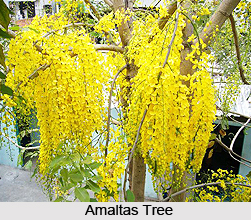
 Amaltas, known as the golden shower tree and by other names, is a flowering plant in the family "Fabaceae". Amaltas is a tree which is available with small or medium size. This tree is generally evergreen and it grows up to a height of 24 m. This species is a native to south-eastern parts of Asia. But today, this plant is widely distributed in the tropics where it is mainly cultivated for decorative purposes. It is also the state flower of Kerala in India and of immense importance amongst the Malayali population. It is a popular ornamental plant and is also used in herbal medicine. Found generally in all parts of India, it is cultivated in mixed deciduous forests and certain hilly tracts having an altitude of 1200 m in the outer Himalayan region. This tree is also commonly found in the central and southern parts of India and in the Gangetic valley.
Amaltas
Amaltas is one of the valuable medicinal trees in India found commonly in mixed-deciduous and hilly areas.
About Amaltas Plant
Amaltas, known as the golden shower tree and by other names, is a flowering plant in the family "Fabaceae". Amaltas is a tree which is available with small or medium size. This tree is generally evergreen and it grows up to a height of 24 m. This species is a native to south-eastern parts of Asia. But today, this plant is widely distributed in the tropics where it is mainly cultivated for decorative purposes. It is also the state flower of Kerala in India and of immense importance amongst the Malayali population. It is a popular ornamental plant and is also used in herbal medicine. Found generally in all parts of India, it is cultivated in mixed deciduous forests and certain hilly tracts having an altitude of 1200 m in the outer Himalayan region. This tree is also commonly found in the central and southern parts of India and in the Gangetic valley.Different Names of Amaltas
In English this Indian Medicinal Plant is known as "Golden Shower" or "Indian Laburnum"; in Hindi, it is referred to as "Amaltas"; in Sanskrit as "Aragvadha"; in Malayalam as "Vishu Konnai"; in Tamil it is known as "Arakkuvadam" or "Konrai" and so on. The botanical name of Amaltas is "Cassia Fistula" and it belongs to the Gulmohur family.
Characteristic Features of Amaltas
Amaltas is a medium-sized tree, growing to 10-20 m tall with fast growth. Amaltas tree possesses grey coloured smooth barks spreading out in some small, woody scales up to a thickness of 1.5 cm. The leaves of this tree is paripinnate, usually 20 to 40 cm in length, petioles and rachis are glandless, leaflets are 3 to 8 pairs, markedly stalked, 5 to 15 cm in length and 3.5 to 9 cm in width, ovate or oblong, peak acute, base acute to wedge shaped, dressed with silvery pubescence during the younger period. The flowers of Amaltas are bright yellow in colour, axillary, pendulous, many-flowered lax racemes of 10 to 40 cm in length; 5 sepals, pubescent, green, ovate or oblong-obtuse; 5 free corolla, short-clawed, sub-equal and reddish-veined petals. The fruits of this tree are black or dark brown in colour, having a pendulous or cylindrical shape and it is usually 25 to 30 cm long. The diameter of the fruit or pod is 1.5 to 3 cm in diameter. The seeds of Amaltas are smooth, flat, small, light brown in colour. There are around 40 to 100 seeds in a pod or fruit, set in a sweetish black pulp. Flowers in this tree bloom from the months of April till October and the fruits of this tree are ripe from the months of December till April as per the local environment.
Medicinal Values of Amaltas
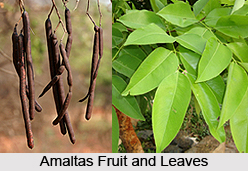 The dried pulp and pods of Amaltas are considered precious for their laxative properties. The bark and pods demonstrate antiviral activity. The extraction of the pods is prescribed for common fever and pneumonia. Swelled neck as a result of severe cold can be treated by applying heated pods. The pulp is regarded as a safe purgative, highly recommended for children and pregnant women to relieve liver upsets and biliousness. The same is also used externally for the treatment of rheumatism and gout, and it may also be safely used as an analgesic. It is also used for the treatment of black water fever, malaria, leprosy and diabetes. The slightly sweet seeds of Amaltas contain carminative, laxative, cooling and antipyretic properties. The seeds are used to give relief from constipation and for the treatment of jaundice, skin diseases, biliousness and swollen throat. Intestinal worms are cleared by the use of the powdered whole seeds of Amaltas. In Ayurvedic medicine, it is used for the treatment of diseases of the skin like leucoderma and eczema. The extraction or powder of the bark of Amaltas is prescribed for treating syphilis and heart disease. The powdered wood is reportedly used for dysentery and its ash is used as a caustic to promote healing of open abscesses.
The leaves possess laxative and anti-periodic, and are used in the treatment of piles, externally for skin eruptions, ulcers, wounds, prurigo and pruritis. However, a paste of the fresh leaves is used internally by central Orissa tribal women to cure amenorrhoea. In the north-eastern parts of the state of Karnataka, the roots of Amaltas mixed with goat milk are given in little doses regularly for the treatment of breast diseases. The aqueous extract of the bark of the root shows anti-inflammatory activity. The edible flowers of this tree possess astringent, febrifugal, purgative and anti-bilious properties.
Use of Amaltas as Medicines
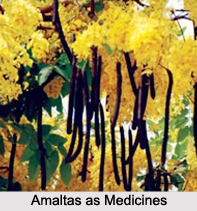 Cassia Fistula is commonly known as Amaltas. It is indigenous to India and is an old medicine of the Hindu Materia Medica. It is a popular ornamental plant and is an herbal medicine. The tree is uncommonly beautiful when in flower, few surpassing it in the elegance of its numerous long pendulous racemes of large bright yellow flowers, intermixed with the young lively green foliage. The tree is categorized into 3 types, namely:
•Cassia Sophora, in Sanskrit "Kasamarda"
•Cassia Tora, in Sanskrit "Chakramarda"
•Cassia Alata, in Sanskrit "Dadrughna"
Health Benefits of Amultas
Amaltas is known as a "disease killer". The pulp of the fruit is used as a mild cathartic. The root is also described as laxative and useful in fevers, heart diseases, retained excretions, biliousness etc. The root, leaves and seeds of Cassia fistula enter into the composition of numerous compound prescriptions. It is described as expectorant and useful in skin diseases, cough and hoarseness, but it does not appear to be much used in these diseases.
Dose of Amultas in Medicine
The compound decoction "Arogbadhadi" which passes by this name is a very commonly used purgative in native practice. To prepare it, take the pulp of Cassia fistula, Picrorrhiza Kurroa (katuki), chebulic myrobalans, long pepper root and the tubers of Cyperus rotundus (mustaka), about 64 grains each, water 32 tolas, and boil down to 8 tolas. Half of this quantity, or in strong constitutions the whole of it, is given for a dose.
The seeds of Cassia Sophora, Raplianus sativus (mulaka) and sulphur, in equal parts, are rubbed into a paste with water and applied to patches of pityriasis and psoriasis. The seeds of Cassia Tora are steeped in the milky juice of Euphorbia neriifolia and afterwards rubbed into a paste with cow"s urine for application to keloid tumours.
Dadrughna signifies as a curer of ringworm. Its leaves are used in this disease. Equal parts of the seeds of Cassia Tora and Pongamia glabra (karanja) with a fourth part of the root of Tinospora cordifolia (gulancha) are rubbed together into a paste and applied in ringworm.
Recently updated articles in Flora & Fauna
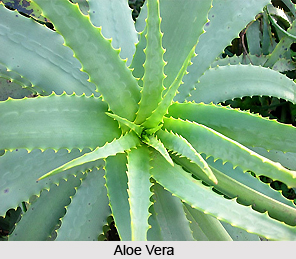
Indian Aloe Vera
Indian Aloe, growing to moderate heights, appears glossy, with pulpy leaves, essential in making drugs.
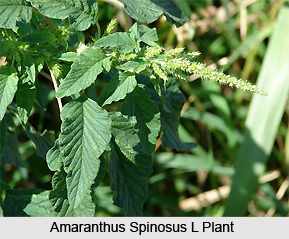
Amaranthus spinosus
Amaranthus spinosus is a medicinal herb found in India and is commonly known for its medicinal value.
Shilli Wildlife Sanctuary
Shilli Wildlife Sanctuary in Himachal Pradesh was established in 1963 in order to preserve the Himalayan Black Bear which is an endangered creature. D...
Flora and fauna of Karnataka
Karnataka boasts a remarkable diversity of flora and fauna, nurtured by its varied landscapes ranging from the Western Ghats to dry plains. The state’...

Vedanthangal Bird Sanctuary
Known to be the oldest water bird sanctuary in the country, Vedanthangal Bird Sanctuary is home to myriad types of migratory birds including 26 rare s...
Related articles in Flora & Fauna
Flora and Fauna of Ladakh
Flora and Fauna is typical to t he kind of mountainous terrain which dominate the entire landscape of the region. Though some varieties of fauna are t...

Flora and Fauna in Meghalaya
70 percent of Meghalaya is forested. Meghalayan forests are considered to be among the richest botanical habitats of Asia. These forests receive abund...
Flora and Fauna of Jammu & Kashmir
Jammu and Kashmir is rich in flora and fauna. Flora includes thorn bush type of the arid plain to the temperate and alpine flora of the higher altitud...
Flora and fauna in Andaman and Nicobar Islands
Economy of this region is primly based on agriculture. In Andaman island, paddy is the main food crop, while in Nicoabar island coconut and areca nut...
Flora and Fauna of Manipur
Flora and fauna of Manipur are known to be the assemblage of a huge variety including the endangered ones. The place is especially famed for orchid sp...