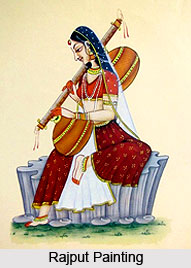
Abanindranath Tagore is regarded as the father of India`s modern art. He was born on 7th of August 1871. He is the leader of Renaissance movement of Indian Painting as he contributed a lot to the revival of ancient Indian art, specially the Moghul and Rajput style of art. He was also an eminent writer of Bengal and especially famous for his writings for children.
Early Life of Abanindranath Tagore
He was born in the famous and aristocratic family of the Tagores in Jorasanko in Kolkata. Abanindranath grew up in an environment of art, culture and creativity. He was the youngest son of Gunendranath Tagore and nephew of Rabindranath Tagore. His grandfather Girindranath Tagore and eldest brother Gaganendranath Tagore were also well-known painters. Abanindranath in his early life showed reluctance for formal academic studies. But he devoted himself to painting lessons by European artists along with his brothers Samarendranath and Gaganendranath. He studied at Sanskrit college from 1881 to 1890 and took lessons of art there. In 1889 Abanindra got married to Smt Suhasini Devi. After leaving Sanskrit college he was admitted as a special student of English in St. Xavier`s college that he continued for a year and a half. He started taking private lessons from an Italian artist Signor Gilhardi on cast drawing, foliage drawing, and pastel and life study when he was about twenty-five years of age. Later Abanindra attended the studio of Mr. Charles L. Palmer, an English painter for three-four years and attained sound proficiency in portrait and oil-painting.
Career of Abanindranath Tagore
Soon Abanindranath got famous for his talent with paintbrush and his own oeuvre came from discarding European Materialism and recovering Indian `Spiritualism` in his paintings. He had a particular interest in watercolour although he learned full range of techniques. He joined as the vice-principal at the Government College of Art at Calcutta and earned reputation from his unorthodox method of teaching. In this time Abanindranath painted a number of works on `Krishna` influenced by the Moghul-style. In the early 1890s Abanindra`s many illustration was published in Sadhana magazine as well as in Chitrangada and other works of Rabindranath. He had several International exhibitions among which London and Paris exhibition in 1913 and Japan exhibition in 1919 can be named. Most of his paintings (over 500) are now in the collection of Rabindra Bharati Society of Jorasanko, Calcutta and his works are declared as National Art Treasure.
 Abanindranath had embodied the high political feelings of the time in the form of Bharat Mata. A secular figure of a woman was painted like a Hindu deity. However, instead of the divine attributes, she carried in her four hands the emblems of the common man`s dreams-sheaves of corn representing freedom from hunger, a piece of cloth representing clothes for all, a manuscript for knowledge and rudraksha beads for spiritual experience. She has a halo behind her head and lotuses bloom at her feet.
Eventually, Abanindranath had evolved his own poetic style of painting full of fantasy and whimsy. He painted literary, historic and mythological themes. Among his early famous works, there is the memorable `The Last Moments of Shah Jahan`. Among his later works, the Arabian Nights series is wonderful. He also painted some landscapes. In his later years, he made small, whimsical sculptures with found objects like barks and twigs of trees and called them Katum Kutum. There is a small collection of these sculptures at the Santiniketan Museum.
Abanindranath Tagore made several radical changes during his stint in Government Art College from 1905 to 1915 like he made stencil cutting and origami compulsory for the students and replaced the European paintings on the school wall by Moghul and Rajput paintings. He established a department of fine arts where he invited the reputed artists from all over the India and gave his students the chance to meet them and exchange their ideas. In 1907 Tagore founded `The Bengal School` and `Indian School of Oriental Art`. His students were also very famous in their own arena and started the Revivalist movement in India.
In his own way Abanindranath started the pan-Asian art movement also as he was introduced to the Japanese style of art by great artist Okakura, who had influenced him by the Japanese landscape and calligraphic style of art. On the other hand Abanindra`s own sense of Indian spiritualism was reflected through his contribution to freedom movement as he helped in reviving smutted handloom clothes from Jessore and Pabna by acquiring them and bringing them to Swadeshi stores.
Abanindranath Tagore as a Writer
Abanindranath`s fame as painter will perhaps is rivalled by his reputation as a writer of children`s stories in Bengali. The wit and imagination of stories such as Kshirer Putul (Doll made of Khoya) or Raj Kahini (Tale of Kings) are still cherished by readers of Bengali. He is even more respected among artists and intellectuals for his essays on aesthetics that is theories and philosophy of art and its appreciation.