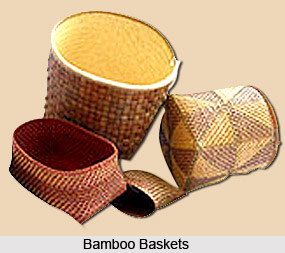
Baskets, of different shapes and structures, are prominent products used by the tribes of Manipur for varied purposes. An interesting custom among the tribal belts of Manipur is the practice of presenting a close weave conical basket as part of the dowry, when a daughter in the family gets married. It is a firm belief amongst the tribal folks that if a daughter is born, then the family must make a present of such baskets as dowry at the time of the girl"s marriage. Right at the time of birth of the girl child, the elders of the family prepare such a basket and store it upon the Lup, where it is exposed to steam and smoke for conditioning. Thus, the practice is still in vogue despite various social changes. If the elders in the family cannot make one, then they purchase it from the village craftsmen who make such baskets on demand. It becomes a natural duty for the elders of the family to weave or to purchase such number of baskets as corresponding to the number of unmarried girls in the family, and keep them in store for use later. The practice of keeping a conical basket stored for use at the time of a girl`s marriage is thus considered an integral aspect of the tribal custom, and, in a way, is more or less an evidence of the living tradition. Apart from this, the elders make small conical baskets for use by the kids in the family.
 Conical baskets are usually carried about by placing the straps, called Namlee, that are attached to the baskets, upon the head with the basket resting on the back. The normal posture of the person carrying such baskets is inclined at 45 degrees. To ease the task of carrying heavily laden baskets, the men folk use a shoulder-length wooden appliance called Lengkot, fixed to the Namlee. The Lengkot is placed horizontally on the nape of the neck, but is mainly borne by the shoulders. The womenfolk of the Moyon, the Monsang and the Lamgong tribes use cane Lengkots instead of wooden ones. Resembling the wooden Lengkots, the cane Lengkots feature a slightly curved shoulder-length stiff cane of big size, fixed to the Namlee. The Namlee on conical baskets are of two types: those fixed permanently on the baskets and those which are removable and replaceable with new ones. Some tribes like the Kom, the Vaiphei and the Haokip keep the conical baskets and the Namlee stored separately when not in use. The Namlee is fixed onto the basket only when needed for its use. To lesson the pressure of baskets on the back, the womenfolk of the Maram tribe use mats (54 cms x 26 cms) attached to the Namlee, placed in between the basket and the back. These mats are made up of dried plants called Shalem, found abundantly on the banks of Barak River. The Mao, the Maram and the Paomai tribes hold a great importance to Namlee and decorate it with exquisite designs and patterns. Corresponding to the differences in the structure of the conical baskets from one particular tribe to the other, the base of the conical baskets of each tribe differs accordingly. The difference ranges from the use of bamboo or dried vine, either of Uri or Chingthrao (Bauhinia vahlii) for the base to the use of bark of the Heirit plant (Ficus cunia) for the same. The Maram womenfolk employ a device, a thorn-like projection called Shou, by means of which the items kept inside the baskets are prevented from spilling out when the baskets get accidentally dropped on the ground or if they happen to overturn. The Shou are left projecting like thorns or hooks on the inner surface of the baskets in their weaving.
The carrying baskets with straps are usually hung like bags on the left or the right shoulder. Some carrying baskets with straps are carried in the same fashion as the conical baskets, i.e., hung on the back with the straps placed upon the head. The baskets normally hung on the shoulders are of an elongated, compressed type. The men folk of Andro village and the tribal men folk use such type of baskets in hunting, jungle trekking, field work etc. Andro men folk use a fishing basket called Sungtu, the height of which is 36 centimetres with the diameter of the mouth being 11 centimetres.
Womenfolk of Maram and Paomai tribes use baskets with straps, having circular mouths and square base for carrying things when going to paddy fields and markets. The baskets are short in stature. The basket used by the Paomais for fishing purpose is called Be, with height 13 centimetres and the mouth"s diameter 16 centimetres. Women of the Chiru Tribe use a small carrying basket with strap called Inbow, while going to work in the paddy fields. These baskets dangle from the waist. The two ends of the straps are fixed to the basket forming a sort of round belt. The person then fits himself in the belt, pulling it from the feet up to the waist where it is adjusted and tied as desired. These Inbows are basically used for keeping smoking pipes and tobacco. The Chiru tribe use a basket known as Pai for fishing, with the height of 35 centimetres and diameter of the mouth 20 centimetres.
The Maram Tribe uses a container basket called Rashakok, which is finely woven in the open weave type with thin bamboo splits. In December, they celebrate community festival in which banana leaves are spread out on these Rashakok baskets and the men folk eat rice served on the banana leaves. Each household has a minimum of 3 to 4 Rashakoks, as per the number of family members. It is an indispensable tradition for the Maram tribe to keep Rashakoks, if and when a new home is established. The Maram tribe also uses two types of fishing baskets, Kaijara, with 46 centimetres length and 85 centimetres circumference of the mouth, and Khoshii, with 21 centimetres height and 14 centimetres mouth diameter.
The Maring Tribe use a cane and bamboo basket which is generally used as a common dining table for the family, about 7 centimetres high. They use a fishing basket called Tik with a length of 25 centimetres and 11 centimetres diameter. Hulluk is a type of container vessel used by the Tangkhul Nagas of Manipur. Umbong is a loosely woven basket used by the Vaiphei tribe to carry a gourd containing rice beer. The Haokip tribe on the other hand uses a thickly woven basket made from cane for drinking rice beer.

The Moyon and the Monsang tribes use a particular container basket called Irang on which steamed rice is poured out, and unwanted ingredients like rice chaffs, weed seeds, tiny pebbles etc. are picked out. The form of the Irang is concave and it has a circular base which makes it possible to keep the basket firm without the least fear of tilting it. Irangs have two forms of weave, an outer weave and a surface weave. The Monsang tribe also uses a container basket called Baruk, which is sturdy, useful and decorative, in addition to a fishing basket called Butu, 25 centimetres high and 11 centimetres diameter.
The Yangkok baskets used in Manipur are generally made by the Koibu-Maring, the Ngarum-Maring and the Purum-Chothe tribes. The Tarao tribe also makes such baskets. There is an apparent difference between the Yangkoks made by the Marings from those of the Chothes, being the former has a drooping bottom whereas the later has a firm one. At the time of using the Yangkok, some people apply cow dung onto the bottom of the basket so that it becomes firm when it dries. It ensures a more efficient handling while winnowing rice chaffs. If it so happens that the dried cow dung fall off piece by piece after some time, the usual practice is to apply fresh cow dung and then dry it in the sun.
Rectangular baskets are used by the tribes of south Manipur for drying grains in the sun. In construction, the corners of these baskets are slightly elevated in a drooping fashion. Barring this, the rest of the rim is plain and when not in use, the basket can be rolled up and stored away.

 The Mao (constituting both Memis and Paomatas), the
  The Paomai Nagas too have their own specialised designs of storage baskets. Sushi Khaipii is a 30 centimetre high single weave basket used by them for storing chilli. It has a narrow mouth and bulges below. Bou is a type of basket used by the Paomai Nagas for grain storage. It is a sturdy basket woven with thick bamboo or
  The
The  The use of traps or Lu for catching fish in