 From the beginning of time, the ownership of great gemstones had been the privilege of royalty. Only royal people like kings and queens had the wealth to buy or the power to seize them. However, the monarchies and powerful financial tycoons were replaced with the rise of democracies as the buyers of expensive jewels. Later with the passage of time the collectors who were the frequent visitors at the auction became among the chosen few to possess those expensive gems
Many celebrated diamonds passed to the public displays of world-famous museums from the august private collections of individuals. Today, these museums are enthusiastic to spend millions of dollars on a single stone. The Shah diamond is considered as the representative of this latter trend.
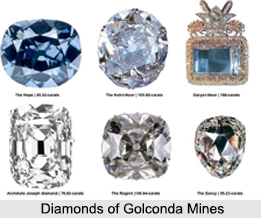
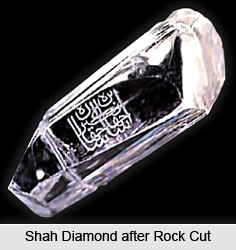
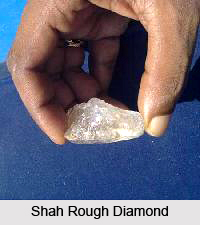 There left very few legendary gemstones of the world`s that have escaped being geometrically patterned by man. The Shah diamond, a substantial symbol of centuries of vicissitudes is not cut. However, after being polished in parts this Golconda gem has been reduced from its original weight of 95 carats to 88.70 carats.
The Shah diamond pale yellow in color, with its irregularly shaped has three smooth cleavage faces. But the fourth one that is faceted and it represents an early form of a Mughal style of cutting that triumphed in India. The Shah diamond has never been set in a jewel for personal ornamentation. The diamond is superbly fixed on the three cleavage faces and these three cleavages are associated with the names of the three rulers who owned it. The stories divulged through these inscriptions that have made the Shah a diamond of perpetual interest to historians and jewel lovers all over the world.
The year 1000 in the Muslim calendar is the first date on the stone i.e. 1591 in the English calendar. Along with this date the name of the king to be mentioned is Bourhan Nizam Shah II, the ruler of Ahmadnagar. The Mughal emperor Shahjahan invaded this kingdom, situated near Bijapur, in 1636.
With a fragile lettering reads, "Son of Jahangir Shah, jahan Shah 1051", the next date on the diamond inscribed is 1051 (1641). It can be implicit from this sequence of dates that when the Mughal emperor took possession of Bourhan II`s palace and wealth, the ice-sheer Shah cut down in the hands of his. The time when Aurangzeb succeeded Shah Jahan, the third of his four sons, the diamond passed on to him as a dynastic heirloom. In the year 1665, he was shown into the highly wrought court, when Jean-Baptiste Tavernier went to Aurangzeb`s palace to take leave of the emperor. He portrayed of what he saw in his reports: "On the side of the throne which is opposite the Court, there is to be seen a jewel consisting of a diamond of about HO to 90 carats weight, with rubies and emeralds around it, and when the King is seated he has this jewel in full view."
Perisan ruler Sultan Qajar Fath Ali Shah is the third name inscribed on the diamond, and the year is 1824. In 1739 when Nadir Shah the plundered Delhi, he carried away to Persia an unbelievable quantity of riches, including that of the Shah diamond. The diamond, which stayed in that country for nearly a century, passed from one ruler to the next.
During the year 1827, a kind of disparity arose between Persia and Russia, which resulted, into the declaration of war involving the two nations. Persia was strong with its compact troops would have marched bravely towards victory. But Fath Ali Shah was thrifty and made a wrong decision as he refused to pay his soldiers during the cold winter. The dejected troops made their way back home. Russia won the war in 1838, and pressurized Persia into signing the Treaty of Turkmanchai under the leadership of Alexander Sergeyevich Griboyedoff.
The Russian ambassador to Persia in recognition of his services appointed Griboyedoff during the war. But the Persians disliked him and opposed him volubly. A beginning event started when two girls of Russian-Armenian origin escaped from Ali Shah`s harem and sought the help of their nationals to return to their homeland. Griboyedoff offered them protection but the Persians were so annoyed with his interference and this deed was to cost him his life as they killed him.
Nervous and apologetic Fath Ali Shah, without delay sent a gift in order to pacify to the Russian ruler, Tsar Nicholas I. With that he wanted to avoid the chance of another battle. And the gift was the Shah diamond that made its way to St Petersburg.
In 1914, the diamond was taken from the Diamond Room in the White Palace at St Petersburg, and at the beginning of the First World War it was transported to Moscow for safekeeping. Today, the Russian Diamond Fund proudly possesses its ownership. The diamond became a part of the treasures of their fund and is on display at the Kremlin, which is its proud custodian. The pellucid Shah, with its scrupulous lettering, is possibly one of the most precious museum pieces in existence.