
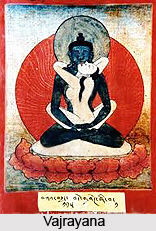
 Tantra in Buddhism was forged from a variety of metaphysical currents and religious practices within a particular socio-political context. The essence of Tantra is revealed in its etymology. In Buddhism a Tantric practitioner can cultivate an uninterrupted continuum between his ordinary initial mind, the advanced mind on the path and resultant fully enlightened mind of Lord Buddha.
Tantra in Buddhism
Tantra in Buddhism is an ancient practice in which there are many processes to attain Nirvana. All human beings are part of the same Universal energy according to Buddhist Tantrism.
Introduction
Tantra in Buddhism was forged from a variety of metaphysical currents and religious practices within a particular socio-political context. The essence of Tantra is revealed in its etymology. In Buddhism a Tantric practitioner can cultivate an uninterrupted continuum between his ordinary initial mind, the advanced mind on the path and resultant fully enlightened mind of Lord Buddha.Sources of Tantric Theory
Tantric theory shares much in common with the classical Indian systems. Its linguistic or metalinguistic speculations are based on those of Mimamsa. Its cosmology is modeled on the categories of Samkhya. Tantric metaphysics mostly of the non-dualistic, absolutistic type is Vedantic especially in case of Hindu Tantras and Mahayanist in case of Buddhist Tantras. Tantric theory is a jumble of ideas which includes the leading tenets of Buddhism.
Methods in Tantric Buddhism
The main Tantric practices in Buddhism can be summarized in the four purities like seeing one`s body in the body of deity, seeing one`s environment as the pure land or Mandala of the deity, perceiving one`s enjoyments as the bliss of the deity and considering as free from any attachment and performing one`s actions only for the benefits of the others
 The Tantric Buddhism has three methods - Guru Yoga, deity Yoga and death Yoga.
Guru Yoga: It is the Tantric devotional process where the practitioner unites their mind stream with the mind stream of the guru. The process of Guru Yoga often involves the visualization of a refuge tree as an invocation of the lineage.
Deity yoga: Deity yoga employs high-refined techniques of imagination and visualization in order to self identify with the divine form and sacred qualities of a particular deity as the union of skill and wisdom. The deity is represented as Murti, Tangka or Mandala. Visualization, invocation and evocation are important parts of Deity Yoga. Mandalas are sacred enclosures and uncontainable essence of a Yidam.
Death Yoga: It is another important aspect of Tantra techniques. The death Yoga is practiced during the life. It is the meditative practice that helps to prepare the practitioner for what they need to do at the time of their death. At the time of death the mind is in a clear state that can achieve enlightenment, when used very skillfully. During the time of death, rebirth and in between state the mind is in a very subtle state and an advanced practitioner can use these natural states to make significant progress in the spiritual path.
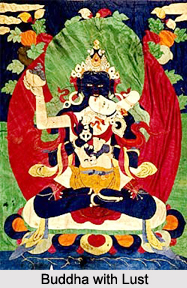
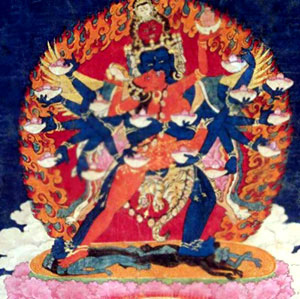
Love and Passion are important part of Tantric Buddhism. Buddhist iconographers use sexual polarity to symbolize the twin concepts of insight and compassion. All goddesses are the symbols of the insight and the gods represent the compassion. This union is represented visually by showing two deities in the sexual congress. In Sanskrit such images are called Yuganaddha. This sexual metaphor is also used to denote the highest stage of Yoga in which everything is free from polarity or any discrimination. The Buddhist couples of Tantric iconography celebrate the deep harmony of sexes, which ultimately devoted to the realization of the ultimate truth.
Gods of the Hindu pantheon are not recognised in Buddhist Tantra. It does not mention about Shakti and Shaktism. The Buddhists have Upaya and Prajna. The Buddhists advocate Sunyata. As far as goal and ways to achieve it are concerned it has similarities to Hindu Tantra. Mantra, guru and Mandala are recognised in Buddhist Tantra too. It is claimed that names of Hindu deities which end or begin with Vajra owe their origin to Buddhist Tantra. Buddhist Tantra recognised Puranic deities as Ganesha and Sarasvati. Buddhist Tantra does not emphasise the cult of Mother Goddess as in Hindu Tantra. However it recognises her. Guhyasamajatantra and Manjusri-mulkalpa are the Buddhist Tantras which date back to a period earlier than 650 A.D. Some amazing powers like transformation of a dragon into an insect, crossing rivers on foot are attributed to the Buddha in some works. Literary evidences are pointed out to show that the Buddha was influenced by Tantric ideas.
The Tantric Buddhism has three methods - Guru Yoga, deity Yoga and death Yoga.
Guru Yoga: It is the Tantric devotional process where the practitioner unites their mind stream with the mind stream of the guru. The process of Guru Yoga often involves the visualization of a refuge tree as an invocation of the lineage.
Deity yoga: Deity yoga employs high-refined techniques of imagination and visualization in order to self identify with the divine form and sacred qualities of a particular deity as the union of skill and wisdom. The deity is represented as Murti, Tangka or Mandala. Visualization, invocation and evocation are important parts of Deity Yoga. Mandalas are sacred enclosures and uncontainable essence of a Yidam.
Death Yoga: It is another important aspect of Tantra techniques. The death Yoga is practiced during the life. It is the meditative practice that helps to prepare the practitioner for what they need to do at the time of their death. At the time of death the mind is in a clear state that can achieve enlightenment, when used very skillfully. During the time of death, rebirth and in between state the mind is in a very subtle state and an advanced practitioner can use these natural states to make significant progress in the spiritual path.
Love and Passion are important part of Tantric Buddhism. Buddhist iconographers use sexual polarity to symbolize the twin concepts of insight and compassion. All goddesses are the symbols of the insight and the gods represent the compassion. This union is represented visually by showing two deities in the sexual congress. In Sanskrit such images are called Yuganaddha. This sexual metaphor is also used to denote the highest stage of Yoga in which everything is free from polarity or any discrimination. The Buddhist couples of Tantric iconography celebrate the deep harmony of sexes, which ultimately devoted to the realization of the ultimate truth.
Gods of the Hindu pantheon are not recognised in Buddhist Tantra. It does not mention about Shakti and Shaktism. The Buddhists have Upaya and Prajna. The Buddhists advocate Sunyata. As far as goal and ways to achieve it are concerned it has similarities to Hindu Tantra. Mantra, guru and Mandala are recognised in Buddhist Tantra too. It is claimed that names of Hindu deities which end or begin with Vajra owe their origin to Buddhist Tantra. Buddhist Tantra recognised Puranic deities as Ganesha and Sarasvati. Buddhist Tantra does not emphasise the cult of Mother Goddess as in Hindu Tantra. However it recognises her. Guhyasamajatantra and Manjusri-mulkalpa are the Buddhist Tantras which date back to a period earlier than 650 A.D. Some amazing powers like transformation of a dragon into an insect, crossing rivers on foot are attributed to the Buddha in some works. Literary evidences are pointed out to show that the Buddha was influenced by Tantric ideas.
Types Of Buddhist Tantras
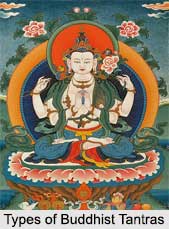 Types of Buddhist Tantras are divided into four categories. The goal of all these tantras bring about enlightenment of the mind. The more commonly accepted types of Buddhist Tantras are, namely:
1. Kriya Tantra
2. Charya Tantra
3. Yoga Tantra
4. Anuttarayoga Tantra.
The four types of Buddhist Tantras are briefly discussed below:
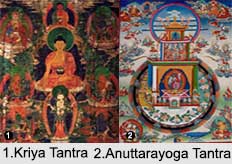
Kriya Tantra: Kriya Tantra is meant for the sake of candidates who delight in outer action. These outer actions are such actions as bathing, cleaning, etc. These help the sadhaka to purify his body, speech and mind. In the Kriya Tantra, the deity is viewed as external to the sadhaka. The practice of Kriya tantra is believed to lead the practitioner to enlightenment in a span of 16 lifetimes. Kriya Tantra Sadhana involves three methods; they are mediation with muttering (Japa), meditation without muttering and accomplishment of Siddhi after appropriate service (Seva). Susiddhikara and Dhyanottaraopa Talakrama are considered important Kriya Tantras.
 Charya Tantra: Charya Tantra is directed at candidates who delight in practicing outer action and inner yoga in equal measure. The term "Charya" means conduct and it refers to the action to be performed in the ritual and more importantly to the whole conduct of the performer while preparing for the action and carrying it out. The practice of Charya helps the sadhaka to familiarize him with dharma. It is believed to enable him to achieve liberation in 7 lifetimes.
Yoga Tantra: The Yoga Tantra was revealed for the sake of subduing the candidates who delight in the yoga of inner Samadhi. In this case, yoga means union with the Dharmadhatu by means of intense contemplation of a God. Here, ritual and conduct are subordinate to meditation. The student embarks on a journey from the external to the internal. The goal is profound concentration which is gateway to personal liberation. Samadhi is attained by suppressing the wanderings of discursive thought and by fixing the mind one-pointedly on the object of mediation. In the Yoga Tantra, the practitioner imagines himself to be the form body of Lord Buddha. In this way the vulgar body, speech and mind together with their conduct are transmuted in to the Buddha"s body, speech and mind together with their marvellous action. In Yoga Tantra, the sadhaka visualizes himself as the deity and merges the yidam with him. The practitioner is believed to attain liberation in 3 lifetimes.
Anuttarayoga Tantra: The Anuttarayoga Tantra is the incomparable tantra aimed at subduing the candidates who delight in inner yoga. The steps of the path traced out in Anuttarayoga Tantra are divided into two steps. The first is called the path of maturation in which the forms of the male and female deities are visualized within their complete Mandalas. Their forms, Mandalas, symbols and seed-syllables are used to snare and purify the various arising manifestations of the personality. The step of the purification is necessary to proceed to the next process of completion. The steps of completion are called the path of liberation. In it the union of the two purified forms, Mandalas and the seed-syllables of the deities of Wisdom and Means are performed. The whole process is indicated by the word “evamâ€.
Thus, it can be concluded saying that Buddhist Tantras are classified in such a manner that it brings about purification of the mind of the sadhaka and paves his way towards enlightenment.
Guhyasamaja Tantra in Buddhism
The Guhyasamaja Tantra is considered as one of the most important scriptures of esoteric
Buddhism. Guhyasamaja Tantra is known as the highest form of
Tantra. All the paths of Tantrism and the words of entire, extensive sutra teachings and
meanings are combined in Guhyasamaja tantra. It is therefore described as ?Za-ma-tog?, a
basket of all the sutras and the tantras. In its complete form it consists of seventeen
chapters. A separate "explanatory tantra" (vyakhyatantra) known as the Appendix Tantra
(uttaratantra) is also at times considered as its eighteenth chapter.
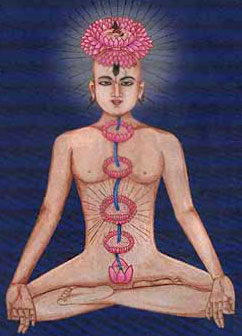
In India Guhyasamaja Tantra was considered as a Yoga or Mahayoga Tantra. There are two primary methods of practice in highest yoga tantras? Generation stage and Completion stage. Generation stage involves a process of transformation through imagination and serves to prepare the practitioner for the Completion stage. The Completion stage focuses on a practice that relies on energy channels, winds and drops to activate subtle clear-light-mind and realize emptiness. These practices of Guhyasamaja give birth to the so called illusory body, and eventually to the union of clear light and illusory body that leads directly to the experience of full enlightenment.
The Guhyasamaja Tantra is ascribed by tradition to the sage Asanga. The first of 18 chapters presents the text?s mandala, a visual image used in ritual and meditation and understood as the symbolic embodiment of a Tantric text. In the centre of the mandala of this text stands Aksobhya, the Imperturbable Buddha, the central celestial figure in Tantric Buddhist symbolism. Surrounding him are Vairocana, the Illuminator Buddha, in the east; Amitabha, the Buddha of Infinite Light, who dwells in the Western Paradise, the Pure Land; and the celestial Buddhas, Amoghasiddhi in the north and Ratnasambhava in the south.
Origin of Guhyasamaja Tantra : Origin of Guhyasamaja Tantra can be attributed to the Buddha who for the first time undertook the responsibility to teach it. He taught the Guhyasamaja Tantra in the form of Vajradhara to Indrabhuti the King of Oddiyana who is also known as King Dza. The Guhyasamaja Tantra form stands, along with the Mahayana and Theravada, as one of the main branches of Buddhism.
Iconography of Guhyasamaja Tantra : The main deity of the Guhyasam?ja is a blue-black coloured Akshobhyavajra. She is a form of Akshobhya, one of the five transcendent lords. Akshobhyavajra is seen holding a vajra and bell in his first two hands while in the others she is seen holding the symbols of the four other transcendent lords: wheel of Vairocana and lotus of Amitabha in his rights, and gem of Ratnasambhava and sword of Amoghasiddhi in his lefts. The mandala consists of thirty-two deities in all.
In India Guhyasamaja Tantra was considered as a Yoga or Mahayoga Tantra. There are two primary methods of practice in highest yoga tantras? Generation stage and Completion stage. Generation stage involves a process of transformation through imagination and serves to prepare the practitioner for the Completion stage. The Completion stage focuses on a practice that relies on energy channels, winds and drops to activate subtle clear-light-mind and realize emptiness. These practices of Guhyasamaja give birth to the so called illusory body, and eventually to the union of clear light and illusory body that leads directly to the experience of full enlightenment.
The Guhyasamaja Tantra is ascribed by tradition to the sage Asanga. The first of 18 chapters presents the text?s mandala, a visual image used in ritual and meditation and understood as the symbolic embodiment of a Tantric text. In the centre of the mandala of this text stands Aksobhya, the Imperturbable Buddha, the central celestial figure in Tantric Buddhist symbolism. Surrounding him are Vairocana, the Illuminator Buddha, in the east; Amitabha, the Buddha of Infinite Light, who dwells in the Western Paradise, the Pure Land; and the celestial Buddhas, Amoghasiddhi in the north and Ratnasambhava in the south.
Origin of Guhyasamaja Tantra : Origin of Guhyasamaja Tantra can be attributed to the Buddha who for the first time undertook the responsibility to teach it. He taught the Guhyasamaja Tantra in the form of Vajradhara to Indrabhuti the King of Oddiyana who is also known as King Dza. The Guhyasamaja Tantra form stands, along with the Mahayana and Theravada, as one of the main branches of Buddhism.
Iconography of Guhyasamaja Tantra : The main deity of the Guhyasam?ja is a blue-black coloured Akshobhyavajra. She is a form of Akshobhya, one of the five transcendent lords. Akshobhyavajra is seen holding a vajra and bell in his first two hands while in the others she is seen holding the symbols of the four other transcendent lords: wheel of Vairocana and lotus of Amitabha in his rights, and gem of Ratnasambhava and sword of Amoghasiddhi in his lefts. The mandala consists of thirty-two deities in all.
Works on Buddhist Tantra
 Works on Buddhist Tantra is not easy to typify. Though there has been some categorization of Tantric scriptures. There was a division of texts as Kriya (Action), Carya (Performance) or Yoga (Union), which is sequential. Kriya Tantras are earlier than the Carya and the Carya precede the Yoga. From the time of the Yoga Tantras there is a consciousness of the classification tradition and a development and expansion of categories. This division is further expanded by the addition of the Anuttarayoga or Maha Yoga Tantras and their secondary - divisions into father and mother Tantras.
 The largest class of Tantras is the Kriya which has around 450 known Tantras assigned to it. The earliest texts dates back to the 2nd century and they continue to appear till the 6th century. These texts were designed to achieve a variety of worldly goals like easing of illness, weather control, generation of health and prosperity, placation of deities and safety from danger. The word Tantra frequently appeared in texts during the period of Yoga and Maha yoga Tantras.
Carya is the smallest of the categories as very less texts are assigned to it. Maha Vairocana Sutra is one of the important Tantras. The role played by Buddha Vairocana where he is depicted in the centre of a symmetrical Mandala is one of the important features of Carya. The development of the idea of the practitioner developing meditative identification with the deity was developed during this age. The goals were worldly which a further step was towards to quicken the process of becoming a Buddha.
Important works of the Yoga Tantras include the Tattvasamgraha Sutra, the Vajrasekhara Tantra and the well known Namasamgiti. Vairocana`s figure at the center of Mandalas continues with the Yoga Tantras. During this period Tantric Buddhism begins to promote itself as a powerful means to gain Buddha hood.
MahaYoga Tantras appear by the end of the eighth century which evolved closely out of the Yoga Tantras. They continue the five-Buddha and five-family system of the Yoga Tantras. The use of sexual imagery and the consumption of forbidden and impure substances are the other notable features of the MahaYoga Tantras. The other feature of the Mother Tantras is that more than one tantra can be associated with the principal deity of the Mandala. Mother Tantras comprise of a number of different "cycles". The title of these Tantras are derived from the distinctive roles played by female figures in them with the central deities surrounded by dancing female figures called Yoginis whose appearance mirrors that of the central figure.
Recently updated articles in Religion in India
Maheswara
Maheswara, meaning “the Great Lord,” is a revered name of Lord Shiva in Hindu tradition. It represents Shiva’s supreme authority over creation, preser...
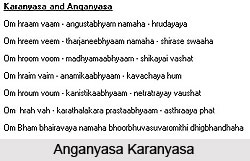
Anganyasa and Karanyasa
Anganyasa and Karanyasa are preparatory rituals in Hindu worship that sanctify the body and hands through the recitation of sacred mantras and symboli...
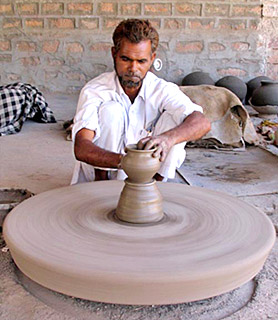
Kumbhakar / Kumhar Caste
Kumbhakar or Kumhar caste is a traditional artisan community in India known for pottery making. Derived from Sanskrit word Kumbhakar, meaning potter,...

Dhimar Caste
The Dhimar caste, predominantly residing in the Central Provinces of India, is a distinct Hindu community with a rich heritage and diverse occupationa...
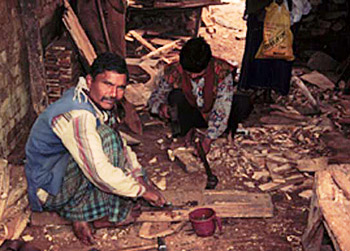
Barhai Caste
Barhai Caste is a traditional Hindu artisan community historically associated with carpentry in India. Known for their craftsmanship, Barhais contribu...
Related articles in Religion in India
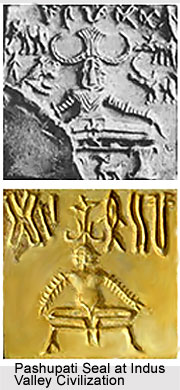
Religion in Indus Valley Civilization
Religion in Indus Valley Civilisation included Hinduism, Buddhism and Jainism. Details about the religion in Indus Valley Civilization have been gathe...
Iyer Brahmin
Iyer Brahmins are originally from Tamil Nadu of South India. They are known for their adherence to Advaita philosophy and Smarta traditions. Tradition...
Kumbhakar / Kumhar Caste
Kumbhakar or Kumhar caste is a traditional artisan community in India known for pottery making. Derived from Sanskrit word Kumbhakar, meaning potter,...

Gujjars in Mughal Era
Gujjars in the Mughal era enjoyed great power. Further their power increased with the decline of Aurangzeb, Mughal emperor.
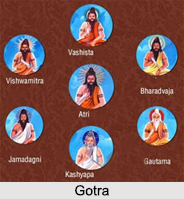
Gotra in Hinduism
In Hinduism, gotra refers to a lineage system tracing descent from ancient sages, primarily through the paternal line. Originating from Vedic traditio...