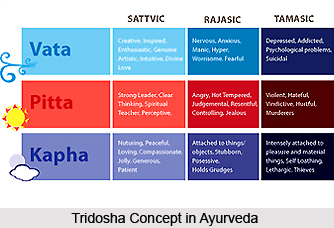
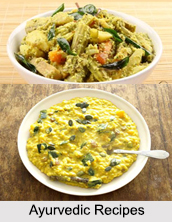
 Kapha, the third of the Tridoshas is made up of the elements water and earth and is the foundation of all the solid structures in the body. It is concerned with firmness, heaviness, strength, sexual potency, forbearances and restraints. It can be said that kapha dosha integrates the whole body by giving it mass and stability and protecting it from foreign invasions.
In the opinion of Ashtanga Ayurveda, kapha exists in the upper part of the body, above the "epigastrum" line, mainly investing the thoracic cavity, upper limbs and head. According to Ashtang Ayurveda, the five elements or the Pancha Mahabhutas are the source of the bodily humours or doshas namely, vata, pitta and kapha. These preside over all the physical and mental activities of the body and thus ensuring good health, vivacity and immunity. In each dosha, any two of the five Bhutas are present with any one being predominant.
Characteristics of Kapha Dosha
People with kapha type of body tend to possess a large body framework with padded joints. They have thick, smooth skin which is a bit oily and their hair is glossy and wavy. They exhibit stability and tranquillity in thought, speech and action, prove flexible and supportive in relationships. Moreover, they are steady and loyal. Since they are calm and serene, they enjoy long heavy sleeps and dislike humid, congested surroundings. Their primary quality is their calmness and sweetness. The famous Ayurvedic text, the Charaka Samhita, meticulously jots down the characteristics of kapha personality in the following manner: heavy (guru), soft (mridu), cold (sheetoha), exhibiting lubrication (snigdha), sweet (madhura); stable and immune (sthira) and greasy (tikshila).
Types of Kapha Doshas
There are five types of kapha doshas namely; kledaka kapha, bodhaka kapha, avalambaka kapha, tarpaka kapha and shleshaka kapha. 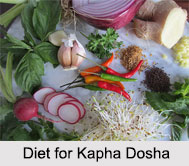
•Kledaka Kapha: This rules the gastric region. Its main function is to lubricate ingested food thus facilitating digestion.
•Bodhaka Kapha: This is positioned in the tongue and throat and determines the taste. It lubricates food and makes it easier to swallow.
•Avalambaka Kapha: This functions in the heart, chest and lower back. Its activity includes lubricating the heart and lung tissue thus slowing down wearing and tearing.
•Tarpaka Kapha: This resides in the heart, sinuses and spinal fluid. Its function is to lubricate the nerve and brain tissue.
•Shleshaka Kapha: This is present in the joints and provides lubrication to keep the joints smooth and flexible.
Remedies for Kapha Dosha
The three Ayurvedic tastes that are suitable for the Kapha personality are pungent, bitter and astringent, so more of these should be included in the diet in order to balance kapha. Light warming foods help to balance kapha. Kapha deficiency causes a feeling of emptiness in the stomach and other body cavities, a sensation of dryness or internal burning, looseness of joints, weakness, thirst and sleeplessness. Excess of kapha is exhibited through whiteness of complexion, a feeling of coldness, tiredness, fullness of the stomach, heaviness, looseness of the joints and a tendency to sleep excessively. In case of vitiation, kapha can cause digestive disorders, numbness of limbs, vomiting and distaste for food.
Thus when kapha predominates in a person, a proper diet and various Yoga therapies that fit the kapha personality should be maintained to prevent disorders in this dosha.