
 Billiards is believed to have developed from a game called "ground billiards", played in Northern Europe and probably France, although countries from China to the Netherlands are sometimes linked to the origins of the game.
Manuscript evidence (the earliest dated around the 1300 AD) describing the equipments used for the game places it`s invention roughly at the medieval period, around the 14th century. The game was originally played outdoors (on grass) till the 17th century after which the modern practice of playing indoors (on a table) grew more common. Some records indicate that King Louis XI of France purchased a Billiards table in the year 1470. During that time, the billiards table used to be made of wood, covered with green cloth to simulate the grass of lawn and a simple border was placed around its edges.
The term`billiard` is derived from the French language. The origin of this term is either the word `billard` (meaning a wooden stick) or the word `bille` (meaning ball). The players would not strike the balls; but push them with wooden sticks, named maces. The cue sticks of modern times started to be used in billiards from the early part of the 17th century.
 The modern game named pocket billiards is actually an American version of the English game.
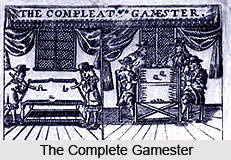
The later half of 16th century and early half of the 17th century was a memorable period in the history of billiards. Billiards became quite familiar to the public and several writers of that period also started to mention the game in their writings. The first book detailing the rules of billiards was named the `The Complete Gamester` and was written by Charles Cotton. The book was published in England in the year 1674. Almost all the towns in England had public billiard-tables during that period. The popularity of billiards among the French nobility also increased substantially till the French Revolution, in 1789. However, contrary to contemporary Indian opinion, billiards was not restricted to the elite in those times; and people from all walks of life played the game at public billiard tables.
The original game was markedly different from the modern form: it used to be played with only two balls, one belonging to each of two players on a six-pocket table. An upright stick was used as a target.
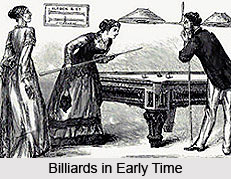 The aim of the player was to strike the opponent`s ball with his own ball so that his own ball travelled through the `target`. After achieving the required number of points, the more successful player used to finish the game by using his own ball to strike the opponent`s ball to make the ball rebound off a small post.
The `hoop` and `target` on the billiards table disappeared with the course of time. Both of these disappeared one after another during the 18th century and only the balls and pockets were left. By this time, the game had grown restricted to the elite, and only nobles and royal personages would play the game. This was a principal reasons for the game being called the "Noble Game of Billiards" since the early 1800s. The most popular form of the game, played all over the world, the `8-ball` was invented around 1900. Another popular form of Billiards named as `9-ball` was devised around 1920. The game, popular throughout the world, has found several luminaries from India, such as Geet Sethi and Pankaj Advani.
History of Billiards
The game of Billiards has quite an old and rich history. Though no exact time frame can be mentioned about the invention of the game, several evidences indicate that the starting point of the history of Billiards was in medieval times.