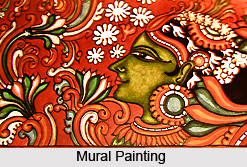
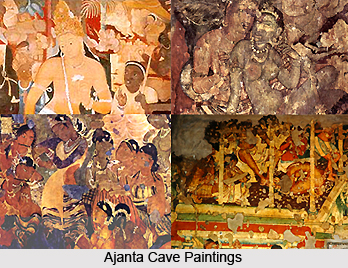
The sanctified caves of Ajanta, Maharashtra India houses in all probability the world"s oldest examples of wall paintings, widely known as Ajanta Murals. Mural Paintings are the earliest remnants of Indian Art. Ajanta Murals includes sculptures of animals, guards and deities. It also includes paintings of courtly life, scenes from the life of Lord Buddha and also has a few statues of the lord himself. History records that the Ajanta Murals sate back to the 2nd century BC.
In the cave of Ajanta a male figure who emanates a sense of compassion, tenderness and even a trace of melancholy at witnessing the sorrows of the world is one of the masterpieces of world art. The figure embodies within its form the various ideals of beauty. For instance his eyes are like the petals of lotus and he has a waist of leonine tautness. This is the "Ajanta Boddhisattva" and one of the finest examples of Ajanta Murals.
History of Ajanta Murals
The mining of Ajanta caves was started in the 4th century AD. Over the centuries, 29 such caves were plowed by the Buddhist monks, and used as monasteries. These caves are decorated with sculptures of animals, guards and deities, and paintings of civil life and Buddhist tales.
Influences of Ajanta Murals
The murals of Ajanta interestingly use light and shade of different colors. The Ajanta cave murals also tell "Jataka" stories of the many births of Lord Buddha. The ceilings are filled with decorative motifs from the vegetable and animal world. Many of the features have left a lasting impact on Indian art. Historians describe the Ajanta murals as superb example of Gupta art.
In the Ajanta Murals the rough stone walls were first covered with two layers of mud plaster. These were covered with a lime wash. In the paintings generally mineral colors were used. The drawings of figures and forms were outlined in red cinnabar. The artists used pigments from local sources-red and yellow ochre, green from mineral. White used beautifully to portray the intricate jewellery and create highlights came from lime and kaolin or what is known as china clay. Black was derived from lamp soot and blue was made from lapis lazuli which was imported. Perhaps, that is why the use of blue is relatively rare. Glue was used as a fixing agent to bind the pigments and animal hair-brushes were used.
Ajanta Murals had had heavy influence on modern Indian Art. Many of the contemporary artists like Nandalal Bose have heavily drawn from the style of Ajanta Murals. For instance like the eyes of Lord Buddha in the walls of Ajanta, Nandalal Bose also tried using of half-closed, lotus petal eyes. Today, the Ajanta caves are the largest tourist attraction of the small Indian town of Aurangabad.
Ajanta Murals
Ajanta Murals are one of the best forms of Indian Art. Mural Paintings of Ajanta mostly revolve in and around the life stories of Lord Buddha.