Munda Language, Indian Tribal Languages - Informative & researched article on Munda Language, Indian Tribal Languages
  Indianetzone: Largest Free Encyclopedia of India with thousand of articles Indian Languages


in  
Art & Culture | Entertainment | Health | Reference | Sports | Society | Travel
Forum  | Free E-magazine
Indian Languages : Languages of India l Origin of Indian Languages l Official languages of India l Indian Classical Languages l Scripts of South India l Indo - European languages l Indian Tribal Languages l Indology l Brahmic family Languages l Indian Spoken Languages l Languages of South India l Linguistic History of India l Indian Language Movements l Indian Regional Languages l Indian Scripts l Amara Kosha l English Language in India l Indian Language Families l Dogri Language
Home > Reference > Indian Languages > Indian Tribal Languages > Munda Language
Munda Language, Indian Tribal Languages
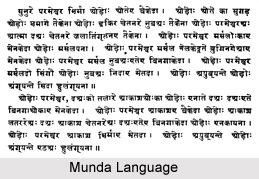
Munda Language is usually spoken in the central-eastern parts of the country. This Indian tribal language belongs to the Austro-Asiatic tribal language family. It is also spoken in the neighbouring country of Bangladesh.

Munda TribesMunda language is a particular Indian tribal language that is spoken by more than nine million people in the central and eastern regions of India. It is also spoken by people in India`s neighbouring country that is Bangladesh. Munda language forms a branch of the Austro-Asiatic tribal language group. Munda language is basically placed in opposition to the Mon-Khmer languages, which are prominent in Southeast Asia. However, the origin of Munda language is not properly known. It is said that this language is autochthonous language of the eastern region of India.

There are basically two branches of Munda language family and these are North Munda, which is mostly spoken in the Chota Nagpur Plateau of the states of Jharkhand, Chhattisgarh, Orissa and West Bengal. The second branch of this language family is known as South Munda, which is principally spoken in the central region of Orissa and along the Andhra Pradesh and Orissa border region. In the North Munda branch, Santhali is considered as the chief language. Moreover this branch is the larger one among the two. The languages of this group are chiefly spoken by more than nine-tenths of the total Munda language speakers of the country. Mundari and Ho languages rank next, after Santhali language, in terms of the total number of speakers. These are followed by Korku and Sora languages of this group. However, the rest of the Munda languages are spoken by small and isolated groups of people and they are also little known.

The basic characteristics of Munda language comprises two genders (animate and inanimate), three grammatical numbers (singular, dual, and plural), a division between inclusive and exclusive first person plural pronouns and also the usage of either suffixes for indicating tense. Consonant sequences are quite irregular in Munda sound systems, apart from the middle of a word. Pronunciation is generally predictable in Munda language except Korku, as in this particular language syllables show a difference between the high and low tone.

One of the fascinating characteristics of Munda languages is their ability to use any word for any concept. Part of speech distinctions like nouns, verbs, adjectives and adverbs are vague or lacking in these languages. Research shows that the words in Munda languages are of great functional elasticity.

(Last Updated on : 13/02/2010)
  More Articles in Indian Tribal Languages
 
Bhili Language Lamani Language Gondi language
Indo Aryan Tribal Languages Dravidian Tribal Languages Tibeto Burman Tribal Languages
Khasi Language Munda Language Tribal Languages of Jharkhand
Kharia Language Kokborok Language Bodo Language
Santhali Language Bangani Language Garo language
Brahui language Sora language Karbi language
Recently Updated Articles in Indian Languages
  • Development of Tamil Scripts
    Development of Tamil scripts can be traced to the period just after the reign of Asoka. The Tamil script is believed to have developed from the Brahmi script.
  •  
  • Tamil Scripts
    Tamil ScriptS is used to write the Tamil language and other Dravidians languages. The Tamil script varies from other Brahmi-derived scripts in numerous ways.
  •  
     
  • Maturaikkanci
    Maturaikkanci is a Tamil poetic work which is included in the Pathinenkilkanakku anthology of Sangam literature dating between 100 BCE – 100 CE. It has 782 lines of poetry in the Achiriyappa meter.
  •  
  • Pure Tamil Movement
    Pure Tamil Movement or Thanittamil Iyakkam is a movement of linguistic purism which insisted on avoiding Sanskrit, English and Persian loan-words and attempting to imitate the original Tamil language.
  •  
  • Ancient Tamil Grammatical Works
    Ancient Tamil grammatical works includes Tolkappiyam, the earliest available literary work which was written around 3rd century B.C. There are other grammatical works as well, which precede the Tolkappiyam.
  •  
    E-mail this Article | Post a Comment
    RSS Feeds
    Forum
    Forum on Indian Languages

    Free E-magazine
    Subscribe to Free
    E-Magazine on Indian Crafts
     
     
    Munda Language, Indian Tribal Languages - Informative & researched article on Munda Language, Indian Tribal Languages
    Sitemap
    Contact Us   |   RSS Feeds
    Copyright © 2008 Jupiter Infomedia Pvt. Ltd. All rights reserved including the right to reproduce the contents in whole or in part in any form or medium without the express written permission of Jupiter Infomedia Pvt. Ltd.