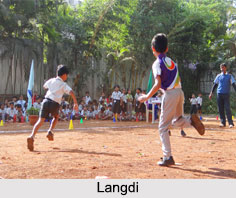
Kabaddi is one of the most ancient games of India, which is mainly popular among Indian villages. India has participated in four Asian games in Kabaddi and won gold in each of them. There are four forms of Kabaddi which are Amar, Suranjeevi, Huttuttoo, and Gaminee. Amar is mainly played by Punjabi sportsmen; Huttuttoo was played by men in Maharashtra and Suranjeevi is the most played form of Kabaddi around the world, which is used in international matches like Asian Games. In India, Kabaddi was primarily played as a way to develop the physical strength and speed in young men. Kabaddi is also known as Hu-Tu-Tu in Western India, Ha-Do-Do in Eastern India and Bangladesh, Chedugudu in Southern India and Kaunbada in Northern India.
Mythological Significance in the History of Kabaddi
The history of Kabaddi dates back to the pre-historic times. In Hindu mythology, the dramatised version of the Hindu epic Mahabharata, Arjuna had a unique talent in the game of Kabaddi. Historians find resemblance with the technicalities of Kabaddi with a situation in the great battle of Mahabharata, where the warrior Arjuna`s son Abhimanyu is trapped in the `Chakravyuha` set by his enemies of the war. According to the Buddhist literature, Gautama Buddha played Kabaddi for recreational purposes.
Recognition of Kabaddi as a Sport
Kabaddi was given the national status of a game in India in 1918. Standard set of rules and regulations for the game were formulated in the same year. However, the rules and regulations were brought to print in 1923. Kabaddi received international status during the 1936 Berlin Olympics. The game was introduced in the Indian Olympic Games at Calcutta in 1938.
Foundation of All India Kabaddi Federation
In 1950 the All India Kabaddi Federation came into existence. The first men`s national tournament was organized in Chennai in 1955, while the women`s nationals were held in Kolkata. In 1961, the Indian University Sports Control Board (IUSCB) included the game of Kabaddi in its curriculum as an important sports discipline for the students. In 1962 the game was introduced as one of the important games in the school by the School Games Federation of India (SGFI). In 1971 the National Institute of Sports (NIS) included Kabaddi in the curriculum of Regular Diploma courses. The Amateur Kabaddi Federation of India (AKFI) was founded in 1973. The Asian Kabaddi Federation was founded under the chairmanship of Mr. Janardan Singh Gehlot.
Indian in Kabaddi Championships
The Asian Kabaddi Championship was organised in 1980 where India emerged as champion and Bangladesh as runner-up. In 1985, the Asian Kabaddi Championship was held in Jaipur, India. Kabaddi was included for the first time in the Asian Games in Beijing in 1990 where India, China, Japan, Malaysia, Sri Lanka, Pakistan and Bangladesh took part, where India emerged as victorious. India completed its hattrick of winning Asian Games gold in Hiroshima in 1994, Bangkok in 1998 and also won gold for a fourth time in Busan Asian Games, 2002. India won the gold medal in the 2006 Asian Games at Doha.
Evolution of Kabaddi in India
The popularity of the game has increased over the passing years, from a popular game in the rural India to a sport recognized at the national level. A number of championships have been organised for Kabaddi both at the national and international level, where the Indian national Kabaddi team has delivered commendable performances. The introduction of Federation Cup Kabaddi matches in 1981 is a milestone in the history of Kabaddi in India. In 2004, India hosted the first ever Kabaddi World Cup in Mumbai and lifted the trophy.