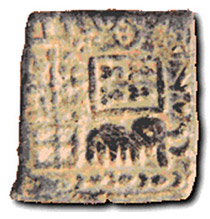
The ancient Saurashtran Janapada was situated in modern Gujarat on the west coast of India. As per the historical evidences this Janapada had issued a series of small irregularly shaped silver coins and these coins had been punched by the single die technique. The coins maintained a particular weight standard and a few specimens of smaller denominations are also known.
The earliest ruler of the Surasena kingdom known from their coins was Gomitra. He was followed by Suryamitra, Brahmamitra, Dhridhamitra and Vishnumitra. The coins of these rulers were enriched with symbols similar to those that were used earlier for the punch marked coins. The coins also include the figure of a standing female deity not unlikely representing Yamuna. The coins in most cases have been re-struck several times. A few coins had been over-struck on cut down Magadhan karshapanas with design traces of the Magadhan under type on them. A large number of types and subtypes of coins have been discovered. According to some scholars, only four main-types, viz. hill, tree, seated goddess and elephant. Some early symbols like Srivatsa, turtle and swastika had also been used on the coins. Apart from these symbols, the coins of Surasena kingdom include Banyan tree, a symbol looking like a barrel, a peculiar U-shaped symbol and a great number of miscellaneous other symbols. Some other symbols were used on the coins in the later period and had developed elegance in comparison to the artistically inferior style of the earlier coins. New trade contacts and with them new artistic insights and inspirations from the Indo-Greek coinages and from contemporary temple artwork worked as the influential factors for the style development of the Saurashtran coins. In this context a special attention is paid to the Lakshmi images.
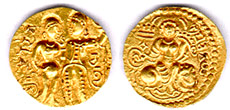
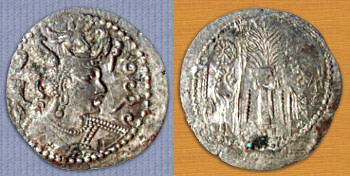
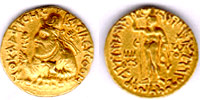
The Mitra dynasty was superseded by the Datta kings who were Seshadatta, Purushadatta, Uttamadatta, Ramadatta, Kamadatta and Bhavadatta. These rulers were seen on their coins bearing the regal titles `Raja` and `Maharaja` respectively. The rulers of this dynasty adopted the pattern of the Mitra rulers. This ruling dynasty was replaced by the rulers of a foreign dynasty and the earliest of them was Rajuvula. His earliest coins were `hemidrachm` of silver, highly debased with lead. These coins resemble the late issues of the Indo-Bactrian rulers. The portrait on the obverse side of the coins bore the king facing to the right; the blundered Greek provided his name with the title `Basileos Basilion Sotoros`. The reverse side of the coins had the Pallas Athene and the Kharoshthi legend. He also issued another type of coin in lead that contained a lion on the obverse and Herakles on the reverse side of the coin with Greek and Kharoshthi legends. These coins were common in Taxila and when he seized Mathura, he issued coins similar to the coins of the earlier rulers of that place. The coins had a standing female deity on the obverse and Abhisheka Lakshmi on the reverse of the coin with the inscription in Brahmi.
The coins of Surasena had a very characteristic design. In most of the cases the designs had been deeply incused by a single punch of round or oval shape. Many varieties exist in the shape of the animals and the kind of the additional symbols. Sometimes the fish was replaced by a second lion, a sun or a taurine. A huge number of variations were discovered by some scholar that the coins of this dynasty had different types and subtypes. Some types of coins issued during this time were evidenced where the coins contained a fish above and below the lion, sometimes the fish was omitted. The flan type was round, square and rectangular. Many Surasena coins had been re-struck on an older coin. Sometimes it was done on another Surasena specimen but mostly on a Panchala Janapada coin, a feature supporting the attribution of the `fish over lion` type to the Surasena Janapada. It had been observed that nearly all the restrikes of Surasena coins on Panchala coins were on specimens with blank reverses.
As per the inscriptional evidence, Saurashtra was incorporated into the Mauryan Empire at the end of the 4th century B.C. In comparison to the earlier coins, the later coins were made somewhat larger than earlier coins. The re-striking was employed throughout all phases of the Saurashtran coin series. Most of the coins vestiges at least five re-strike with no general re-strike pattern recognisable. As per the scholars, Saurashtran punch-marked coins had been issued in one long series from about 450 B.C. to about 50 B.C.