 The history of Awadh depicts that in 1720, Muhammad Amin who was popularly known as Sadat Khan, the Wazir of the Mughal Empire, was made the Subedar of Awadh. His dominion was expanded from the divisions of Lucknow and Faizabad and the districts of Ghazipur, Banaras and Gorakhpur. In 1773, the districts of Allahabad and Kora were added and in the following year the area of Rohilkhand was seized. He and his successors governed these territories as Nawab Wazirs on behalf of the Mughal emperors. Lord Hastings, the British Governor General, in 1818, induced Ghaziuddin Haider, the then Nawab of Awadh, to make himself independent of Delhi by assuming the title of king. Consequently, in 1856, Ghaziuddin Haider was enthroned as king.
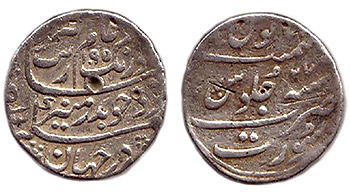
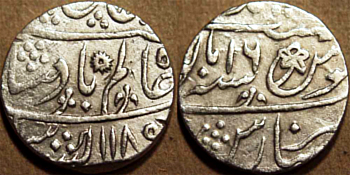
A mint was opened at Banaras in 1737 under the name of Muhammadabad Banaras. The mint produced coins in the name of the Mughal emperors under the authority of the Nawabs of Awadh. The issue of coins was resumed under the mint name Muhammadabad Banaras from Lucknow by the initiation of Asaf-ud-daula and his successors, when the district of Banaras passed into the hands of the East India Company. After the annexation of Rohilkhand in the Awadh administration, coins were also issued from Bareilly. But all these were issued in the name of the Mughal emperor.
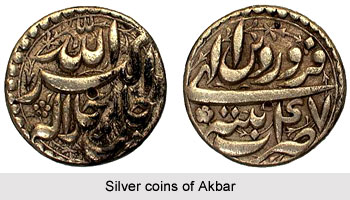
During the period of Ghaziuddin Haider, he was hesitant to issue coins in his own name. He retained in the beginning the usual obverse of the coins of Shah Alam II. He introduced his coat of arms which depicted two fish facing each other surmounted by a crown and a tiger on either side holding a pennon as a support. He also placed his own legend in the form of a couplet. The obverse legend in the form of a couplet remained the fashion on the coins of all the subsequent rulers namely Nasiruddin Haider, Muhammad Ali, Amjad Ali and Wajid Ali. At first Ghaziuddin Haider placed the year 5 on his new coins as the regnal year, counting it from the date of his accession to the `nawabi`. But soon he abandoned it and renewed the regnal year from the date of his assumption of kingship. The coins issued during the first year of his kingship had the mint`s name `Suba Awadh Darul-amarat Lakhnau`. From the second year, the epithet `Darul-amarat` was changed to `Darul-saltanat`.
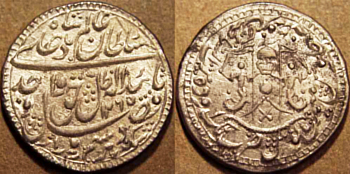 All the five kings issued gold `asharfi` with its half, quarter, eighth and sixteenth parts. But all the denominations of Wajid Ali Shah alone were generally seen. Similarly, five denominations of the silver rupee were issued by them. In copper, the first rulers issued only `fulus`. Wajid Ali in his first regnal year also issued its half, quarter and eight parts. Two large silver medals were issued associated with the Awadh dynasty. The first commemorated Shuja-ud-daula`s victory over the Rohillas in 1774 and the second was struck by Ghaziuddin Haider on the occasion of his assumption of kingship. On the observe of the latter was an ornate and realistic portrait of the king and the coat of arms on the reverse.
In 1857, when the country revolted against the British power, the power of Awadh declared Birjis qadr as `Nawab-Wazir`. The revolutionaries hated the idea of kingship under the English influence. So they issued these gold, silver and copper coins in the name of Mughal ruler Shah Alam II, with the mint name `Suba Awadh`, the date 1229A.H. and the regnal year 26. It has also been believed that this was in continuity of Nawab Wazarat, which had terminated with the accession of Ghaziuddin Haider in 1229 A.H. Then a pattern coin, most likely in gold was prepared. It bore the couplet that shows the name of the reigning Mughal emperor Bahadur Shah. It too had the mint name Suba awadh and was dated in the regnal year 26. It was sent to Delhi for the approval of the emperor. Before the approval could reach Lucknow, the tables had turned in favour of the British.
After the revolt failed, the British tried Mughal emperor Bahadur Shah for treason before a military court that was constituted by them for this purpose. Along with the king, the renowned Persian poet Mirza Ghalib was also implicated as his co accused. The poet was charged for composing the couplet for that seditious coin. But later it was known that the couplet was actually composed by some anonymous local poet. The later history of the gold pattern coin was not known.