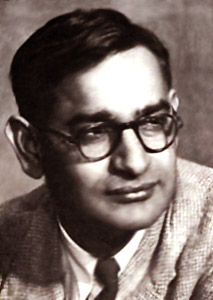
 Har Gobind Khorana is an Indian-American molecular biologist of Indian-Punjabi origin. Har Gobind Khorana, the Indian born biochemist, was responsible for producing the first man made gene in his laboratory. Khorana`s work is an important scientific landmark of the 20th Century. It has brought closer the day, when synthetic DNA (Deoxyribonucleic acid) may be introduced into the defective human tissues to bring about their repair or treat mentally retarded people and change them into more intelligent and healthy human beings. His synthesis of RNA (Ribonucleic acid), capable of replication in laboratory, is a step towards the creation of life artificially. In fact, the researches have opened up a new branch called Genetic Engineering in Science. Har Gobind Khorana, along with Robert W. Holley and Marshall W. Nirenberg, was awarded the Nobel Prize in Physiology or Medicine in the year 1968. In the same year, Khorana, along with Nirenberg, was also honoured with the Louisa Gross Horwitz Prize, by the Columbia University. In 1966, he became a citizen of the United States and eventually was awarded the National Medal of Science.
Early Life of Har Gobind Khorana
Har Gobind Khorana was born in Raipur, Punjab (now in Pakistan) on 9th January 1922. His father was the village Patwari or Taxation official. Khorana attended D.A.V. High School in Multan and took his M. Sc from Punjab University at Lahore. On a Government scholarship in 1945, he went to England and obtained a PhD from the University of Liverpool, in the year 1948. Har Gobind Khorana spent a year in Zurich in 1948 - 1949, as a post-doctoral fellow at the Swiss Federal Institute of Technology.
Career of Har Gobind Khorana
Har Gobind Khorana returned to England in the year 1950 and spent two years on a fellowship at Cambridge and began research on nucleic acids under Sir Alexander Todd and Kenner. His interest in proteins and nucleic acids grew at that time. In 1952, he went to the University of British Columbia, Vancouver on a job offer and there a group began to work in the field of biologically interesting phosphate esters and nucleic acids with the inspiration from Dr. Gordon M. Shrum and Scientific counsel from Dr. Jack Campbell. Har Gobind Khorana joined the University of Wisconsin, as Professor in 1960 and co-Director of the Institute of Enzyme Research and Professor of Biochemistry from 1962 to 1970 and continued his research. In the meantime, he also attained the citizenship of US. Khorana continued research on nucleic acid synthesis and prepared the first artificial copy of a yeast gene. Har Gobind Khorana is also the first to synthesise Oligonucleotides, that is, strings of nucleotides. These custom designed pieces of artificial genes are widely used in biology labs for sequencing, cloning and engineering new plants and animals. The Oligonucleotides, thus, have become indispensable tools in biotechnology. In 1970 he became the Alfred Sloan Professor of Biology and Chemistry at the Massachusetts Institute of Technology USA, where he continues to work.
Har Gobind Khorana also worked with the RNAs with three repeating units and thus produced three different strings of amino acids. In this way, Har Gobind Khorana and his team had established that the mother of all codes, the biological language common to all living organisms, is spelled out in three letter words that are each set of three nucleotides codes for a specific amino acid. Khorana was also the first to isolate DNA ligase, an enzyme that links pieces of DNA together. This invention of Dr. Khorana has become automated and commercialised. The Nobel lecture of Har Gobind Khorana was delivered on 12th of December, 1968.
Achievements of Har Gobind Khorana
Khorana is recipient of many awards and honours for his achievement. He was awarded the Nobel Prize in Physiology or Medicine in the year 1968. An intense worker of the interpretation of the genetic code and its functioning in protein synthesis, Har Gobind Khorana was also awarded the Louisa Gross Horwitz Prize from Columbia University in the same year. He also received Distinguished Service Award from Watumull Foundation, Hawaii in 1968; American Academy of Achievement Award, Pennsylvania in 1971; Padma Vibhushan, highest Presidential Award from India in 1972; J.C.Bose Medal also in 1972 and Willard Gibbs Medal of the Chicago Section of American Chemical Society in 1973-74.
He was also elected a member of the National Academy of Sciences, Washington as well as a Fellow of the American Association for the Advancement of Science. In the year 1971, Har Gobind Khorana became a foreign member of USSR Academy of Sciences and in 1974 Honorary Fellow of the Indian Chemical Society.
Har Gobind Khorana was married to Esther Elizabeth Sibler of Swiss origin in 1952. They have three children Julia Elizabeth, Emily Anne, and Dave Roy. Khorana is currently settled in Cambridge, Massachusetts in United States of America.
