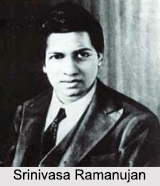
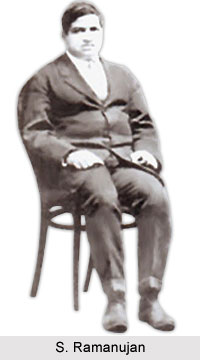
 Contribution of S. Ramanujan is widespread in fields of Algebra, Geometry, Trigonometry, Calculus, Number theory etc. He has also made some extraordinary contributions to the fields like Hyper-geometric series, Elliptic functions, Prime numbers, Bernoulli`s numbers, Divergent series, Continued fractions, Elliptic Modular equations, Highly Composite numbers, Riemann Zeta functions, Partition of numbers, Mock-Theta functions etc. In reality, apart from a few elementary ones, most of the contributions of S.
Ramanujan belong to a higher realm of mathematics that is often referred to as Higher Mathematics. But the most significant contributions are Ramanujan Prime, Ramanujan Theta function, Ramanujan-Soldner constant, Ramanujan`s sum etc.
Contribution of S. Ramanujan is widespread in fields of Algebra, Geometry, Trigonometry, Calculus, Number theory etc. He has also made some extraordinary contributions to the fields like Hyper-geometric series, Elliptic functions, Prime numbers, Bernoulli`s numbers, Divergent series, Continued fractions, Elliptic Modular equations, Highly Composite numbers, Riemann Zeta functions, Partition of numbers, Mock-Theta functions etc. In reality, apart from a few elementary ones, most of the contributions of S.
Ramanujan belong to a higher realm of mathematics that is often referred to as Higher Mathematics. But the most significant contributions are Ramanujan Prime, Ramanujan Theta function, Ramanujan-Soldner constant, Ramanujan`s sum etc.
Mathematical and Scientific Contributions of S. Ramanujan
According to an eminent mathematicians, all the numbers were actually the intimate friends of S. Ramanujan. In order to calculate the value of `pi` up to 17 million places using a computer, the present day mathematicians actually use S. Ramanujan`s method. Ramanujan was close to the numbers that he made the number 1729 as the `Ramanujan number`, as the other mathematicians call it so in his honour. The main reason behind this is that S. Ramanujan gave its fine characteristics in an anecdote involving G. H. Hardy, who had visited him in a sanatorium by hiring a taxi having this number. The mathematical contributions of S. Ramanujan have also been widely used in solving various problems in higher scientific fields of specialisation. The diverse specialised higher scientific fields include the likes of particle physics, statistical mechanics, computer science, space science, cryptology, polymer chemistry and medical science.
Apart from the above fields, S. Ramanujan`s mathematical methods are being used in designing better furnaces for smelting metals and splicing telephone cables for communications, as well. Ramanujan was shown how to solve cubic equations in 1902 and he went on to find his own method to solve the quadratics. The following year, not knowing that the quadratics could not be solved by radicals, he tried to solve the quadratics. It was in the Town High School that Ramanujan came across a mathematics book by G S Carr called Synopsis of elementary results in pure mathematics. This book, with its very brief style, allowed Ramanujan to tutor himself mathematics, but the method of the book was to have a rather unfortunate result on the way Ramanujan was later to write down mathematics since it provided the only model that he had of written mathematical arguments. The book contained theorems, formulae and short proofs. It also contained an index to papers on pure mathematics which had been published in the "European Journals of Learned Societies" during the first half of the 19th century. The book, published in 1856, was of course well out of date by the time Ramanujan used it.
By 1904, Ramanujan had begun to undertake deep research. He investigated the series ä(1/n) and calculated Euler`s constant to 15 decimal places. He began to study the Bernoulli numbers, although this was entirely his own independent discovery.
Ramanujan, on the strength of his good school work, was given a scholarship to the Government College in Kumbakonam which he entered in 1904. However the following year his scholarship was not renewed because Ramanujan devoted more and more of his time to mathematics and neglected his other subjects. Without money he was soon in difficulties and, without telling his parents, he ran away to the town of Vishakhapatnam, about 650 km north of Chennai. He continued his mathematical work, however, and at this time he worked on hypergeometric series and investigated relations between integrals and series. He was to discover later that he had been studying elliptic functions.
S. Ramanujan essentially belonged to the Formalist School of Mathematics. It is true that Ramanujan had not given much attention to the deeper meaning of mathematics but he had given the subject a concrete form with the help of formulas, theorems, identities etc. He also searched for forms or patterns in mathematics and he actually worked more by intuition and induction and showed relationships between numbers, something that nobody could even imagine at that time. He had found results that were both original and very different in nature. Some of his famous discoveries were the Ramanujan prime and the Ramanujan theta function.
Notebook of S. Ramanujan
S. Ramanujan wrote down all his mathematical findings, in ledger-like notebooks that lately became famous as Ramanujan`s Frayed Notebooks. The Cambridge University Press brought out his Collected Papers in 1927 and after this, the mathematicians all over the world became fascinated by his work and personality. In 1929, two British mathematicians, G. N. Watson of the University of Birmingham and B. M. Wilson of Liverpool University, started to study and edit the notebooks with an intention to unearth the mathematical gems lying undiscovered in them. The Notebooks contained numerous formulas most of which were related to mock theta functions and q-series and around a third are about modular equations and singular module and other formulas of congruencies, integrals, asymptotic series.
Eventually, the Tata Institute of Fundamental Research, Mumbai published the facsimile editions of the two volumes of Ramanujan`s notebooks in 1957. The books were published at the initiative of the Indian nuclear physicist Dr. Homi Jehangir Bhabha and the publication once again, renewed the mathematicians` interest in Ramanujan`s notebooks. S. Ramanujan surmise has remained a bench mark in Mathematics. The most outstanding contribution of Ramanujan was his formula for p (n), the number of partitions of "n". For all these reasons, he is hailed as an all time great mathematician like Euler, Gauss or Jacobi for his natural intellect.
To commemorate Ramanujan, Indian Government issued postage stamps to celebrate his 75th birthday.