Pradakshina or Pradakshinam is a method of salutation consisting of turning round the person to be greeted taking care always to have him to the right of one.
Pradakshina means circumambulation, which is walking around in a `circle` as a form of worship in Hindu ceremonies in India. The devotees walk around the innermost chamber of the shrine housing the temple deity. It is done around sacred fire or the Agni, trees and plants as well.
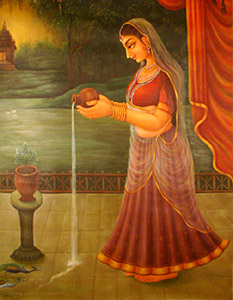 The Pradakshina is done around Tulsi plant and Peepul tree. Pradakshina or Parikrama is done in pilgrimage centres also. Parikrama around the Govardhana mount near Mathura is very famous. This Pradakshina involves a walk of twenty-six miles around Govardhana mound, which is associated to Shri Krishna`s life as a child.
The circumambulation or moving around is done usually in a clockwise direction except in the Lord Shiva temples. The clockwise direction is followed since the devotees should have their right side towards the object of worship. For this purpose, the followers have to walk towards their left hand side from the front of the object of worship. Pradakshina literally means: to the right or the Dakshina. So in Pradakshina, one goes to the left hand direction to keep the deity on one`s right side.
In the Shiva place of worship, the devotees start the Pradakshina as usual from the front and go clockwise till they reach the drainage opening from the Sanctum Sanctorum. The drainage outlet for the custom ablution offered on the Shiva Linga with water, milk, curd, coconut water, etc. is not to be crossed. So the disciples have to return in anti-clockwise direction till they reach the other side of the drainage outlet to complete the circle. After that the followers have to return to the front in the clockwise direction.
Another type of Pradakshina is the Shayana Pradakshinam, which is done, in a lying posture. It starts with a Sashtanga Namaskara in front of the holy place. In Sashtanga Namaskara, the worshippers have eight parts of their bodies touching the ground. The body part includes are the forehead, chest, shoulders, hands and knees touch the ground. The folded hands will be directed always towards the deity. In this pose, the devotees circumambulate on the Pradakshina path. The family members and friends of the devotees help them to roll around. This is a tiresome ritual.
There are various types of Pradakshinas, different for each god and goddesses. For Ganesha one Pradakshina is done; two for Lord Shiva, three for Vishnu; four for Ayyappa; five Pradakshinas for Subrahmanya or Karthikeya; six for goddesses Durga and seven around the Peepul Tree.
According to Swayambhu Agama performing Pradakshina twenty-one times to any deity is sanctified and sacred. The pathway where the Pradakshina is performed is made of granite stone around the shrine and is called the Pradakshina path. Pradakshina around the sacred fire is a part of the Hindu marriage ceremony.