The precursor to the camera was the camera obscura. The camera obscura is an instrument consisting of a darkened chamber or box, into which light is admitted through a convex lens, forming an image of external objects on a surface of paper or glass, etc., placed the focus of the lens. The camera obscura was first invented by the Iraqi scientist Ibn al-Haytham (Alhazen) as described in his Book of Optics (1015-1021). English scientist Robert Boyle and his assistant Robert Hooke later developed a portable camera obscura in the 1660s.
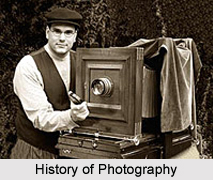
The first camera that was small and portable enough to be practical for photography was built by Johann Zahn in 1685, though it would be almost 150 years before technology caught up to the point where this was useful. Early photographic cameras were essentially similar to Zahn`s model, though normally with the addition of sliding boxes for focussing. Before each exposure, a sensitised plate would be inserted in front of the viewing screen to record the image. Jacques Daguerre`s popular daguerreotype process utilised copper plates, whereas the calotype process was invented by William Fox Talbot recorded images on paper.
The first permanent photograph was made in 1826 by Joseph Nicephore Niepce using a sliding wooden box camera made by Charles and Vincent Chevalier in Paris. Niepce built on a discovery by Johann Heinrich Schultz (1724) - silver and chalk mixture darkens under exposure to light. However, while this was the birth of photography, the camera itself can be traced back much further. Before the invention of photography, there was no way to preserve the images produced by these cameras apart from manually delineating them.
 The development of the collodion wet plate process by Frederick Scott Archer in 1850 cut exposure time considerably, but required photographers to prepare and develop their glass plates on the spot, generally in a mobile darkroom. In spite of their complexity, the wet-plate ambrotype and tintype processes were used in a widespread manner in the latter half of the 19th century. Wet plate cameras were slightly different from previous designs, though there were some models, for instance, the sophisticated Dubroni of 1864, where the sensitising and developing of the plates could be carried out inside the camera itself, rather than in a separate darkroom. Other cameras were fitted with multiple lenses for making cartes de visite (French, referring to business card or visiting card). The first colour photograph was made by James Clerk Maxwell, with the assistance of Thomas Sutton, in 1861.
The revolution was further given an impetus by the pioneering Kodak cameras, available with several innovative features, quite a catch for those times. The first reflex camera was the Franke & Heidecke Rolleiflex medium TLR of 1928. The Rolleiflex was adequately compact to achieve extensive recognition and the medium-format TLR design became popular for both high- and low-end cameras. A similar revolution in SLR design began in 1933, with the introduction of the Ihagee Exakta, a compact SLR, which used 127 roll films.
The development of the collodion wet plate process by Frederick Scott Archer in 1850 cut exposure time considerably, but required photographers to prepare and develop their glass plates on the spot, generally in a mobile darkroom. In spite of their complexity, the wet-plate ambrotype and tintype processes were used in a widespread manner in the latter half of the 19th century. Wet plate cameras were slightly different from previous designs, though there were some models, for instance, the sophisticated Dubroni of 1864, where the sensitising and developing of the plates could be carried out inside the camera itself, rather than in a separate darkroom. Other cameras were fitted with multiple lenses for making cartes de visite (French, referring to business card or visiting card). The first colour photograph was made by James Clerk Maxwell, with the assistance of Thomas Sutton, in 1861.
The revolution was further given an impetus by the pioneering Kodak cameras, available with several innovative features, quite a catch for those times. The first reflex camera was the Franke & Heidecke Rolleiflex medium TLR of 1928. The Rolleiflex was adequately compact to achieve extensive recognition and the medium-format TLR design became popular for both high- and low-end cameras. A similar revolution in SLR design began in 1933, with the introduction of the Ihagee Exakta, a compact SLR, which used 127 roll films.
Photographers were like artists, because they recorded contemporary events only with keener flexibility and on a much greater scale. One of the first photographic documents of history-in-the-making was also the greatest. This was the American Civil War, shot by 20 photographers. Most of them were initially under the direction of Mathew B. Brady. They could not capture the action of battle with their big equipment, but their blunt views of landscapes, plagued with the dead changed the popular vision of war.