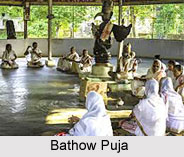
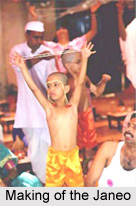
 The making of the Janeo is particularly done during the ceremony of Upanayana. The boy is brought to his guru or the spiritual preceptor to attain the title of Dvija after acquiring the thread of Janeo. The sacrament of Upanayana determines the social status of the individual. This sacrament is performed at the young age of eight or may be delayed till sixteen. It is only when a boy wears the sacred thread called Janeo, he has a right to be known as the Dvija or twice born.
Any ceremonial observance remains ineffectual for the Hindus, unless the thread or Janeo is put on. A Brahmin, before the sacrament of initiation is called a Vipra, later when he is initiated; he attains the qualification of learning the Veda or Brahma. This ancient conviction in birth as a Shudra, or a Vipra, before Upanayana ceremony, is no longer considered for a Brahmin by birth and so on. In the present day, the Janeo is not always worn by the higher castes; while on the other hand; the people belonging to the Shudra castes often wear it.
The type of the sacred thread or Janeo is different in every caste group or sect of the society. These types of Janeo are:
1. Brahmgandh: 5 knots in the Janeo is for the higher grades of Brahmins and 3 knots is for the lower grades of Brahmin
2. Vishnugandh: This kind of Janeo is with one knot for all other castes.
To become learned in the Vedas, Brahmins have to wear the Janeo at the age of five. If a Kshatriya desires the same, he should wear it at six, and in case of a Vaishya, he should wear the Janeo in the eighth year of age if he desires success.
The making of the Janeo mainly involves the use of cotton, which is purchased on the 13th day after the new moon in August-September. This cotton is spun into thread by the Brahmin girls or by married women. However, the widows are not allowed to do this task. The cotton should be picked up from a clean field that is free from filth. A Janeo can be made up of one or two Agras. 3 lines lie on the fingers.
The Brahmins wind one single thread on the upper lines for 96 times, the Kshatriyas run it over the central line 86 times and the Vaishyas over the lower line for 76 times. The thread is then folded three times and twisted on a Kath. Kath is a special tool used in preparing the Janeo. Again the janeo is folded for three times and then nine threads appear in the cord.
To make an Agra,the thread is again folded thrice, now there are 27 threads in each Agra. The number of famous ancestors in each gotra is actually the number of knots in every Agra. Gotra means a clan. One Agra is given to a Brahmin in the Brahmchari or disciplinary stage of life. The second Agra is given to him when he reaches the second ashram; that is the Grehsthashram or householder state. The first thread is twisted from right to left and the second one is twisted from left to right and so on. The second Agra is made in the same way and when both are worn, three or five knots tie them together. Rituals are made during particular duration and requires certain material for different types of Janeos for varied castes or varna:
Brahmin use Cotton - 96 chappas 8th-16th yr age (A chappa is approximately a four finger`s breadth)
Kshatriy use Hemp - 95 chappas llth-22nd yr age
Vaishye use Wool - 94 chappas 12th-24th yr age
A Janeo may be worn at any time, but if the Brahmin truly desires to learn Vedas or a Kshatriya desires to gain all the strength, then the age is determined to be quite earlier, as mentioned above. The rules are not observed that strictly, but the rule for the length of the sacred thread is usually followed.