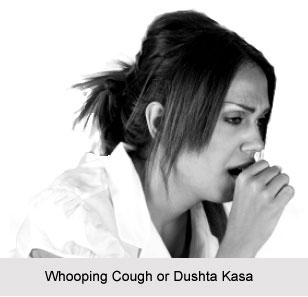
 Whooping cough is known as dushta kasa in Ayurveda. It is an infectious bacterial disease, which occurs mainly in children. Whooping cough is mainly an infectious bacterial disease that causes uncontrollable coughing. The name comes from the noise some one makes when take a breath after coughing. Sometimes coughing can results inti vomit also. Anyone can get whooping cough, but it is more common in infants and children. It`s especially dangerous among infants. The coughing spells can be so bad that it is hard for infants to eat, drink or even breathe.
Before there was a vaccine, whooping cough was one of the most common childhood diseases and a major cause of childhood deaths in the U.S. There are fewer cases today because there are both pertussis. only vaccines and combination vaccines for tetanus, diphtheria and pertussis. If someone has whooping cough, treatment with antibiotics may help if given early.
Causes and Symptoms: Whooping cough is caused by a bacterium named Bordetella pertussis and is one of the most contagious bacterial infections. In the beginning, it is marked by catarrh of the nose, sneezing, watering of the eyes, irritation of the throat, feverishness, and cough. Later, the symptoms of catarrh disappear but the cough becomes more persistent. The cough is marked by paroxysms of coughing, consisting of a series of violent and rapid expiratory coughs. It is often succeeded by a loud, sonorous or crowing inspiration i.e. the whoop and hence the name is whooping cough. The patient sometimes turns blue in the face because the paroxysm deprives his lungs of air. Children are usually more susceptible to the malady than adults. According to Ayurveda, whooping cough is the result of disturbance of the vata dosha in the body.
If one child in a group of siblings gets it, the other children are extremely likely to become infected if they have not already had the disease or been vaccinated. Although infants who are breastfed are usually protected against most common childhood infections, they receive no protection against whooping cough. This is why early vaccination is recommended. Children with a cold or cough should be kept away from non-vaccinated children as well as women in labour and newborn babies.
Whooping cough commonly affects infants and young children but can also be prevented by immunization with pertussis vaccine. Pertussis vaccine is most commonly given in combination with the vaccines for diphtheria and tetanus. (Pertussis is the `P` in the DTaP combination vaccination routinely given to children, and the `p` in the Tdap vaccine administered to adolescents and adults) Since immunity from the pertussis vaccine wears off with time, many teenagers and adults get whooping cough.
Medicines & Prescriptions: The best remedies for whooping cough are Aparajita Leha, Dashamuli Ghrita, Kantakaryavaleh, and Panchmuli Kashaya.
These may be taken as indicated on the packing or as prescribed by the physician.
Home Remedies: Juice of ginger i.e. 14 ml, with an equal quantity of honey, taken twice a day is also helpful.
Diet and Other Regimen: The dietary regimen for whooping cough is the same as prescribed for dry, hacking coughs or disorders of the throat.
Castor oil should be administered occasionally to the patient to relieve his constipation, and also to relieve the pain he is liable to feel because the paroxysms make his abdominal muscles tender. The patient must be protected against exposure and sudden colds. These are actually liable to aggravate his condition and hamper a quick recovery.
Whooping Cough or Dushta Kasa
Whooping cough is an infectious bacterial disease that causes uncontrollable coughing.